What if the key to modernizing hospital infrastructure wasn’t more funding—but smarter financing?
Hospitals across the country are facing mounting financial pressure as cuts to Medicaid and Medicare shrink reimbursement rates. These constraints are forcing difficult decisions: scaling back services, delaying equipment upgrades, and even reducing staff. Yet, amid these challenges, a powerful opportunity is emerging.
By strategically leveraging the expanded Section 179 tax deduction, hospital leaders can unlock new pathways to innovation—without compromising financial stability. This approach, especially when paired with equipment leasing, enables hospitals to upgrade critical technology, enhance patient outcomes, and remain competitive in a rapidly evolving healthcare landscape.
Industry Trends: The Rise of Equipment Leasing
- The U.S. medical equipment rental market is projected to grow to $5.4 billion by 2028. An increasing demand for advanced technologies and cost-effective procurement options drives this growth.
- As Medicare and Medicaid reimbursement criteria become more stringent, hospitals are increasingly turning to leasing as a strategy to manage capital constraints and adapt to rapid technological advancements.
- The transition toward value-based care, alongside the needs of an aging population, is further accelerating the demand for leased diagnostic and therapeutic equipment.
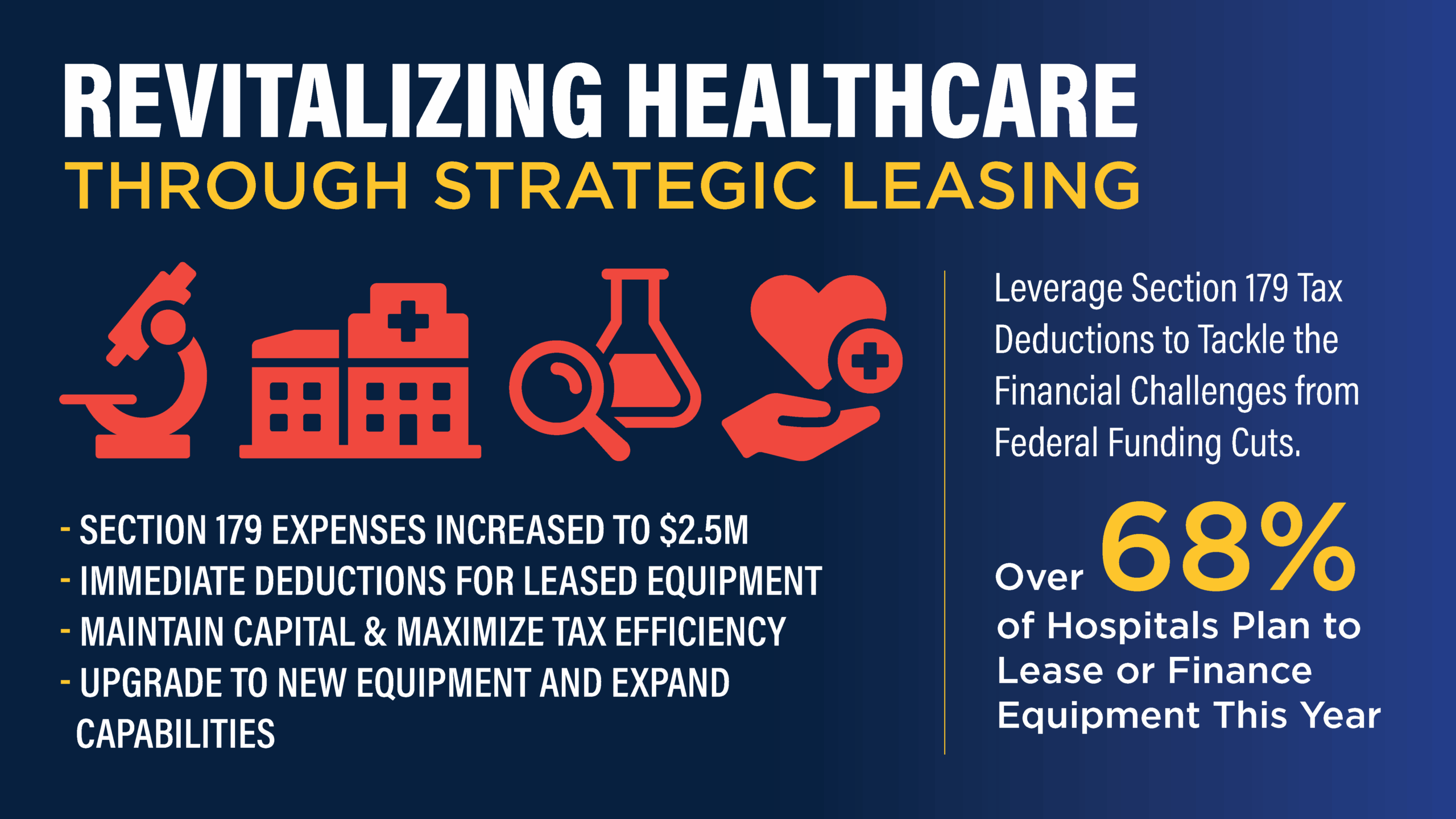
- Data Markets Insight highlights a significant trend this year: approximately 68% of hospitals in the U.S. are opting to lease or finance medical equipment instead of making outright purchases. This approach enables these institutions to manage their budgets more effectively, stay current with the latest technology, and maintain operational flexibility.
Section 179: A Key Advantage for Equipment Leasing
- Immediate Deduction for Leased Equipment: The revised Section 179 guidelines enable hospitals to deduct the costs of qualifying leased equipment, such as advanced imaging systems and diagnostic platforms, within the same tax year that the equipment is placed in service. This provision allows healthcare facilities to access cutting-edge technology while maintaining liquidity and operational flexibility.
- Increased Deduction Limits for Larger Projects: The legislation has raised the deduction limit to $2.5 million, with a phased-out threshold starting at $4 million. This significant increase empowers hospitals to undertake expansive projects and lease a broad spectrum of equipment, from state-of-the-art surgical suites to essential IT infrastructure, all while maximizing expense deductions.
- Enhanced Interest Deductions: The bill reinstates an EBITDA-based limitation on interest deductions, allowing hospitals to deduct a considerable portion of interest associated with leased equipment. This beneficial change enhances after-tax cash flow, resulting in improved financial flexibility. With improved cash flow, hospitals can allocate more resources toward patient care and operational enhancements, making leasing an increasingly strategic option.
Case Study: Strategic Leasing in Action
A mid-sized regional hospital recently faced a familiar challenge: outdated imaging equipment was compromising diagnostic accuracy, but capital constraints—exacerbated by reduced Medicaid reimbursements—made outright purchases impossible.
Instead of postponing upgrades, the hospital’s leadership chose to lease new MRI and CT systems through a strategic financing arrangement. By utilizing the expanded Section 179 tax deduction, they were able to deduct the full cost of the leased equipment—nearly $1.8 million—in the same year it was placed into service.
Results:
- Improved Patient Care: Diagnostic wait times dropped by 40%, and scan quality improved, leading to faster and more accurate treatment decisions.
- Preserved Capital: The hospital maintained its cash reserves, allowing for investments in staff development and facility improvements.
- Tax Efficiency: The Section 179 deduction significantly reduced taxable income, freeing up resources for future upgrades and operational needs.
- This example demonstrates how strategic leasing and effective tax planning can enable hospitals to modernize care delivery, even amid financial uncertainty.
Implications for Hospital Leadership
- Maintain Capital: Leasing offers a way for hospitals to bypass the significant upfront costs of acquiring advanced medical technology, conserving capital for other essential needs such as staffing and facility upgrades.
- Accelerate Modernization: Leasing enables the swift replacement of outdated technology and allows hospitals to expand their medical capabilities, thereby ensuring improved patient care without the delays linked to capital fundraising or bond issuance.
- Maximize Tax Efficiency: By leveraging the advantages of Section 179 and bonus depreciation, hospitals can substantially reduce their taxable income, resulting in significant savings that can be reinvested into their operations.
- Enhance Adaptability: Leasing arrangements support regular updates to equipment in alignment with technological advancements, ensuring hospitals remain competitive and responsive to the evolving demands of healthcare.
By fully embracing the opportunities offered by Section 179, hospital leadership can address the financial challenges of modernization, improve patient care quality, and maintain long-term financial stability.
Is your hospital leveraging Section 179 to its full potential? Connect with one of our Healthcare Specialists and explore how strategic leasing can support your goals.
Channing Lyon (413) 841-2580, clyon@ffequipmentleasing.com
Anthony Marchioni (585) 317-8099, amarchioni@ffequipmentleasing.comHello, world