Thanks to a range of factors, including high inflation, high interest rates, as well as supply chain vulnerability associated with geopolitical conflicts and the aftermath of the COVID-19 pandemic, there is financial uncertainty within the materials handling sector.
According to Philip Rosenmüller, head of technical sales industrial MHE fleet management & consulting with CHG-MERIDIAN USA Corp, this uncertainty is reshaping how businesses invest in materials handling equipment.
“While inflation and market volatility have made companies more cautious with large capital outlays, these same pressures are driving smarter, more flexible investment strategies,” says Rosenmüller.
Overall, even amid the uncertainty, Rosenmüller says he is seeing a clear trend toward strategic reinvestment through flexibility – where leasing, electrification, and automation combine to build smarter, more resilient, and future-ready operations.
Asked if any sectors are currently more active than others, in terms of such equipment purchases, Rosenmüller says logistics and automated warehousing are leading the way.
“The continued rise of e-commerce and the demand for faster, more efficient fulfilment have pushed these sectors to expand and modernise rapidly,” he notes.
“We’re seeing significant growth in automation technologies – not just high-end systems, but increasingly accessible and scalable solutions that make automation viable for operations of all sizes.”
Nominating manufacturing, along with ports and distribution hubs as other industries to watch, Rosenmüller says that the most active sectors are those under pressure to move goods faster, smarter, and more sustainably.
“That’s where automation, digitalisation, and flexible equipment solutions are making the biggest impact,” he says.
The rise of FMV leases
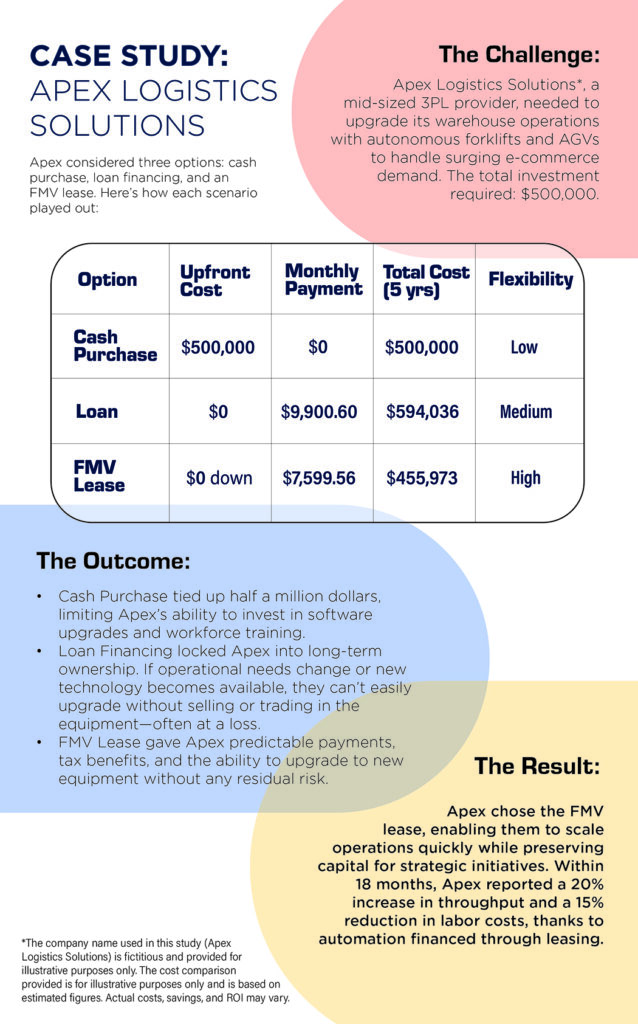
According to Rosenmüller, flexible options like Fair Market Value (FMV) leases are helping accelerate this technology adoption.
The logic of choosing this option stems from the understanding that spreading costs and optimising equipment life cycles allows businesses to access the latest electric and automated technologies without heavy upfront spending. It makes it possible for them to ensure their fleets are not just modern and efficient, but also cost-effective.
In contrast, the problem with traditional CapEx loans – and the reason they are increasingly overlooked in favour of options like FMV leases – is that they can result in ageing fleets, higher maintenance costs, and more downtime as equipment reaches the end of its life cycle.
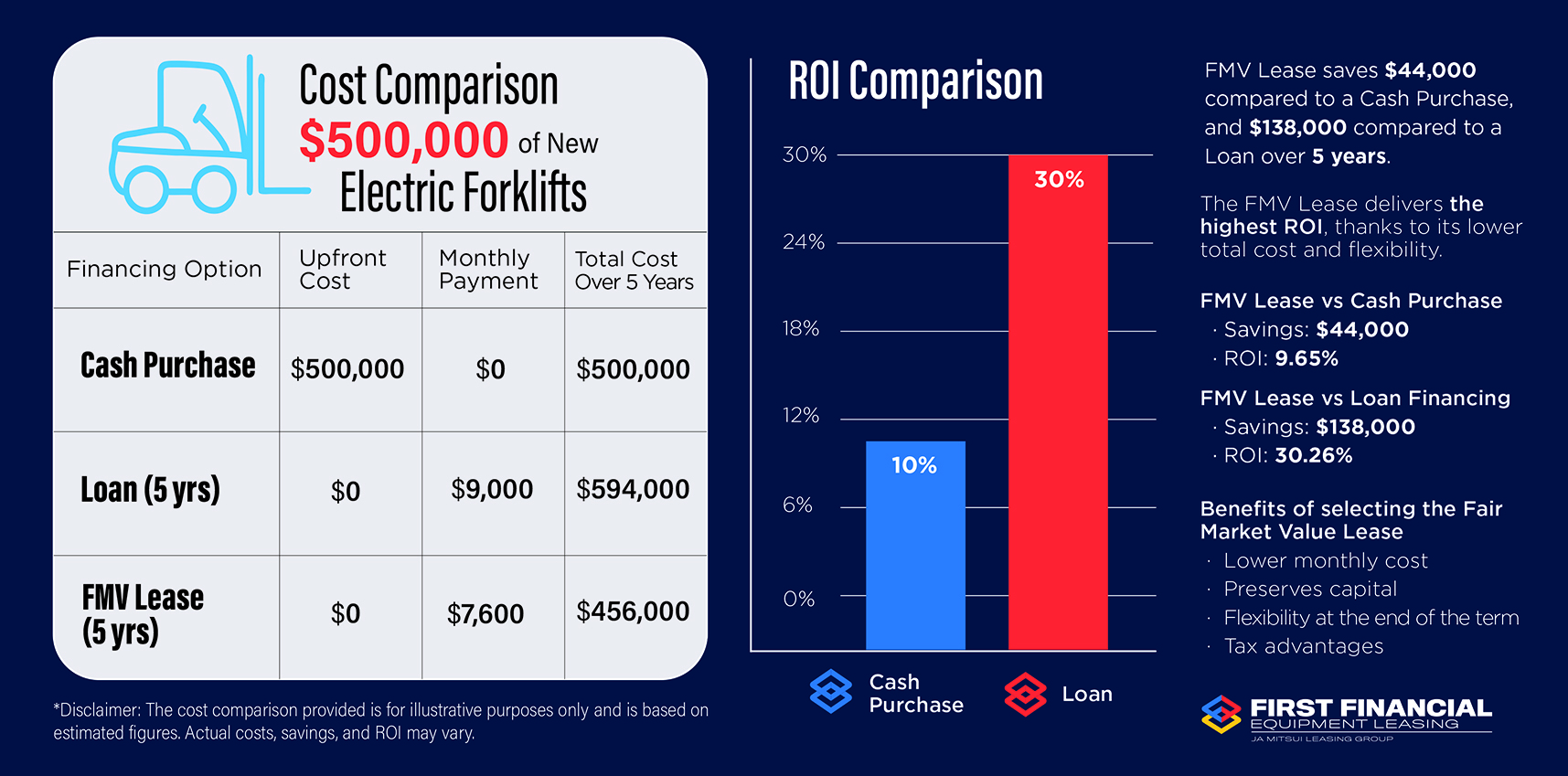
“Leasing not only helps reduce overall costs – often by 30% or more when factoring in maintenance, uptime, and residual value – but it also enables smarter, total cost of ownership (TCO)-based fleet management,” says Rosenmüller.
Arrangements of this type make it possible for businesses to right-size their equipment, refresh fleets more frequently, and access newer, more efficient technologies without the burden of large upfront investments.
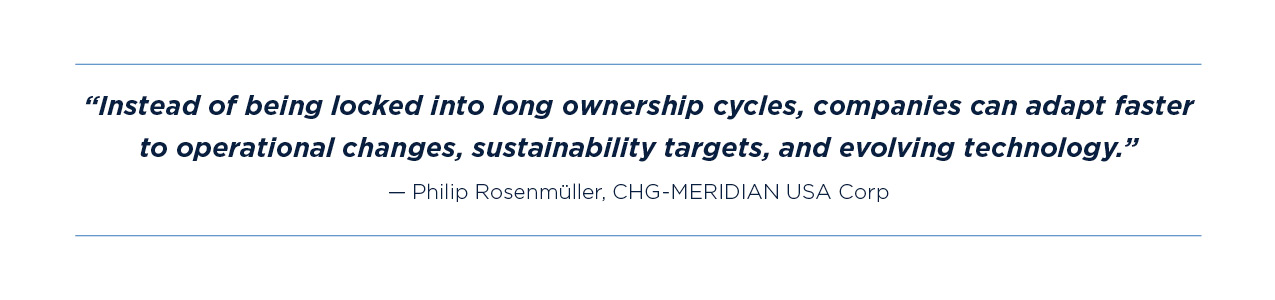
“Instead of being locked into long ownership cycles, companies can adapt faster to operational changes, sustainability targets, and evolving technology,” says Rosenmüller.
“As a result, leasing and lifecycle-based financing have moved from being alternatives to becoming the preferred strategy for many forward-thinking organisations in the materials handling industry.”
An organisation that operates in 32 countries – and is able, through its subsidiaries and partners, to support clients in nearly 190 countries – CHG-MERIDIAN provides FMV leasing solutions directly to its clients.
The company’s team of industry experts works closely with clients to analyse existing fleets and design TCO-based strategies that reduce costs, minimise downtime, and improve sourcing processes in the long-term.
 Tax benefits in the US
First Financial Equipment Leasing (FFEL), a US-based organisation focused on helping businesses in the materials handling sector and elsewhere match the best leasing options with the latest technologies, also sings the praises of FMV leases.
According to Elise Hardy, the company’s regional vice president sales, “their popularity stems from the combination of flexibility, tax efficiency, and cash flow advantages” they deliver.
Ensuring lower monthly payments compared to ownership-based financing, and allowing customers to return, renew, or purchase equipment at fair market value, FMV leases are ideal for rapidly evolving technologies, such as automation and robotics.
Hardy says that in the US, which is the market in which FFEL does all its business, changes to Section 179 tax benefits have significantly influenced financing strategies.
Specifically, for 2025, the deduction limit increased to USD2.5 million, with a spending cap of USD4 million. According to Hardy, this change allows businesses to deduct the full purchase price of qualifying equipment – new or used – provided it is placed in service by December 31, 2025.
In addition, the restoration of 100% bonus depreciation means that companies can deduct any remaining equipment costs not covered by Section 179 in the same year.
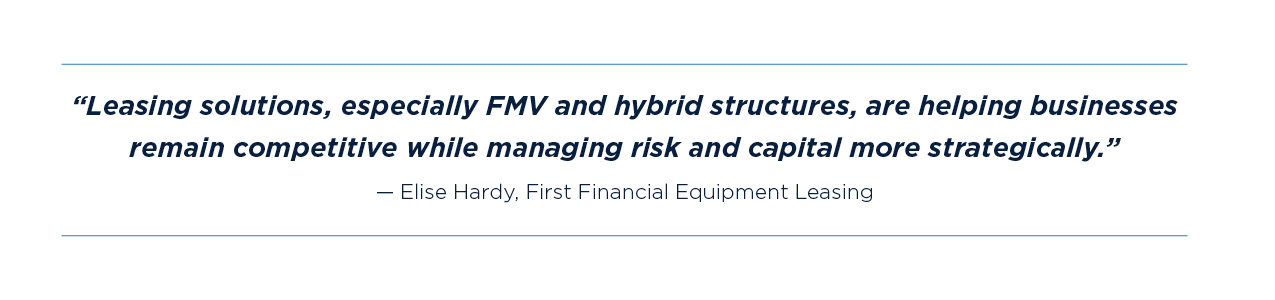
“This evolution reflects how customers now prioritise productivity, scalability, and financial agility over traditional ownership,” says Hardy. “Leasing solutions, especially FMV and hybrid structures, are helping businesses remain competitive while managing risk and capital more strategically.”
According to Hardy, the FMV leasing model is designed to support businesses not just for their current needs but also to help them grow and adapt in a fast-changing market.
“Unlike traditional loans or fixed leases, this approach offers more flexibility, making it easier for companies to take advantage of new technologies. This flexibility is crucial in today’s supply chain, which is constantly changing and evolving,” she says.
As a result, businesses are able to scale their operational capacity up or down based on market demand, allowing for better resource allocation and responsiveness to business fluctuations.
In addition, they can implement automation solutions at a manageable pace, ensuring that their workforce can adapt without disruption while enhancing efficiency and productivity. By avoiding large upfront capital expenditures, they can free up valuable financial resources and therefore enable funds to be used for other strategic initiatives or investments.
And they can also be sure to access the latest technology. FMV leases allow businesses to stay ahead of the curve by obtaining cutting-edge technology without the risk of obsolescence, ensuring that their operations remain competitive and innovative.
 SMEs and capital investment
While, traditionally, investment in the latest materials handling equipment has been dominated by large organisations with established automation teams and the requisite capital to fund full-scale projects, that is no longer always the case.
“We’re seeing far greater activity from small and medium-sized enterprises (SMEs), particularly those looking to improve efficiency and reliability without taking on heavy capital costs,” says Dr Paul Rivers, managing director of Guidance Automation.
“For SMEs, the case for better materials handling has always been clear – it directly affects productivity, flow, and customer delivery times. But the entry point was often too high.”
In other words, conventional purchase or lease models have always demanded significant upfront investment, long payback periods, and external integration support. Combined, these barriers have prevented many smaller manufacturers and distributors from modernising their handling operations.
“Our goal, [at Guidance Automation], is to make advanced materials handling capability accessible to businesses of every size,” says Rivers. “By offering flexible, service-based access to equipment, SMEs can trial solutions in their own environments, prove the return, and expand as confidence grows.”
Rivers says he is impressed by how effectively these companies adopt new technologies once the barriers are removed.
“Smaller firms tend to make decisions quickly, involve the right people on the shop floor, and measure results closely,” he says. “Working in partnership with them means we share the risk and the reward – delivering measurable improvements in throughput, safety and utilisation without the burden of traditional capital expenditure.”
Pay-as-you-go
Guidance Automation’s most popular investment solution is Autonomous GO, a flexible, pay-as-you-go automation model for materials handling and transport that removes the need for capital investment or long-term commitment.
Customers who sign up for this solution pay only for the hours their robot workers operate – at half the UK Living Wage – with installation, servicing and support fully included. A straightforward operating-expense approach, it involves monthly invoicing, as well as the option to give just 30 days’ notice, without penalty, if the product in question is not the right fit.
According to Rivers, Autonomous GO delivers ROI within just one hour.
“[Up to] 30–50% of a production worker’s time is typically spent moving materials rather than applying the specialist skills they’re trained for,” he explains. “Automating that movement allows human workers to focus on work that genuinely requires their expertise.”
Because Autonomous GO is fully managed and performance-based, customers don’t carry the risk of ownership or maintenance. A practical alternative to traditional ownership or leasing models that align investment directly with productivity, it delivers predictable costs, measurable results and the flexibility to scale or pause as required.
Like the various other options mentioned above, Autonomous GO places materials handling operations of all sizes and persuasions in a position to navigate current global uncertainties and reap the benefits that investment in the latest capital equipment can deliver.
*** Click to view on Forklift Action website ***Hello, world