Leasing provides an affordable way to update and upgrade business equipment, preserving cash for other needs. The choice between Fair Market Value (FMV) and capital leases can significantly impact operational efficiency and financial health. To make the best choice, it’s crucial to understand leasing option advantages, particularly in terms of cost per hour.


THE DIFFERENCE BETWEEN FMV LEASES AND CAPITAL LEASES

FMV leases are operating leases and the prevalent choice in the market today. With FMV leases, the lessee can use the equipment for a specific period, paying relatively lower monthly installments. At the end of the lease term, the lessee has the flexibility to return the equipment, purchase it at its fair market value, or extend the lease. This empowers businesses to align equipment usage with evolving needs, making FMV leases a practical and versatile option.

Capital leases, also known as finance leases, are more akin to a loan. The lessee essentially finances the equipment purchase, typically with higher monthly payments, and owns the equipment at the end of the lease term. With this type of lease, there are higher monthly payments when compared to an FMV lease, but at the end of the lease term, the lessee purchases the equipment for $1. This is like an equipment loan and is ideal if you plan to keep the equipment for a long time, or when equipment obsolescence isn’t a concern.


COST PER HOUR ANALYSIS

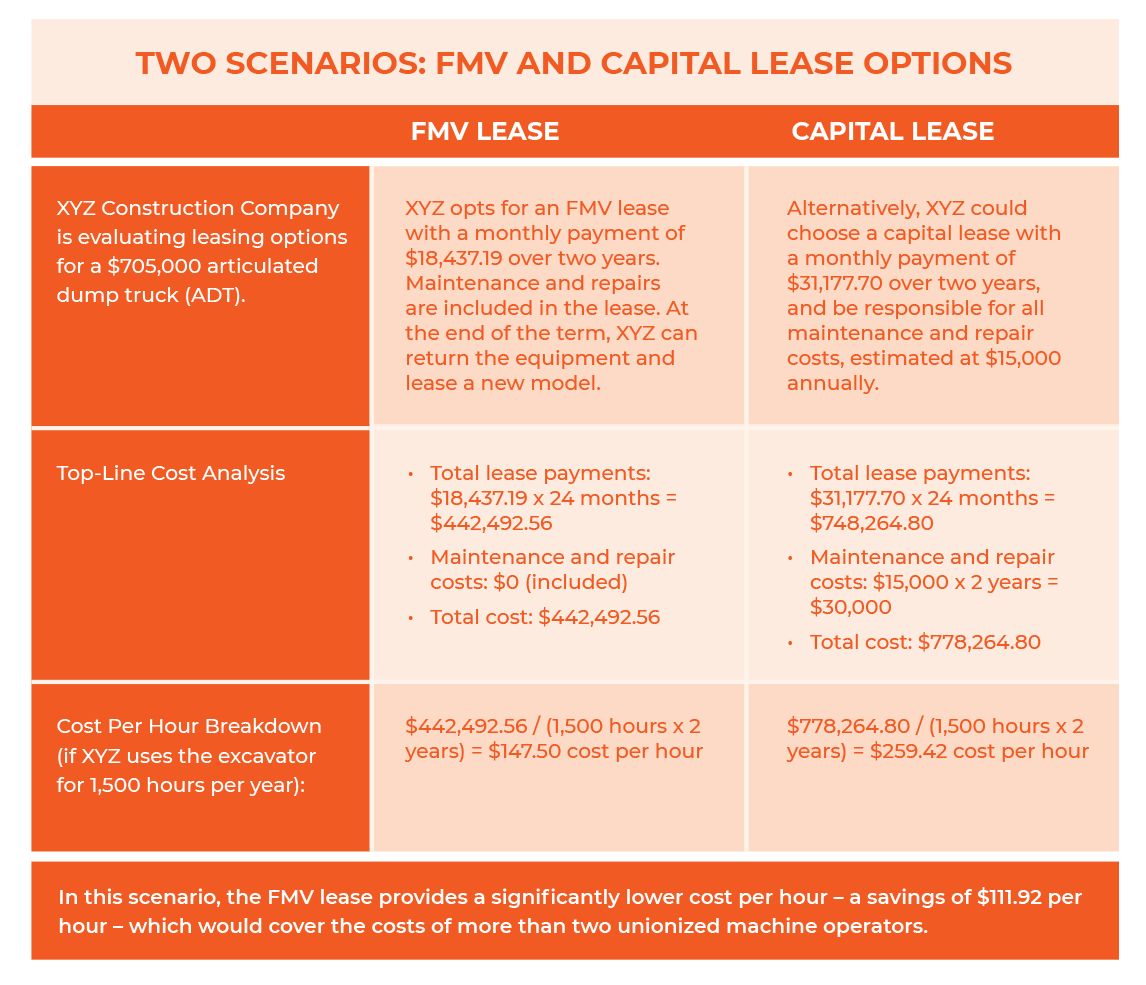
Cost per hour is a crucial metric that measures the total cost of owning and operating equipment; it’s calculated by dividing the total payments for the initial lease term by the number of hours the equipment is used.

FMV leases can provide several cost per hour advantages:

Lower monthly payments
Since FMV leases do not require the lessee to pay the full equipment cost over the lease term, the monthly financial burden is significantly reduced compared to capital leases. Lower payments mean better cash flow, allowing businesses to allocate funds to other critical areas, such as labour, materials, and project development.

Maintenance and repair costs
FMV leases often include maintenance and repair services as part of the lease agreement. This can equate to substantial savings in equipment operation cost per hour. With maintenance covered, businesses can dodge unexpected repair costs, reduce downtime, and ensure equipment is always in optimal working condition. In contrast, with a capital lease, the lessee is typically responsible for maintenance and repairs, which can be unpredictable and costly.

Technological advancements
Heavy construction equipment technology is constantly evolving. With an FMV lease, companies can upgrade to newer, more efficient models at the end of the lease term without the financial burden of owning outdated equipment. This ensures ongoing access to the latest technology, for greater productivity and reduced operational costs. Capital leases could lock companies into long-term ownership of equipment that may become obsolete, leading to higher costs due to less efficiency.

Flexibility and scalability
FMV leases offer greater flexibility compared to capital leases. Projects vary in scope and duration, and it’s critical to adjust equipment needs accordingly. With FMV leases, companies can scale equipment fleets up or down based on project requirements without long-term ownership commitment. This ensures equipment costs align with actual usage, optimizing cost per hour.

Tax advantages
FMV leases can offer tax benefits not available with capital leases. Lease payments under an FMV lease are often fully deductible as business expenses, reducing taxable income which can provide significant tax savings, lowering overall equipment operation cost per hour. Capital leases typically allow for depreciation deductions, which may not be as advantageous depending on a company’s tax scenario.

FMV leases offer several advantages over capital leases for heavy construction equipment, especially in cost per hour, making FMV leases an appealing option for construction companies seeking to improve their operations and financial well-being.


“The choice between Fair Market Value (FMV) and capital leases can significantly impact operational efficiency and financial health.”

–– NELSON ABELHA, Regional Vice President, First Financial Canadian Leasing

 Hello, world

Maximize Tax Savings While Buying New or Used Equipment Through Section 179 Tax Incentives

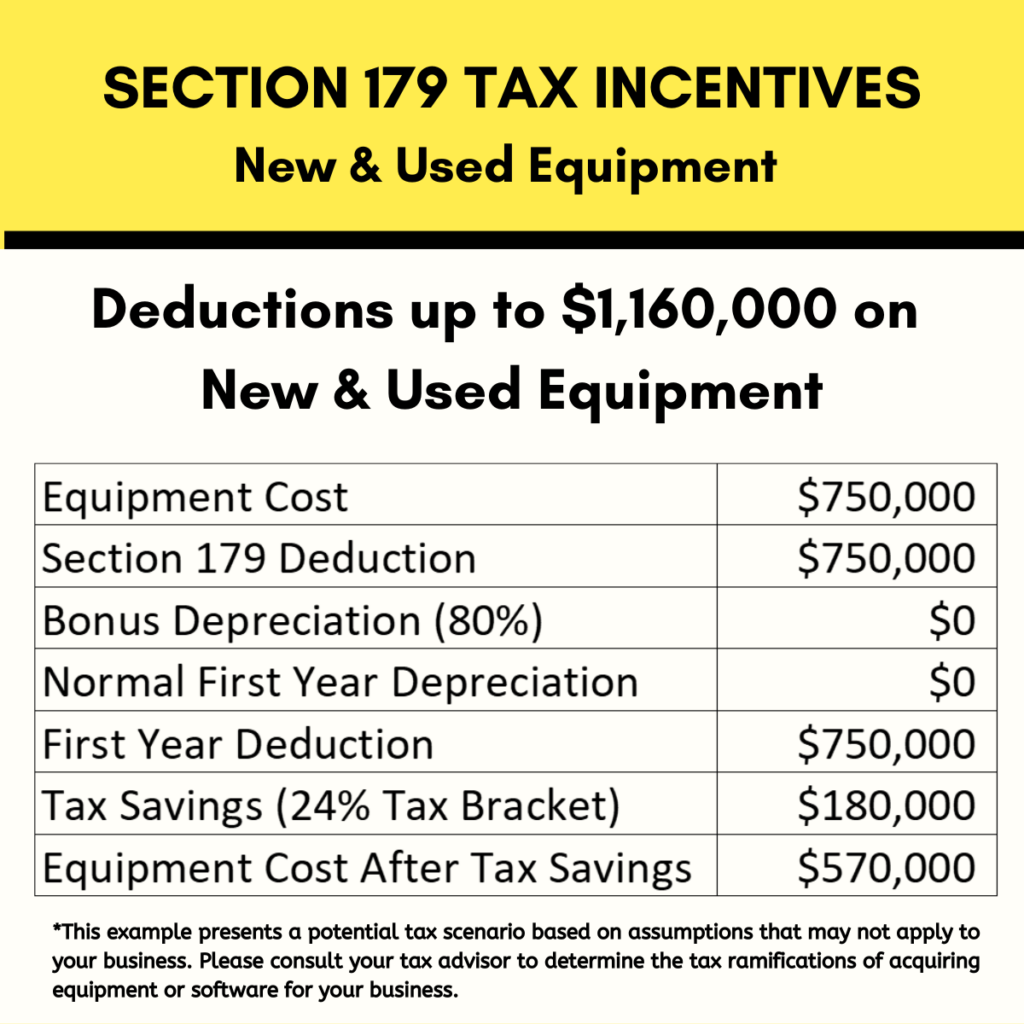
Maximizing your tax savings is always a smart financial decision, and the Section 179 tax incentives for fixed assets make it easier than ever to do so while purchasing new or used capital equipment. By taking advantage of this rule, you can expense 100% of the cost of capital equipment (up to $1,160,000) in the first year, allowing you to reap the benefits of significant tax deductions.

Unlike traditional depreciation methods, Section 179 lets you take the entire depreciation deduction in a single year, which can help you reduce your tax burden significantly. This means that you can deduct the full cost of your new or used qualifying equipment in the year it is purchased instead of deducting its value over the course of several years. The practice of first-year expensing is a great way to save money and reduce your tax bill.

It’s worth noting that Section 179 applies to both new and used qualifying equipment as long as it is new to you. It doesn’t matter if you borrow, lease, or pay cash for the equipment as long as it is placed into service before the end of 2023. This rule applies to different types of equipment, including construction and heavy equipment, tractor-trailers, computers, office equipment, and software.

The maximum amount that can be deducted in 2023 is $1,160,000, which is an increase of $80,000 from 2022. The maximum amount of equipment purchased (and take the full deduction) is $2.8 million. With these tax incentives for fixed assets, you can rest assured that you’re making a smart financial decision while reducing your tax liability.


Hello, world


Investing in new equipment can be a wise decision for businesses that wish to secure their financial future in the current high-inflation environment.

A new study issued by MHEDA reported that despite warnings of a looming recession, new orders for material handling equipment are predicted to increase until early 2024.

The study highlights the resilience of these orders in the face of economic pressures, including higher interest rates, stricter banking regulations, limitations on access to capital by national and regional banks, and confusion and uncertainty in the financial industry.

Are you considering acquiring new equipment but unsure when to do so? The timing of this decision can significantly impact your business’s success. To make an informed decision, there are a few factors to consider. Let’s take a closer look at what you need to know.

Why Equipment Financing Remains a Viable Option Despite Rising Interest Rates
Investing in new equipment can be a wise decision for businesses that wish to secure their financial future in the current high-inflation environment. Asset finance helps you purchase the required equipment with confidence before prices rise again. This stability ensures that businesses can plan with certainty and allocate resources efficiently without worrying about rising costs.

Equipment financing offers lower upfront costs and improved cash flow, providing flexibility to access equipment with no down payment required. This preserves capital, which can be allocated to other expenses or investments, and creates more cash reserves during economic downturns.

There is the potential to significantly increase a business’s purchasing power, offering access to higher-quality equipment that might otherwise have been unaffordable. Additionally, payments are generally lower than traditional debt payments. This allows for customization of the equipment configuration to match the business’s unique requirements perfectly.

It also makes it easier and more cost-effective to replace outdated equipment. You can avoid the costly inconvenience of managing outdated equipment that requires constant maintenance and lowers production and efficiency rates.

For over 23 years, First Financial Equipment Leasing has been serving various markets in the US and Canada, building partnerships based on trust and transparency. We are vendor-neutral and negotiate favorable terms with competitive rates, with a deep understanding of the unique challenges and opportunities in the material handling industry. Our financial experts can help assess whether a deal meets your business’ working capital or growth potential.

Please reach out today to find out how our financing solutions can empower your business to achieve long-term success.

To access MHEDA’s Economic Advisory Report, visit https://www.mheda.org/industry-resources/economic-insight-and-resources/

Hello, world


NorFund Capital to be rebranded as First Financial Canadian Leasing.

ORANGE, CA and TORONTO, Canada – Thursday, December 8th, 2022 – First Financial
Equipment Leasing (FFEL), a leading provider of equipment financing solutions and a member company of JA Mitsui Leasing Ltd (JAML), announces a strategic expansion into Canada with the acquisition of NorFund Capital. Based in Toronto, Canada, NorFund Capital is an independent leasing company specializing in capital equipment, solar and alternative energy, and vendor finance programs.

The acquisition continues First Financial Equipment Leasing’s tremendous growth trajectory, driven by its vision to elevate and broaden solutions offered to its global customers. “NorFund
Capital’s expertise and creativity within the Canadian market made it the ideal fit to lead our growth in new markets and industries,” said Tom Slevin, FFEL Co-Founder and CEO. “With Canada becoming a significant part of our North American platform, this acquisition provides key opportunities for us to extend our financing solutions and enhance the customer experience throughout our global client base.”

“We are excited to join First Financial Equipment Leasing and the JA Mitsui Leasing Ltd. family of companies," said Robert MacFarlane, President and Founder NorFund Capital.”

“Our organizations have a shared passion for building innovative financing solutions with a customer-focus approach. Given the complementary nature of our combined businesses, we look forward
to a strengthened global platform with expanded investment opportunities.”

MacFarlane will lead the newly named First Financial Canadian Leasing as Senior Vice President, overseeing the Canadian sales strategies and business development. He will focus on growing the company’s fair market value (FMV) leases and establishing First Financial Canadian Leasing as a market leader in renewable energy financing in Canada. MacFarlane has over 30 years of experience in the leasing industry and has built and managed several highly successful equipment finance companies.

First Financial Equipment Leasing was represented by Cassels Brock & Blackwell LLP on the transaction.

About First Financial Canadian Leasing

FF Canadian Leasing, Inc. dba First Financial Canadian Leasing (FFCL) is a privately held equipment finance leader working with Canadian businesses and subsidiaries of US corporations. FFCL provides businesses with equipment financing for all categories of commercial assets and various industries, including construction and heavy equipment, IT solutions and services, material handling and automation, and solar and renewable energy. FFCL is a division of First Financial Equipment Leasing, and a member of JA Mitsui Leasing Ltd. (JAML), a Japanese equipment leasing company providing leasing and financial solutions in Japan and Globally (offices in Asia and North America). For additional information, please visit the company’s website at www.ffcanadianleasing.com.Hello, world


First Financial Provides Record Levels of New Automation Technology Financing

Today’s e-commerce driven economy is placing a massive burden on distribution centers and warehousing systems, which is being further strained by labor limitations. As online shopping continues to skyrocket, supply chains are suffering severe disruptions. Businesses are working desperately to keep pace with increasing customer demand, while maintaining a safe work environment for their employees.

By leveraging automation solutions, managers at distribution centers and warehouses can increase accuracy and productivity, operate more efficiently, expand faster and ultimately better serve their customers. Although these operational benefits and financial justifications are obvious, many businesses continue to delay essential projects and capital equipment expenditures.

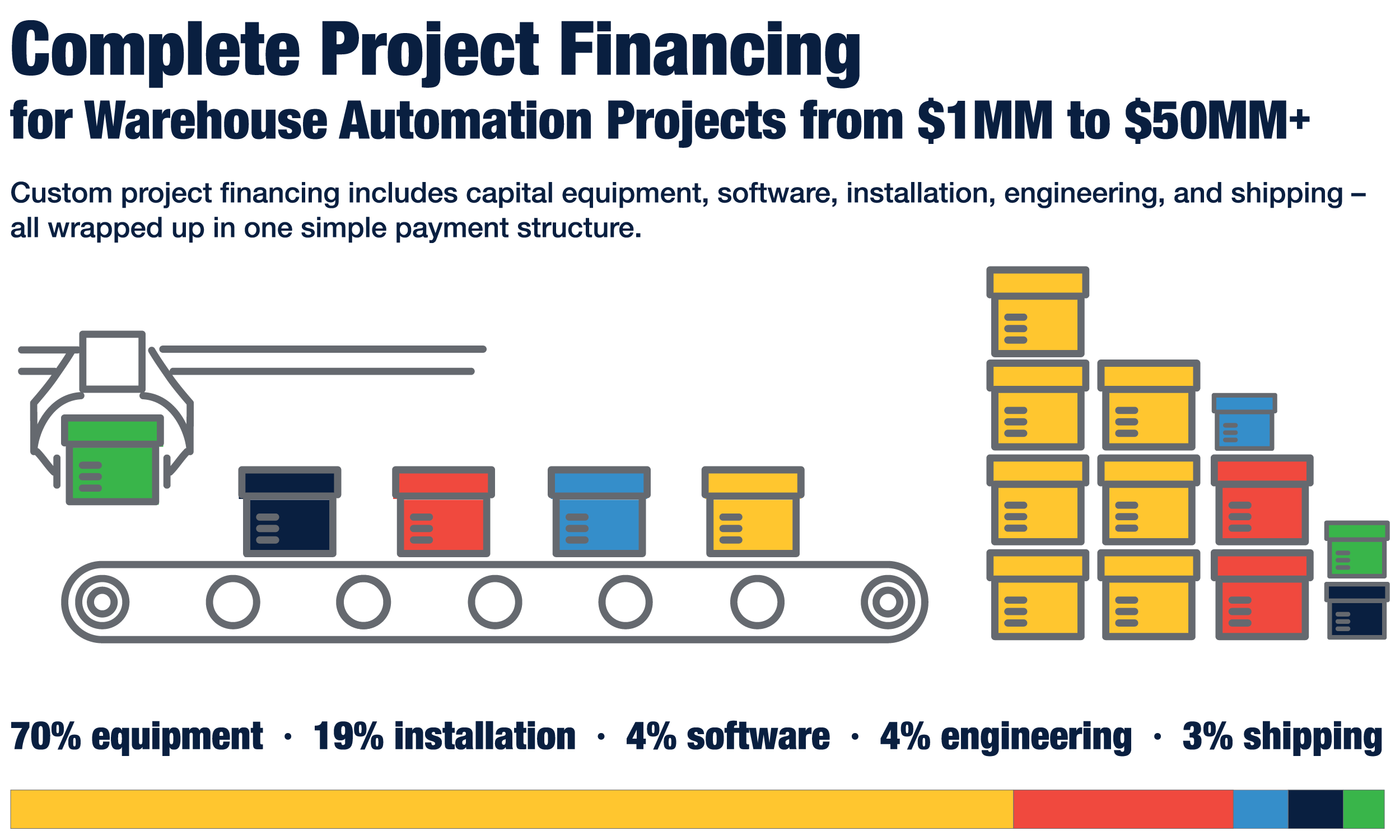
Cost is most often the biggest barrier keeping companies from modernizing warehouses with automation solutions and robotics. Automation integrations can require large upfront payments resulting in many years until positive ROI is achieved due to the hefty price tag – particularly when considering significant costs for installation, engineering, and software. Given today’s economic challenges, traditional lenders and banks have severely tightened their lending parameters, making it tricky to secure funding for extensive projects.

Maintaining Liquidity Through Leasing

Despite the challenges presented by the pandemic, we are seeing companies utilize lease financing to forge ahead with procurement of capital equipment and automation projects – just about everything inside the four walls of their distribution centers and warehouses.

Over the last year alone, First Financial’s investments in automation and material handling equipment have jumped over 30% from the prior year. By working with First Financial to lease their automation projects, many businesses often realize a “day one” savings as the operational benefits exceed the monthly cost of a lease. For unlike a cash purchase or bank loan, First Financial’s leasing solutions provide 100% financing – covering all project costs and eliminating the need for large upfront payments. First Financial makes all initial upfront progress payments, so the customer does not start paying for new automation and material handling solutions until after the project has been implemented and is fully operational.

Capitalizing on the Benefits of Automation Through Leasing

Most recently, First Financial assisted a leading consumer goods company with over $11B in sales avoid an outlay of $27MM for new AGVs and robotics. To keep up with growing consumer demand for their products, the company needed to modernize two distributions centers. Their current facilities operated manually and were highly labor intensive.

The objectives were to implement new equipment and technology tools that would improve operational efficiency, and significantly reduce labor costs. It also required a substantial financial investment, and leasing was a better source of capital than using internal funds.
First Financial stepped in and developed a financing solution that provided 100% financing. This helped the business avoid $27MM in upfront costs for the equipment, and save their working capital for more immediate, short-term needs. First Financial also coordinated with all vendors, manufacturers, and integrators involved in the massive project to make sure all were paid on time.

During the course of the integration – from conception, processing, delivery, to installation – First Financial made all upfront deposits, and covered all costs. This created an enormous day one savings for our customer and offered an immediate return on investment. If the customer had been required to make an up-front capital outlay, it could have taken them several years to realize any ROI.

By moving from labor intensive manual processes to fully automated facilities, the company increased the efficiency of their operations while simultaneously reducing costs. Through the use of AGVs and robotics, the company is expecting to decrease the cost of distribution by as much as 60%. Even more noteworthy, is the anticipated 90% reduction in their workforce the customer hopes to achieve by embracing the right technology solutions to automate their distribution centers.

Automating warehouse and distribution center processes can be transformative for any business, and First Financial’s project financing expertise can make automating attainable and affordable. While there are many factors to consider when making the move to automation, figuring out how to afford the project should not be one of them. Through our lease financing programs, we can equip any business for success by keeping working capital where it is needed most. If you are looking to conserve cash and bring predictability to expenses while moving forward with your automation projects, First Financial is here to help.Hello, world


Hello, world


Hello, world


Hello, world