As we navigate the challenges posed by increasing tariffs and tightening credit conditions, First Financial Equipment Leasing stands firm in our commitment to accelerate growth and expertly guide our customers through these complexities.

The recent shifts in the U.S. economic landscape, marked by changing consumer and business sentiments and rising inflation expectations, indicate that higher rates will impact financing options. However, instead of retreating, businesses have the chance to strategically adapt. Postponing essential equipment purchases can hinder growth and disrupt operations, but we know there’s a better way forward.

While tariffs may elevate costs for parts and equipment, innovative financing solutions like leasing are game-changers, providing considerable advantages for borrowers. In a budget-conscious environment, leasing is not just a practical choice; it’s a strategic imperative. We understand that securing approval in today’s competitive credit climate can be daunting, and that’s where we come in—First Financial Equipment Leasing is dedicated to streamlining this process and making it accessible.

Our financing solutions empower businesses to acquire the equipment they need without the burden of upfront costs, enabling them to channel their resources toward growth and operational excellence. We are not just a lender; First Financial Equipment Leasing is your strategic partner in equipment leasing solutions that drive growth and profitability. With flexible financing options ranging from $100,000 to over $50 million in the U.S. and Canada, we equip our customers to tackle today’s challenges head-on.

In these dynamic times, adaptability is essential. Let’s collaborate to unlock opportunities for success and propel your business forward.Hello, world


https://vimeo.com/1076541437Hello, world


https://vimeo.com/1076541437Hello, world


American Cranes & Transport, Finance Industry Focus: April 2025

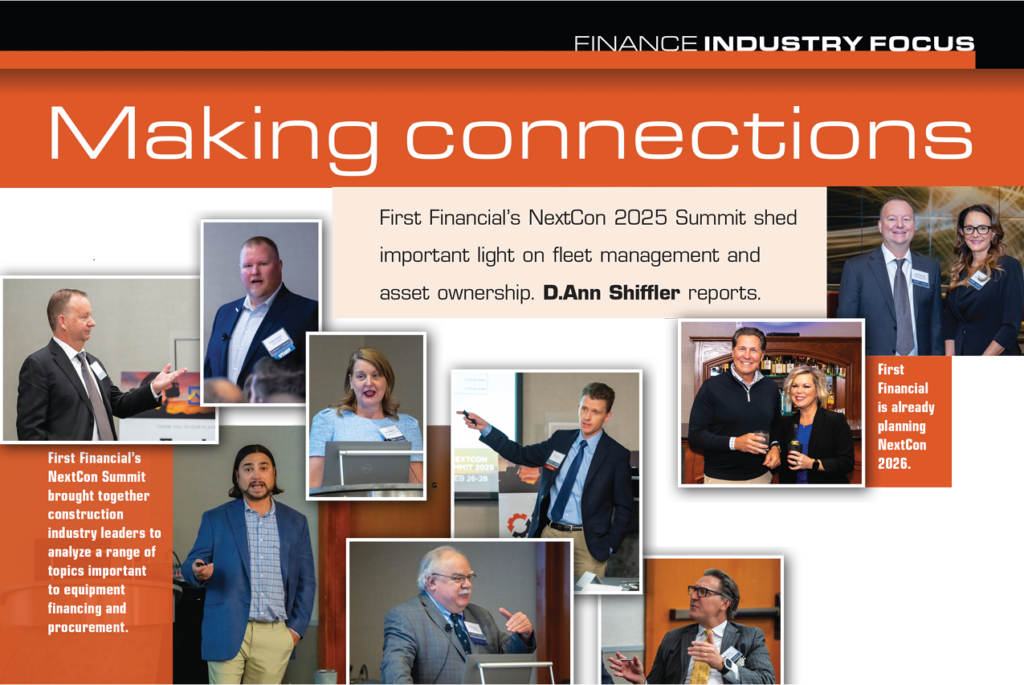
Making Connections

First Financial’s NextCon 2025 Summit shed important light on fleet management and asset ownership. D.Ann Shiffler reports.


The realm of equipment finance is complex, and is further complicated by economic conditions such as interest rates, proposed tariffs, rising insurance costs and even the stock market, to name a few.

To help equipment owners navigate these challenges, First Financial Equipment Leasing hosted its first annual NextCon Summit in Dallas in February. The intimate gathering brought together equipment owners and manufacturers, financial experts and even an economist to discuss topics related to finance and equipment procurement.

“Our goal at the NextCon event was to address the concerns of both longstanding and prospective customers regarding asset ownership,” said Jeffrey Whitcomb, senior vice president and construction sales director for First Financial Equipment Leasing. “Many prospective customers’ experience apprehension about equipment acquisition, especially when deciding between renting, leasing or purchasing. We aimed to ‘demystify’ this decision making process by providing insights into key factors such as economic conditions, advancements in engine technology and shifting dynamics at job sites.”

Industry Forum

With the intricacies of today’s economic and political landscape, Whitcomb said NextCon was a forum for industry leaders to share knowledge and perspectives. The goal was to develop a collaborative roadmap for addressing fleet management and procurement strategies and how to navigate the challenges ahead.

NextCon started with an engaging address by Scott Hazelton, consulting director of global intelligence and analysis, S&P Global Market Intelligence. Hazelton, a well-known construction industry analyst and economist, developed and is responsible for S&P Global Market Intelligence’s Global Construction Outlook. He has developed specific forecasting models for construction equipment companies and associations.

He said the key themes for the North American construction outlook are political uncertainty, including implications related to tariffs, immigration and tax cuts; interest rate divergence; and nonresidential construction, including healthy but diminishing infrastructure outlook in the U.S., Canada and Mexico.

“The U.S. construction market is slowing,” Hazelton said. “Uncertainty is off the charts. The outlook for 2025 is difficult to assess because of all the unknowns.”

Speakers at the event included Lampson International’s Kate Lampson; Komatsu’s Joshua Sexton; Cummins’ Mark Jamieson; Equipment Share’s Willy Schlacks; Pulice Construction’s Luis Cisnal; and Equipment Watch’s Grant Nolen, Aaron Strauch and Sam Franzosa. Whitcomb and his First Financial colleague Derrick Bavol conducted panels and Q&A sessions with the speakers. Tom Slevin, CEO and founder of First Financial Equipment Leasing, provided further insight.

The NextCon Summit had many key take-aways, including the reality that the economy may slow and that higher costs are here to stay.

“Increasing costs directly impact leasing rates and client demand,” Whitcomb said. “By understanding these cost structures, we can work with our customers on pricing models that help us maintain competitiveness while ensuring profitability.”

Labor shortages, workforce age, job site technology and a push for sustainability and carbon neutrality were key topics.

“Predicting the economic outlook for the construction equipment industry in the coming year has its challenges, but it also provides a chance to develop effective strategies,” said Whitcomb. “Our recent get-together with global construction company leaders showed how strong our community is. There was a lot of excitement in the room as we talked about the possibilities ahead and how innovation and technology will help us move toward a brighter future.”

NextCon 2026 is already in the works, Whitcomb said.


Click to download PDFHello, world


UNDERSTANDING EQUIPMENT LEASING: A Comprehensive Guide for Equipment Dealers
By Jeff Whitcomb

Published in AED Magazine:
March 2025


The Role of Equipment Leasing in Economic Resilience

Traditionally, businesses relied on cash, loans or revolving credit to finance equipment and technology purchases. However, with the shifting economic landscape, the demand for cash has significantly increased. Consequently, many organizations are now exploring alternatives to fund their equipment acquisitions, with 82% of U.S. companies indicating they lease some or all of their equipment.

In the fast-paced and capital-intensive contracting sector, equipment leasing has become an essential financial strategy for optimizing operations. For equipment dealers, leasing presents valuable opportunities to broaden their customer base, increase revenue and offer flexible solutions to clients navigating uncertain economic conditions.


Changing Perceptions of Financing Among Customers

Customers’ views on financing have evolved dramatically. It is no longer perceived as a fallback option during financial strains; instead, it is recognized as an effective cash management tool. Clients now evaluate various funding options – such as cash, loans and, increasingly, leases – to determine the best fit for their specific requirements.


Understanding Equipment Leasing

Equipment leasing is a financial arrangement through which a business (the lessee) rents equipment from a dealer or leasing company (the lessor) for a predetermined period. Instead of an outright purchase, the lessee makes regular payments to use the equipment, often with options to buy, upgrade or return it at the lease term’s conclusion. This model is especially prevalent in the equipment industry, where machinery can be costly and technological advancements are frequent. Leasing allows equipment dealers to offer an alternative to direct sales, enabling them to better serve a diverse clientele, including small and medium-sized businesses lacking the capital for outright purchases.


Types of Equipment Leasing

Several types of equipment leasing arrangements cater to different business needs:

1. Capital Lease (Finance Lease): This lease type functions similarly to a loan, with the lessee taking on ownership-like responsibilities, such as maintenance and insurance. At the end of the lease term, the lessee typically has the option to purchase the equipment at a reduced price; this makes capital leases ideal for businesses intending to use the equipment long term.

2. Operating Lease (FMV Lease): Operating leases are short-term rental agreements where the lessor retains ownership of the equipment. They are suitable for businesses requiring equipment for specific projects or those seeking to mitigate obsolescence risks. Operating leases are often more affordable and flexible, featuring lower monthly payments, and are commonly structured around 24- or 36-month terms that align with the equipment’s warranty period.

3. Lease-to-Own: This arrangement allows lessees to make payments with the intention of owning the equipment at the end of the lease. A portion of each payment goes toward the purchase price, making this option appealing for businesses aiming for eventual ownership.

4. Seasonal or Short-Term Leases: Tailored for businesses with fluctuating equipment needs, these leases offer flexibility for short-term projects or seasonal work. Equipment dealers can leverage these leasing options to attract clients requiring machinery for a limited duration.

In summary, equipment leasing serves as a strategic financial tool for construction equipment dealers, allowing them to adapt to changing customer demands and market conditions.


Understanding Equipment Leasing for Equipment Dealers

Equipment leasing is a valuable tool for equipment dealers to navigate the complexities faced by their sales teams. By offering leasing options, dealers can give potential customers the convenience of monthly payments rather than requiring the full up-front cost of equipment. This approach can help avoid excessive discounting, enabling dealers to competitively
position their offerings without sacrificing profit margins.

Leasing facilitates immediate sales and creates opportunities for recurring revenue as customer contracts near their expiration. This approach allows dealers to renew leases or upgrade equipment while incorporating related soft costs – such as training, freight, warranties and installation – into manageable monthly payments. By offering 100% financing, dealers can position themselves as comprehensive solution providers, appealing to a wider range of customers.

In today’s economic environment, access to alternative financing options is particularly important for equipment buyers, who may face budget constraints. Dealers that offer diverse financing solutions enhance their credibility as affordable providers, ultimately fostering long-term customer loyalty.

Here’s a closer look at how the leasing process typically works for equipment dealers:

1. Customer Inquiry: A potential customer approaches the dealer seeking equipment for a project. Instead of a direct purchase, the dealer introduces leasing as an alternative, highlighting its financial and operational advantages while focusing on monthly payments and cash flow benefits.

2. Lease Agreement: The dealer or a partnering leasing company drafts a lease agreement that outlines key terms, including lease duration, payment schedules and end-of-lease options (such as returning, upgrading or purchasing the equipment).

3. Equipment Payments: After the lease agreement is signed, the dealer delivers the equipment to the customer. The dealer may include preventive maintenance and support services as part of the lease package, with these additional costs often capitalized within the lease.

4. Regular Payments: The customer then makes regular payments to the dealer or the leasing company. These payments are frequently tax-deductible as a business expense, and there are options for monthly, quarterly, semiannual or annual payment structures.

5. End-of-Lease Options: At the lease’s conclusion, the customer can choose to return the equipment, extend the lease month-to-month, renew for a specified term (typically at a lower monthly rate), upgrade to newer models, or purchase the equipment at a predetermined price.


Advantages of Equipment Leasing for Equipment Dealers

Equipment leasing presents numerous benefits for construction equipment dealers, beyond establishing a strategic avenue for growth and enhancing customer satisfaction. Here are some key advantages:

1. Expanded Customer Base: By providing leasing options, dealers can attract customers who lack the capital for outright purchases, such as small businesses and budget-constrained contractors.

2. Competitive Advantage: Leasing offers flexibility, allowing dealers to meet varied customer needs. Dealers who include leasing options are often perceived as more customer-oriented and adaptable.

3. Reduced Risk of Obsolescence: Leasing allows for regular inventory updates with the latest equipment, enabling customers to lease modern models and decreasing the risk of outdated stock.

4. Reliable Source if Quality Used Equipment: Leasing creates a steady supply of quality used equipment, typically maintained to high standards. This equipment can be more profitable for resale, often yielding higher margins than new equipment sales without incurring wholesale floor plan costs.

5. Tax Benefits: Lease payments are often classified as operating expenses, thus tax-deductible for lessees. First amendment leases, in particular, allow customers to benefit from tax depreciation on a capital lease and operating lease categorization for GAAP reporting.

6. Customer Loyalty: Leasing fosters long-term client relationships, reinforcing dealer-customer bonds and encouraging repeat business.

Leasing equipment is an impactful strategy for dealers in the industry. This approach caters to the diverse needs of customers – who often seek financial flexibility and access to the latest machinery – and propels business growth by allowing dealers to expand their offerings without the burden of significant up-front costs. By providing clients with affordable, short-term access to high-quality equipment, dealers can build stronger relationships, enhance customer satisfaction and increase market competitiveness. Equipment leasing is a powerful strategy for equipment dealers. It effectively meets customer needs while driving significant business growth through unparalleled financial flexibility.


 Hello, world


https://vimeo.com/1037990083Hello, world


Modern Materials Handling magazine: January 27, 2025

25 Warehouse Automation Trends for 2025: From Warehouse Experts

In 2025, warehouses and material handling operations will face new challenges and opportunities driven by rapidly evolving technology, changing consumer expectations, and unpredictable global events. As companies strive to optimize efficiency and resilience, staying ahead warehouse automation trends is more critical than ever. From integrating cutting-edge robotics and dynamic forecasting tools to tackling macro-level issues like climate change and cybersecurity, today’s supply chains are transforming at an unprecedented pace.

Prepare to explore the innovations and strategic shifts that will define material handling and warehousing over the coming year. The path forward is marked by challenges, but for companies ready to embrace these trends, the future promises growth, resilience, and efficiency.

Whether it’s harnessing digital twins for strategic planning, adapting to workforce shifts, or safeguarding assets with resilient cybersecurity, the warehouse automation insights in this blog post will provide a roadmap for success in a world where adaptability is key.

Below we dive into 25 emerging warehouse automation trends that will shape the warehousing landscape in 2025, highlighting how forward-thinking companies are responding to complex demands and securing their operations for the future. Each warehouse automation trend is grouped into one of six major trend categories and accompanied by insights from industry leaders, offering perspectives on how to navigate these changes with agility and purpose.


Click to read blog articleHello, world


In the world of heavy equipment, ownership can be costly and burdensome. Aside from the initial purchase price of equipment, there is also the financial responsibility of maintenance, repair, and eventual depreciation.

This is where Fair Market Value (FMV) leases can offer significant cost advantages and flexibility. With an FMV lease, organizations can receive the full benefits of using the equipment while only paying for a portion of the machine’s value over the lease term.


FMV LEASES FREE UP CAPITAL

An FMV lease is a type of operating lease that allows businesses to use equipment for a specified period while making regular payments. This structure is particularly beneficial for companies that need access to heavy equipment but don’t want to invest large amounts of capital up front.

At the end of the lease term, the business has the option to return the equipment, extend the lease, or purchase the equipment at its fair market value. Additionally — and as mentioned previously — one of the biggest advantages of an FMV lease is that it allows businesses to use equipment without having to pay the full cost of ownership. This is especially valuable in the construction sector, where equipment is essential but not always needed long-term. Rather than tying up capital in equipment purchases, companies can allocate those funds toward other critical operational areas.

With an FMV lease, businesses only pay for the use of the equipment during the lease term and are not responsible for the total value of the machine, as they would be with an outright equipment purchase. The result is a more efficient use of financial resources, allowing companies to access the equipment they need while keeping their capital free for other investments.


THE ADVANTAGES OF THE EQUIPMENT-AS-A-SERVICE MODEL

The concept of “equipment-as-a-service” has gained popularity in recent years, and FMV leases are a prime example of this model in action. With equipment-as-a-service, businesses essentially rent the functionality of the machine rather than owning it outright. This approach offers several advantages.

Equipment-as-a-service allows businesses to control costs more effectively by only paying for the use of the machine rather than bearing the total cost of ownership, maintenance, and repairs. Companies can use the equipment for as long as needed and then return it at the end of the lease term, avoiding the long-term commitment and costs associated with ownership.

With an FMV lease, businesses can easily upgrade to newer models at the end of the lease term, ensuring they always have access to cutting-edge technology and the best tools for the job. This regular access to newer equipment can lead to improved efficiency, reduced downtime, and, ultimately, a stronger bottom line.

The ability to turn variable costs into fixed costs has a direct impact on a company’s cash flow and financial forecasting. When costs are predictable, it’s easier for businesses to allocate funds toward other essential areas such as labour, materials, and project development. This is especially important in an industry such as construction, where cash flow can be inconsistent due to the seasonal nature of the work and dependencies on supply chains and project timelines.

By returning equipment at the end of the lease and opting for newer models, businesses can also avoid the pitfalls of owning outdated equipment, which can become costly to maintain and less efficient over time.


A LOOK AT THE EQUIPMENT-AS-A SERVICE MODEL IN ACTION

ABC Construction needed a fleet of excavators for a two-year project. Instead of purchasing the machines outright, ABC opted for an FMV lease.

By choosing to lease rather than purchase, ABC Construction effectively shielded itself from potential financial losses tied to the resale of depreciated equipment at the project’s end. This savvy decision relieved the company from the obligation of paying the total value of the machines up front and eliminated burdensome maintenance costs.

Opting for a Fair Market Value (FMV) lease allowed ABC Construction to streamline its expenses into a single manageable monthly payment. This not only ensured consistent monthly costs covering the equipment but also included essential maintenance, repairs, and soft costs like installation. Such an approach not only simplifies budgeting but also enhances operational efficiency, making it a wise choice for any construction firm.

This strategic shift stabilized ABC Construction’s cash flow, providing the funds needed for critical areas like hiring skilled labor and procuring materials. As a result, the company boosted profitability and increased its capacity to take on more projects without the fear of unexpected financial burdens.

At the conclusion of the 24-month project, ABC simply returned the equipment, having only paid for its use throughout the lease. This method allowed them to expand its equipment fleet for the larger short-term project and return the machinery once it was no longer needed. Ultimately, this strategy put them in a prime position to upgrade to the latest models, ensuring the company always has access to cutting-edge technology for future projects.

By leasing rather than purchasing, ABC Construction avoided the costs associated with making payments on the full value of the machine, in maintaining that equipment and taking a loss on the eventual sale of this depreciated equipment at the end of its useful life. By opting for an FMV lease, ABC Construction was able to bundle all these variable costs into its monthly lease payment. Over the course of the lease term, the company enjoyed fixed monthly costs that covered not just the equipment, but also all associated maintenance, repairs, and soft costs such as installation.

This shift allowed ABC Construction to stabilize its cash flow, ensuring it had sufficient funds available for other important areas such as hiring skilled labor and purchasing materials. As a result, the company saw increased profitability and was able to take on more projects without having to worry about unexpected expenses.

At the end of the 24-month project, ABC simply returned the equipment, having only paid for the use of the machines during the lease term. ABC Construction was able to expand its equipment fleet to accommodate this larger short-term project, then return the equipment at the end of the lease, when it was no longer needed. Ultimately, they were able to upgrade to the latest models when their next project required more advanced technology.


A SMART, FLEXIBLE SOLUTION FOR EQUIPMENT NEEDS

FMV leases provide businesses with the flexibility and financial efficiency needed to stay competitive in the construction sector. By allowing companies to receive the full benefit of equipment without paying for its total value, and by offering the option of regular equipment upgrades, FMV leases are effectively turning equipment into a service that businesses can rely on.

An FMV lease provides more than just access to equipment — it offers financial predictability. By converting variable costs such as repairs, maintenance, and soft costs into fixed payments, construction companies can better manage cash flow, reduce financial risks, and make more informed business decisions. For greater financial stability in an unpredictable industry, an FMV lease is a valuable tool that is worthy of consideration.


Hello, world


In the world of heavy equipment, ownership can be costly and burdensome. Aside from the initial purchase price of equipment, there is also the financial responsibility of maintenance, repair, and eventual depreciation.

This is where Fair Market Value (FMV) leases can offer significant cost advantages and flexibility. With an FMV lease, organizations can receive the full benefits of using the equipment while only paying for a portion of the machine’s value over the lease term.


FMV LEASES FREE UP CAPITAL

An FMV lease is a type of operating lease that allows businesses to use equipment for a specified period while making regular payments. This structure is particularly beneficial for companies that need access to heavy equipment but don’t want to invest large amounts of capital up front.

At the end of the lease term, the business has the option to return the equipment, extend the lease, or purchase the equipment at its fair market value. Additionally — and as mentioned previously — one of the biggest advantages of an FMV lease is that it allows businesses to use equipment without having to pay the full cost of ownership. This is especially valuable in the construction sector, where equipment is essential but not always needed long-term. Rather than tying up capital in equipment purchases, companies can allocate those funds toward other critical operational areas.

With an FMV lease, businesses only pay for the use of the equipment during the lease term and are not responsible for the total value of the machine, as they would be with an outright equipment purchase. The result is a more efficient use of financial resources, allowing companies to access the equipment they need while keeping their capital free for other investments.


THE ADVANTAGES OF THE EQUIPMENT-AS-A-SERVICE MODEL

The concept of “equipment-as-a-service” has gained popularity in recent years, and FMV leases are a prime example of this model in action. With equipment-as-a-service, businesses essentially rent the functionality of the machine rather than owning it outright. This approach offers several advantages.

Equipment-as-a-service allows businesses to control costs more effectively by only paying for the use of the machine rather than bearing the total cost of ownership, maintenance, and repairs. Companies can use the equipment for as long as needed and then return it at the end of the lease term, avoiding the long-term commitment and costs associated with ownership.

With an FMV lease, businesses can easily upgrade to newer models at the end of the lease term, ensuring they always have access to cutting-edge technology and the best tools for the job. This regular access to newer equipment can lead to improved efficiency, reduced downtime, and, ultimately, a stronger bottom line.

The ability to turn variable costs into fixed costs has a direct impact on a company’s cash flow and financial forecasting. When costs are predictable, it’s easier for businesses to allocate funds toward other essential areas such as labour, materials, and project development. This is especially important in an industry such as construction, where cash flow can be inconsistent due to the seasonal nature of the work and dependencies on supply chains and project timelines.

By returning equipment at the end of the lease and opting for newer models, businesses can also avoid the pitfalls of owning outdated equipment, which can become costly to maintain and less efficient over time.


A LOOK AT THE EQUIPMENT-AS-A SERVICE MODEL IN ACTION

ABC Construction needed a fleet of excavators for a two-year project. Instead of purchasing the machines outright, ABC opted for an FMV lease.

By choosing to lease rather than purchase, ABC Construction effectively shielded itself from potential financial losses tied to the resale of depreciated equipment at the project’s end. This savvy decision relieved the company from the obligation of paying the total value of the machines up front and eliminated burdensome maintenance costs.

Opting for a Fair Market Value (FMV) lease allowed ABC Construction to streamline its expenses into a single manageable monthly payment. This not only ensured consistent monthly costs covering the equipment but also included essential maintenance, repairs, and soft costs like installation. Such an approach not only simplifies budgeting but also enhances operational efficiency, making it a wise choice for any construction firm.

This strategic shift stabilized ABC Construction’s cash flow, providing the funds needed for critical areas like hiring skilled labor and procuring materials. As a result, the company boosted profitability and increased its capacity to take on more projects without the fear of unexpected financial burdens.

At the conclusion of the 24-month project, ABC simply returned the equipment, having only paid for its use throughout the lease. This method allowed them to expand its equipment fleet for the larger short-term project and return the machinery once it was no longer needed. Ultimately, this strategy put them in a prime position to upgrade to the latest models, ensuring the company always has access to cutting-edge technology for future projects.

By leasing rather than purchasing, ABC Construction avoided the costs associated with making payments on the full value of the machine, in maintaining that equipment and taking a loss on the eventual sale of this depreciated equipment at the end of its useful life. By opting for an FMV lease, ABC Construction was able to bundle all these variable costs into its monthly lease payment. Over the course of the lease term, the company enjoyed fixed monthly costs that covered not just the equipment, but also all associated maintenance, repairs, and soft costs such as installation.

This shift allowed ABC Construction to stabilize its cash flow, ensuring it had sufficient funds available for other important areas such as hiring skilled labor and purchasing materials. As a result, the company saw increased profitability and was able to take on more projects without having to worry about unexpected expenses.

At the end of the 24-month project, ABC simply returned the equipment, having only paid for the use of the machines during the lease term. ABC Construction was able to expand its equipment fleet to accommodate this larger short-term project, then return the equipment at the end of the lease, when it was no longer needed. Ultimately, they were able to upgrade to the latest models when their next project required more advanced technology.


A SMART, FLEXIBLE SOLUTION FOR EQUIPMENT NEEDS

FMV leases provide businesses with the flexibility and financial efficiency needed to stay competitive in the construction sector. By allowing companies to receive the full benefit of equipment without paying for its total value, and by offering the option of regular equipment upgrades, FMV leases are effectively turning equipment into a service that businesses can rely on.

An FMV lease provides more than just access to equipment — it offers financial predictability. By converting variable costs such as repairs, maintenance, and soft costs into fixed payments, construction companies can better manage cash flow, reduce financial risks, and make more informed business decisions. For greater financial stability in an unpredictable industry, an FMV lease is a valuable tool that is worthy of consideration.


Hello, world


*** Click to download Top Women in Equipment Finance & Bank 50 – 2024 Monitordaily article. ***

Click to download Top Women in Equipment Finance & Bank 50 – Monitordaily article.

Hello, world