https://vimeo.com/1037990083Hello, world
Modern Materials Handling magazine: January 27, 2025
25 Warehouse Automation Trends for 2025: From Warehouse Experts
In 2025, warehouses and material handling operations will face new challenges and opportunities driven by rapidly evolving technology, changing consumer expectations, and unpredictable global events. As companies strive to optimize efficiency and resilience, staying ahead warehouse automation trends is more critical than ever. From integrating cutting-edge robotics and dynamic forecasting tools to tackling macro-level issues like climate change and cybersecurity, today’s supply chains are transforming at an unprecedented pace.
Prepare to explore the innovations and strategic shifts that will define material handling and warehousing over the coming year. The path forward is marked by challenges, but for companies ready to embrace these trends, the future promises growth, resilience, and efficiency.
Whether it’s harnessing digital twins for strategic planning, adapting to workforce shifts, or safeguarding assets with resilient cybersecurity, the warehouse automation insights in this blog post will provide a roadmap for success in a world where adaptability is key.
Below we dive into 25 emerging warehouse automation trends that will shape the warehousing landscape in 2025, highlighting how forward-thinking companies are responding to complex demands and securing their operations for the future. Each warehouse automation trend is grouped into one of six major trend categories and accompanied by insights from industry leaders, offering perspectives on how to navigate these changes with agility and purpose.
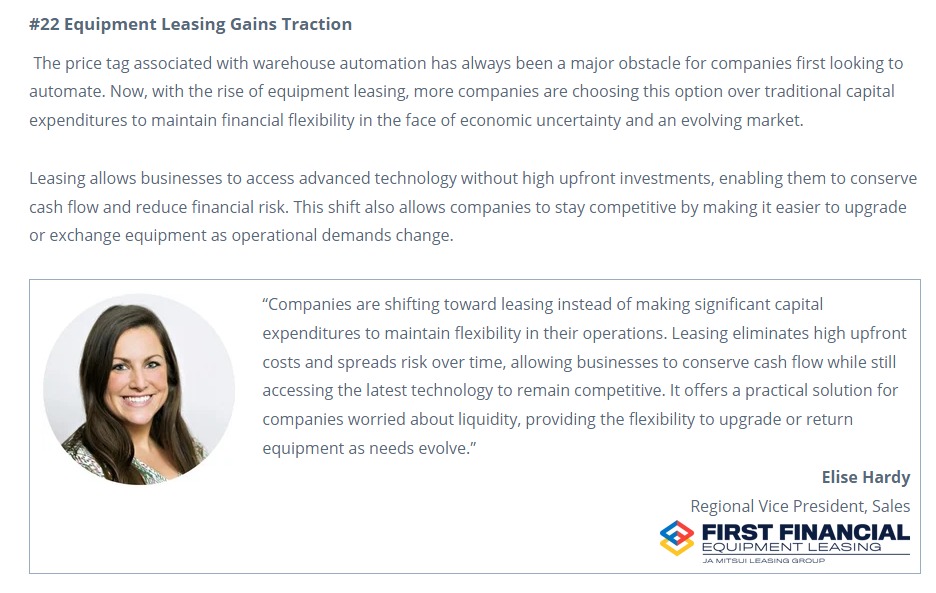
Click to read blog articleHello, world

In the world of heavy equipment, ownership can be costly and burdensome. Aside from the initial purchase price of equipment, there is also the financial responsibility of maintenance, repair, and eventual depreciation.
This is where Fair Market Value (FMV) leases can offer significant cost advantages and flexibility. With an FMV lease, organizations can receive the full benefits of using the equipment while only paying for a portion of the machine’s value over the lease term.
FMV LEASES FREE UP CAPITAL
An FMV lease is a type of operating lease that allows businesses to use equipment for a specified period while making regular payments. This structure is particularly beneficial for companies that need access to heavy equipment but don’t want to invest large amounts of capital up front.
At the end of the lease term, the business has the option to return the equipment, extend the lease, or purchase the equipment at its fair market value. Additionally — and as mentioned previously — one of the biggest advantages of an FMV lease is that it allows businesses to use equipment without having to pay the full cost of ownership. This is especially valuable in the construction sector, where equipment is essential but not always needed long-term. Rather than tying up capital in equipment purchases, companies can allocate those funds toward other critical operational areas.
With an FMV lease, businesses only pay for the use of the equipment during the lease term and are not responsible for the total value of the machine, as they would be with an outright equipment purchase. The result is a more efficient use of financial resources, allowing companies to access the equipment they need while keeping their capital free for other investments.
THE ADVANTAGES OF THE EQUIPMENT-AS-A-SERVICE MODEL
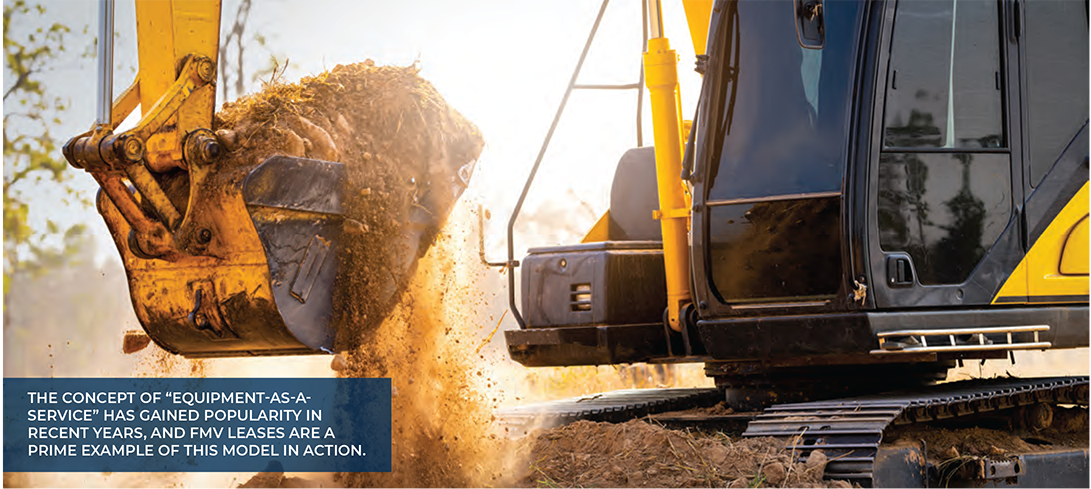
The concept of “equipment-as-a-service” has gained popularity in recent years, and FMV leases are a prime example of this model in action. With equipment-as-a-service, businesses essentially rent the functionality of the machine rather than owning it outright. This approach offers several advantages.
Equipment-as-a-service allows businesses to control costs more effectively by only paying for the use of the machine rather than bearing the total cost of ownership, maintenance, and repairs. Companies can use the equipment for as long as needed and then return it at the end of the lease term, avoiding the long-term commitment and costs associated with ownership.
With an FMV lease, businesses can easily upgrade to newer models at the end of the lease term, ensuring they always have access to cutting-edge technology and the best tools for the job. This regular access to newer equipment can lead to improved efficiency, reduced downtime, and, ultimately, a stronger bottom line.
The ability to turn variable costs into fixed costs has a direct impact on a company’s cash flow and financial forecasting. When costs are predictable, it’s easier for businesses to allocate funds toward other essential areas such as labour, materials, and project development. This is especially important in an industry such as construction, where cash flow can be inconsistent due to the seasonal nature of the work and dependencies on supply chains and project timelines.
By returning equipment at the end of the lease and opting for newer models, businesses can also avoid the pitfalls of owning outdated equipment, which can become costly to maintain and less efficient over time.
A LOOK AT THE EQUIPMENT-AS-A SERVICE MODEL IN ACTION
ABC Construction needed a fleet of excavators for a two-year project. Instead of purchasing the machines outright, ABC opted for an FMV lease.
By choosing to lease rather than purchase, ABC Construction effectively shielded itself from potential financial losses tied to the resale of depreciated equipment at the project’s end. This savvy decision relieved the company from the obligation of paying the total value of the machines up front and eliminated burdensome maintenance costs.
Opting for a Fair Market Value (FMV) lease allowed ABC Construction to streamline its expenses into a single manageable monthly payment. This not only ensured consistent monthly costs covering the equipment but also included essential maintenance, repairs, and soft costs like installation. Such an approach not only simplifies budgeting but also enhances operational efficiency, making it a wise choice for any construction firm.
This strategic shift stabilized ABC Construction’s cash flow, providing the funds needed for critical areas like hiring skilled labor and procuring materials. As a result, the company boosted profitability and increased its capacity to take on more projects without the fear of unexpected financial burdens.
At the conclusion of the 24-month project, ABC simply returned the equipment, having only paid for its use throughout the lease. This method allowed them to expand its equipment fleet for the larger short-term project and return the machinery once it was no longer needed. Ultimately, this strategy put them in a prime position to upgrade to the latest models, ensuring the company always has access to cutting-edge technology for future projects.
By leasing rather than purchasing, ABC Construction avoided the costs associated with making payments on the full value of the machine, in maintaining that equipment and taking a loss on the eventual sale of this depreciated equipment at the end of its useful life. By opting for an FMV lease, ABC Construction was able to bundle all these variable costs into its monthly lease payment. Over the course of the lease term, the company enjoyed fixed monthly costs that covered not just the equipment, but also all associated maintenance, repairs, and soft costs such as installation.
This shift allowed ABC Construction to stabilize its cash flow, ensuring it had sufficient funds available for other important areas such as hiring skilled labor and purchasing materials. As a result, the company saw increased profitability and was able to take on more projects without having to worry about unexpected expenses.
At the end of the 24-month project, ABC simply returned the equipment, having only paid for the use of the machines during the lease term. ABC Construction was able to expand its equipment fleet to accommodate this larger short-term project, then return the equipment at the end of the lease, when it was no longer needed. Ultimately, they were able to upgrade to the latest models when their next project required more advanced technology.

A SMART, FLEXIBLE SOLUTION FOR EQUIPMENT NEEDS
FMV leases provide businesses with the flexibility and financial efficiency needed to stay competitive in the construction sector. By allowing companies to receive the full benefit of equipment without paying for its total value, and by offering the option of regular equipment upgrades, FMV leases are effectively turning equipment into a service that businesses can rely on.
An FMV lease provides more than just access to equipment — it offers financial predictability. By converting variable costs such as repairs, maintenance, and soft costs into fixed payments, construction companies can better manage cash flow, reduce financial risks, and make more informed business decisions. For greater financial stability in an unpredictable industry, an FMV lease is a valuable tool that is worthy of consideration.
 Hello, world
In the world of heavy equipment, ownership can be costly and burdensome. Aside from the initial purchase price of equipment, there is also the financial responsibility of maintenance, repair, and eventual depreciation.
This is where Fair Market Value (FMV) leases can offer significant cost advantages and flexibility. With an FMV lease, organizations can receive the full benefits of using the equipment while only paying for a portion of the machine’s value over the lease term.
FMV LEASES FREE UP CAPITAL
An FMV lease is a type of operating lease that allows businesses to use equipment for a specified period while making regular payments. This structure is particularly beneficial for companies that need access to heavy equipment but don’t want to invest large amounts of capital up front.
At the end of the lease term, the business has the option to return the equipment, extend the lease, or purchase the equipment at its fair market value. Additionally — and as mentioned previously — one of the biggest advantages of an FMV lease is that it allows businesses to use equipment without having to pay the full cost of ownership. This is especially valuable in the construction sector, where equipment is essential but not always needed long-term. Rather than tying up capital in equipment purchases, companies can allocate those funds toward other critical operational areas.
With an FMV lease, businesses only pay for the use of the equipment during the lease term and are not responsible for the total value of the machine, as they would be with an outright equipment purchase. The result is a more efficient use of financial resources, allowing companies to access the equipment they need while keeping their capital free for other investments.
THE ADVANTAGES OF THE EQUIPMENT-AS-A-SERVICE MODEL
The concept of “equipment-as-a-service” has gained popularity in recent years, and FMV leases are a prime example of this model in action. With equipment-as-a-service, businesses essentially rent the functionality of the machine rather than owning it outright. This approach offers several advantages.
Equipment-as-a-service allows businesses to control costs more effectively by only paying for the use of the machine rather than bearing the total cost of ownership, maintenance, and repairs. Companies can use the equipment for as long as needed and then return it at the end of the lease term, avoiding the long-term commitment and costs associated with ownership.
With an FMV lease, businesses can easily upgrade to newer models at the end of the lease term, ensuring they always have access to cutting-edge technology and the best tools for the job. This regular access to newer equipment can lead to improved efficiency, reduced downtime, and, ultimately, a stronger bottom line.
The ability to turn variable costs into fixed costs has a direct impact on a company’s cash flow and financial forecasting. When costs are predictable, it’s easier for businesses to allocate funds toward other essential areas such as labour, materials, and project development. This is especially important in an industry such as construction, where cash flow can be inconsistent due to the seasonal nature of the work and dependencies on supply chains and project timelines.
By returning equipment at the end of the lease and opting for newer models, businesses can also avoid the pitfalls of owning outdated equipment, which can become costly to maintain and less efficient over time.
A LOOK AT THE EQUIPMENT-AS-A SERVICE MODEL IN ACTION
ABC Construction needed a fleet of excavators for a two-year project. Instead of purchasing the machines outright, ABC opted for an FMV lease.
By choosing to lease rather than purchase, ABC Construction effectively shielded itself from potential financial losses tied to the resale of depreciated equipment at the project’s end. This savvy decision relieved the company from the obligation of paying the total value of the machines up front and eliminated burdensome maintenance costs.
Opting for a Fair Market Value (FMV) lease allowed ABC Construction to streamline its expenses into a single manageable monthly payment. This not only ensured consistent monthly costs covering the equipment but also included essential maintenance, repairs, and soft costs like installation. Such an approach not only simplifies budgeting but also enhances operational efficiency, making it a wise choice for any construction firm.
This strategic shift stabilized ABC Construction’s cash flow, providing the funds needed for critical areas like hiring skilled labor and procuring materials. As a result, the company boosted profitability and increased its capacity to take on more projects without the fear of unexpected financial burdens.
At the conclusion of the 24-month project, ABC simply returned the equipment, having only paid for its use throughout the lease. This method allowed them to expand its equipment fleet for the larger short-term project and return the machinery once it was no longer needed. Ultimately, this strategy put them in a prime position to upgrade to the latest models, ensuring the company always has access to cutting-edge technology for future projects.
By leasing rather than purchasing, ABC Construction avoided the costs associated with making payments on the full value of the machine, in maintaining that equipment and taking a loss on the eventual sale of this depreciated equipment at the end of its useful life. By opting for an FMV lease, ABC Construction was able to bundle all these variable costs into its monthly lease payment. Over the course of the lease term, the company enjoyed fixed monthly costs that covered not just the equipment, but also all associated maintenance, repairs, and soft costs such as installation.
This shift allowed ABC Construction to stabilize its cash flow, ensuring it had sufficient funds available for other important areas such as hiring skilled labor and purchasing materials. As a result, the company saw increased profitability and was able to take on more projects without having to worry about unexpected expenses.
At the end of the 24-month project, ABC simply returned the equipment, having only paid for the use of the machines during the lease term. ABC Construction was able to expand its equipment fleet to accommodate this larger short-term project, then return the equipment at the end of the lease, when it was no longer needed. Ultimately, they were able to upgrade to the latest models when their next project required more advanced technology.
A SMART, FLEXIBLE SOLUTION FOR EQUIPMENT NEEDS
FMV leases provide businesses with the flexibility and financial efficiency needed to stay competitive in the construction sector. By allowing companies to receive the full benefit of equipment without paying for its total value, and by offering the option of regular equipment upgrades, FMV leases are effectively turning equipment into a service that businesses can rely on.
An FMV lease provides more than just access to equipment — it offers financial predictability. By converting variable costs such as repairs, maintenance, and soft costs into fixed payments, construction companies can better manage cash flow, reduce financial risks, and make more informed business decisions. For greater financial stability in an unpredictable industry, an FMV lease is a valuable tool that is worthy of consideration.
Hello, world

Mastering Innovation Through Surfing: Lessons for Business Transformation
In a podcast for TomorrowZone, Dave Anderson explains why the key to success — both in surfing and in business — is experimentation, patience, and embracing failure as part of the journey.
Take a listen! https://podcasts.apple.com/us/podcast/mastering-innovation-through-surfing-lessons-for-business/id1741229036?i=1000673123417
 Hello, world
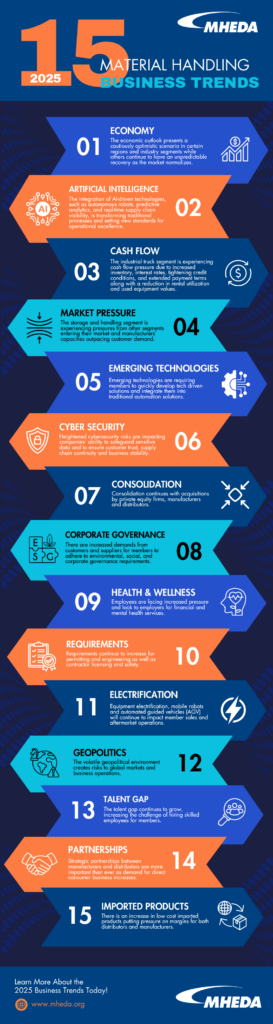
As we move into 2025, MHEDA’s Executive Committee has pinpointed 15 crucial business trends that will significantly impact the material handling industry. Several trends hold particular importance for our organization and our valued customers.
- Cautiously optimistic economic outlook in specific regions and industry segments, with unpredictable recovery in other areas as the market normalizes.
- Integrating AI-driven technologies, such as autonomous robots, predictive analytics, and real-time supply chain visibility, will transform traditional processes and set new standards for operational excellence.
- Pressures from other market segments, with manufacturers’ capacities outpacing customer demand, are placing pressure on the storage and handling segment.
- There is a need for quick development of tech-driven solutions to integrate emerging technologies into traditional automation solutions.
- Continued impact on member sales and aftermarket operations from equipment electrification, mobile robots, and automated guided vehicles (AGV).
Strategic partnerships between manufacturers and distributors are becoming increasingly important as demand for direct consumer business rises. - Growing pressure on margins for distributors and manufacturers due to increased low-cost imported products.
 Hello, world

Life in the construction sector hasn’t been easy lately, given the challenging economy and uncertainties at every turn. Unfortunately, it looks like we’ll all need to continue to keep our seat belts tightly fastened for the foreseeable future. In a recent economic update, Ken Wattret, vice president of global economics at S&P Global Market Intelligence, says: “The path forward will likely remain bumpy, given numerous US-related uncertainties, including the risk of a hard landing, the timing and magnitude of policy rate cuts, and the outcome of elections in November and their policy implications.”
For those in the construction industry, the path to persevere and grow isn’t as clear-cut as in the past. Adaptability is crucial, and this adaptability should also apply to construction equipment financing.
Full Market Value (FMV) leases, which can often be viewed as rigid or conventional, can be customized to meet unique business demands. This ushers in newfound flexibility to help companies adapt and adopt new approaches.
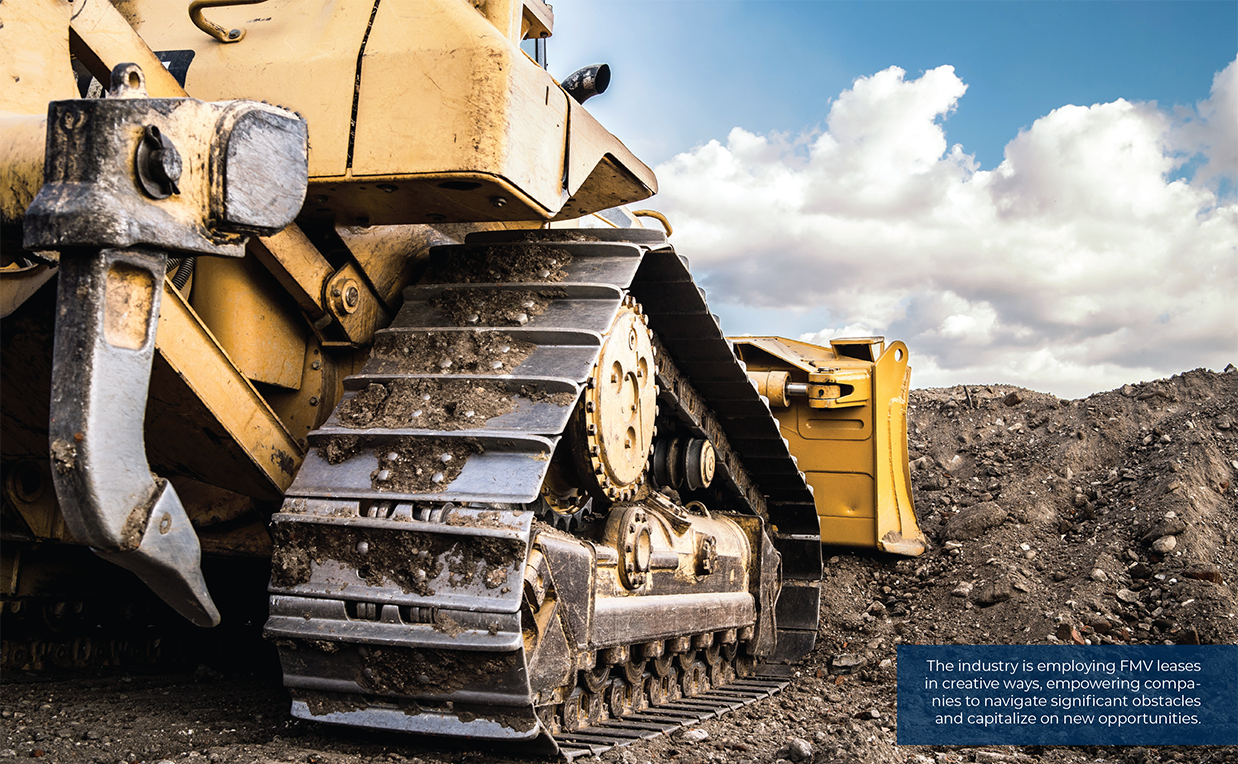
The industry is employing FMV leases in creative ways, empowering companies to navigate significant obstacles and capitalize on new opportunities.
Below are five use cases highlighting the flexibility and potential of FMV leases as creative financing strategies for the construction sector.
1 – CROSSING BORDERS TO SECURE THE RIGHT EQUIPMENT
One area where creative financing approaches can come to the rescue is in the instance of cross-border equipment financing. This may come into play when the equipment needed for your project doesn’t happen to exist in the country you currently operate within. Sometimes, a client may require a piece of equipment built overseas or that exists presently overseas.
Recently, a construction company based in Canada needed to purchase a machine from a dealer in the United Kingdom. The complexities of cross-border transactions can be challenging, especially when it comes to securing the necessary funds. Creative leasing approaches were of benefit here, not only to fund the down payment and ensure the transaction could move forward but also to fully fund the deal before the machine was even shipped to Canada. This approach minimized the financial risk for the company. It streamlined the entire transaction process, making it possible for them to acquire the equipment they needed without delay while enabling them to continuously focus on their day-to-day operations.
2 – MAKING FLEXIBLE PAYMENT STRUCTURES ALIGN WITH CASH FLOW
Cash flow management is critical for construction companies, especially when dealing with large equipment purchases. However, as anyone in the industry knows, cash flow can and often does fluctuate, particularly in the initial months of a contract.
Creative financing approaches can take a debt load off in these scenarios. Look for unique finance structures, such as deferred and skip payments, that align with your revenue streams. By deferring payments or allowing skips in the early months, companies can focus on completing their projects without the added pressure of immediate, substantial payments.
Alternatively, if your business performs seasonal work, such as fewer highway paving projects in the winter months or snow removal in the winter months with less usage in the summer months, payment months can align with months with the highest incoming receivables, making payments much more manageable.
3 – FINANCING SPARE PARTS TO PREVENT DOWNTIME
Unplanned machine downtime can be incredibly costly, so it’s crucial to have spare parts on hand, particularly because replacement parts can be in short supply. Over the past few years, the industry has experienced lengthy lead times for replacement parts.
To help maintain operational efficiency, creative financing approaches can offer needed resources specifically for spare parts purchased along with the machine orders. This proactive approach allows companies to stock essential components to keep their operations running smoothly, by avoiding crucial part shortages and lengthy downtimes.
4 – INTERIM FINANCING FOR FACTORY-ORDERED MACHINES
Long lead times are often required for factory-ordered machines, and manufacturers typically demand a down payment before commencing the build process. For many companies, this presents a significant cash flow challenge, particularly when a machine can take upwards of nine months or longer to build. Creative financing strategies can address this issue by financing the interim payments. This allows organizations to avoid substantial out-of-pocket expenses before the machine is built and operational, providing the financial flexibility needed to begin paying for the equipment once it is put into operation. In this way, companies can achieve a positive return on their equipment investments immediately.
5 – FIRST AMENDMENT LEASES: FLEXIBILITY FOR THE LONG TERM
Creative financing can offer the best of both worlds — a structure that begins with an operating lease, complete with a residual, but with the ability to extend and transition into a full payout term. This innovative approach gives organizations the flexibility to adjust their financing as their needs evolve, giving them more flexibility regarding their assets. Initially, a company can benefit from the lower payments and flexibility of an operating lease. Later, if desired, a company can amend the lease to fully amortize the equipment, retaining it for the long term, giving them more flexibility regarding their assets.
FAIR MARKET VALUE LEASES: THE CREATIVE FINANCING OPTION THAT GIVES YOU OPTIONS
FMV leases can be more than just a standard financing option, they can be incredibly flexible and adaptable; lease terms can be adjusted to address specific needs and an organization’s financial scenario, which is especially crucial when the business outlook and/or cash flow may be unpredictable.
As the use cases above illustrate, they can be a powerful tool to help your business grow, adapt, and thrive. Whether you’re dealing with cross-border transactions, managing cash flow, or planning for future equipment needs, creative financing approaches can help you access needed resources.
As César Pelli, the famous Argentine-American architect who designed some of the world’s tallest buildings and other major urban landmarks, noted, “Construction is a matter of optimism; it’s a matter of facing the future with confidence.” Creative financing gives the construction sector greater capacity and confidence to navigate today’s business and economic challenges.
 Hello, world
Life in the construction sector hasn’t been easy lately, given the challenging economy and uncertainties at every turn. Unfortunately, it looks like we’ll all need to continue to keep our seat belts tightly fastened for the foreseeable future. In a recent economic update, Ken Wattret, vice president of global economics at S&P Global Market Intelligence, says: “The path forward will likely remain bumpy, given numerous US-related uncertainties, including the risk of a hard landing, the timing and magnitude of policy rate cuts, and the outcome of elections in November and their policy implications.”
For those in the construction industry, the path to persevere and grow isn’t as clear-cut as in the past. Adaptability is crucial, and this adaptability should also apply to construction equipment financing.
Full Market Value (FMV) leases, which can often be viewed as rigid or conventional, can be customized to meet unique business demands. This ushers in newfound flexibility to help companies adapt and adopt new approaches.
The industry is employing FMV leases in creative ways, empowering companies to navigate significant obstacles and capitalize on new opportunities.
Below are five use cases highlighting the flexibility and potential of FMV leases as creative financing strategies for the construction sector.
1 – CROSSING BORDERS TO SECURE THE RIGHT EQUIPMENT
One area where creative financing approaches can come to the rescue is in the instance of cross-border equipment financing. This may come into play when the equipment needed for your project doesn’t happen to exist in the country you currently operate within. Sometimes, a client may require a piece of equipment built overseas or that exists presently overseas.
Recently, a construction company based in Canada needed to purchase a machine from a dealer in the United Kingdom. The complexities of cross-border transactions can be challenging, especially when it comes to securing the necessary funds. Creative leasing approaches were of benefit here, not only to fund the down payment and ensure the transaction could move forward but also to fully fund the deal before the machine was even shipped to Canada. This approach minimized the financial risk for the company. It streamlined the entire transaction process, making it possible for them to acquire the equipment they needed without delay while enabling them to continuously focus on their day-to-day operations.
2 – MAKING FLEXIBLE PAYMENT STRUCTURES ALIGN WITH CASH FLOW
Cash flow management is critical for construction companies, especially when dealing with large equipment purchases. However, as anyone in the industry knows, cash flow can and often does fluctuate, particularly in the initial months of a contract.
Creative financing approaches can take a debt load off in these scenarios. Look for unique finance structures, such as deferred and skip payments, that align with your revenue streams. By deferring payments or allowing skips in the early months, companies can focus on completing their projects without the added pressure of immediate, substantial payments.
Alternatively, if your business performs seasonal work, such as fewer highway paving projects in the winter months or snow removal in the winter months with less usage in the summer months, payment months can align with months with the highest incoming receivables, making payments much more manageable.
3 – FINANCING SPARE PARTS TO PREVENT DOWNTIME
Unplanned machine downtime can be incredibly costly, so it’s crucial to have spare parts on hand, particularly because replacement parts can be in short supply. Over the past few years, the industry has experienced lengthy lead times for replacement parts.
To help maintain operational efficiency, creative financing approaches can offer needed resources specifically for spare parts purchased along with the machine orders. This proactive approach allows companies to stock essential components to keep their operations running smoothly, by avoiding crucial part shortages and lengthy downtimes.
4 – INTERIM FINANCING FOR FACTORY-ORDERED MACHINES
Long lead times are often required for factory-ordered machines, and manufacturers typically demand a down payment before commencing the build process. For many companies, this presents a significant cash flow challenge, particularly when a machine can take upwards of nine months or longer to build. Creative financing strategies can address this issue by financing the interim payments. This allows organizations to avoid substantial out-of-pocket expenses before the machine is built and operational, providing the financial flexibility needed to begin paying for the equipment once it is put into operation. In this way, companies can achieve a positive return on their equipment investments immediately.
5 – FIRST AMENDMENT LEASES: FLEXIBILITY FOR THE LONG TERM
Creative financing can offer the best of both worlds — a structure that begins with an operating lease, complete with a residual, but with the ability to extend and transition into a full payout term. This innovative approach gives organizations the flexibility to adjust their financing as their needs evolve, giving them more flexibility regarding their assets. Initially, a company can benefit from the lower payments and flexibility of an operating lease. Later, if desired, a company can amend the lease to fully amortize the equipment, retaining it for the long term, giving them more flexibility regarding their assets.
FAIR MARKET VALUE LEASES: THE CREATIVE FINANCING OPTION THAT GIVES YOU OPTIONS
FMV leases can be more than just a standard financing option, they can be incredibly flexible and adaptable; lease terms can be adjusted to address specific needs and an organization’s financial scenario, which is especially crucial when the business outlook and/or cash flow may be unpredictable.
As the use cases above illustrate, they can be a powerful tool to help your business grow, adapt, and thrive. Whether you’re dealing with cross-border transactions, managing cash flow, or planning for future equipment needs, creative financing approaches can help you access needed resources.
As César Pelli, the famous Argentine-American architect who designed some of the world’s tallest buildings and other major urban landmarks, noted, “Construction is a matter of optimism; it’s a matter of facing the future with confidence.” Creative financing gives the construction sector greater capacity and confidence to navigate today’s business and economic challenges.
Hello, world
 Hello, world