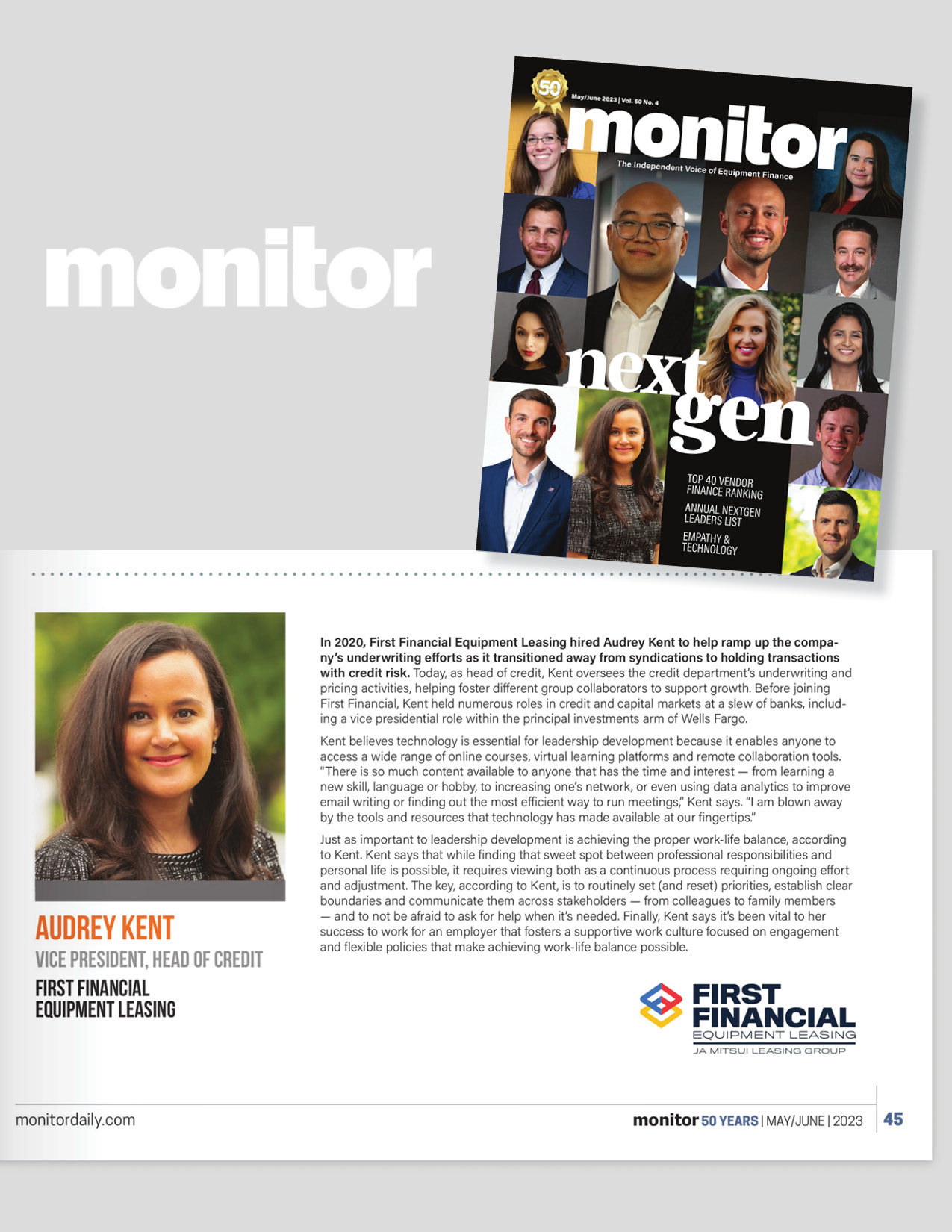
Monitor | 40 Under 40 NextGen Issue: May/June 2023
Featuring Audrey Kent
Click here to view or download article.
Click here to view Monitor e-magazine.
Hello, world
Monitor | 40 Under 40 NextGen Issue: May/June 2023
Featuring Audrey Kent
Click here to view or download article.
Click here to view Monitor e-magazine.
Hello, world
> LINK TO ARTICLE ON AC&T WEBSITE <

Heavy equipment and construction markets are in a unique position. The United States is facing the possibility of a looming recession, while on the flip side, the country is seeing a boom in infrastructure projects following the enactment of President Biden’s Bipartisan Infrastructure Law. With money to spend in the new and used equipment realm, the industry is faced with economic risks and rewards, on both sides of the coin.
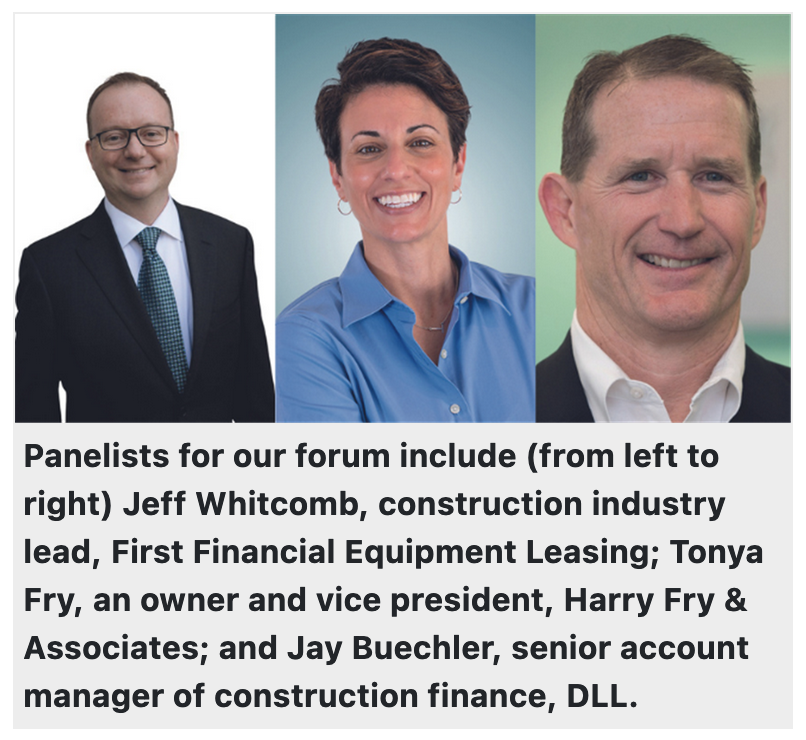
ACT reached out to three finance experts to learn more about their thoughts and perspectives on the current market, interest rates, inflation and much more. Panelists for our forum include Jeff Whitcomb, construction industry lead, First Financial Equipment Leasing; Tonya Fry, an owner and vice president, Harry Fry & Associates; and Jay Buechler, senior account manager of construction finance, DLL.
WHITCOMB: We don’t see it slowing in 2023 or 2024. While it may be that personal consumption drags down GDP, we see both private domestic investment as well as government domestic investment continued strength, and for that reason, we see continued strength in the new and used crane market.
FRY: I would currently characterize the market as cautious. I am continuing to hear from my customers that they have more work than they can service. We are constantly barraged with news of a possible recession, continued record high inflation and interest rate hikes, plus international issues. When this is combined with lack of supply of equipment and delivery delays, of course customers are going to be cautious.
However, I find that many customers are trying not to pay attention to the news, but instead considering what is happening in their geographic market. If they have demand for work or are awarded jobs, they are willing to make the crane purchase as they don’t want to lose the work/jobs. As far as new and used cranes go, if customers are in need of equipment, they will purchase what they can get their hands on. As a result, we have definitely seen prices of equipment significantly increase. I do feel if you are in a market to sell, and have quality, used equipment, you are in a good position.
BUECHLER: Despite the potential for a recession in late 2023, the market remains robust in North America for both new and used cranes, as significant project work continues to require cranes to complete these projects. The supply chain disruptions of the last several years has led to a restricted supply of new cranes, with many new crane models not being available until well into 2024. This has led to a very competitive and aggressive market for used cranes, resulting in increased used crane pricing.
WHITCOMB: We do not think that the recession will have much of an impact on crane sales, both new and used. We think that it will be a consumer recession, and that the commercial activity that has been planned for all this infrastructure work will be in full swing, and that is going to drive strong demand for 2023 to 2025.
FRY: I feel like economists have been predicting a recession since 2021. In addition, the economists have had contradicting opinions on a recession for the past year. As noted above, I think people are trying to pay attention to what is going on in their market area rather than listen to the news. There is still a demand for quality equipment, and I think it is the lack of inventory that is slowing sales.
BUECHLER: Given the short supply of new cranes and equipment and long lead times on some models, we anticipate that new crane sales, as well as used crane sales, will remain brisk and aggressively priced.
WHITCOMB: Well, 5 percent may be the target Fed funds rate, but we see actual real interest rates much higher. This was somewhat offset by lending at the regional bank level where deposits sometimes hold down interest rates. With the recent banking crisis, we’ve seen a massive pullback by small and regional banks, as depositors have fled those banks. Unfortunately for the retail marketplace, it seems that the big will get bigger and the small will continue to fight to survive.
FRY: When the Fed initially began raising rates, I think it was sticker shock for many. For almost a decade, we had prime rates at historic lows. Customers were used to rates in the threes and sometimes twos.
When I began my career in crane financing in 2004, interest rates were in the 7 to 8 percent range, and this was the normal range. When my parents started the company in the 1990s, rates were 10.5 to 12 percent. We often say that a business that started within the past ten years doesn’t know anything other than extremely low rates. It seems that these businesses were more affected/surprised by the cost of financing than the older, established companies. It has taken a bit for customers to understand, but due to the lack of supply, if they needed the equipment, they accepted what the interest rate would be. By Q4 2022, the sticker shock had worn off and most understood that these rates were here to stay. I think it helped our company had a strong fourth quarter in 2022 because customers didn’t want to risk rates going up, so they would make the purchase. We understand higher rates are a real money cost to a business but not acquiring equipment because the rates are high impacts the business even more by lost revenues. The decision to acquire equipment is always difficult but is typically made for future long-term benefits.
BUECHLER: Increased interest rates are combining with rising new and used crane prices to drive up financing payments for entities seeking to finance their crane acquisitions. This is causing crane customers to look long and hard at the economics between where their financing payments are going and what crane rental rates they are able to extract from the market. If the economics no longer makes sense, we would not be surprised to see some crane rental companies back away from new equipment purchases.
WHITCOMB: Absolutely, yes.
FRY: Equipment will definitely be needed, but as is the common theme, the lack of supply is having quite an impact on this. Companies may pay a premium on available equipment as they would not want to risk losing a job.
BUECHLER: New infrastructure projects will definitely continue to require crane utilization. The crane rental companies that will be best positioned for gaining work on these projects will be those that currently have a large installed base of cranes available to work on these projects, such that they are not reliant on the availability of new equipment to service their project work.
WHITCOMB: 2024 will be the biggest year of federal disbursements on record for capital investment. For this reason, we see continued strength and continued demand for crane and lift equipment.
FRY: I think the biggest challenge in financing right now is that credit is beginning to tighten a bit. Lenders are still lending and buying deals. However, we are finding that they are asking more questions. They want more details on why the equipment is needed and projections for additional work in 2023 and beyond. Lenders are definitely still buying deals. With the constant threat of a recession, they are digging a little deeper into deals, and the credit box is just a bit tighter. I would say that customers just need to be patient when asked for additional info.
BUECHLER: The biggest challenge we see currently in the crane financing market, with increased crane prices and increased interest rates already mentioned, is trying to provide a financial solution that results in a payment that makes economic sense for the customer given the rental rates they are able to charge in the market.

> LINK TO ARTICLE ON AC&T WEBSITE <Hello, world
FFEL’s Expansion into Construction Primed to Fuel Growth for JA Mitsui Leasing Group’s North American Initiatives
ORANGE, CA – Monday, May 22, 2023 – First Financial Equipment Leasing (FFEL), a leading equipment leasing solutions provider, announced today that Brian Hutchison joined the company as Senior Vice President to spearhead expansion into the construction and industrial equipment segment. Hutchison has extensive experience building and leading vendor finance programs with partners both in the US and internationally. At FFEL, he will focus on developing dealer and vendor-focused solutions for the company’s entry into the segment.
Through this expansion, FFEL is well-positioned to accelerate the organic growth of its core business and push forward new initiatives with the support of its parent company, JA Mitsui Leasing, Ltd. (JAML). JAML has extensive credentials for supporting the construction industry in Japan and is well-positioned to bring that expertise to the North American market.
Led by Hutchison, a newly formed construction-specific team will focus on significant opportunities within the company to enhance leasing options for vendors, dealers, and customers. “While we have historically provided direct leasing solutions, our construction team will add dealer and vendor-focused solutions to our model,” said Brian Dundon, SVP, Head of Corporate Development, FFEL. “Given his customer-centric leadership style and strong track record of success with manufacturers and dealers, Hutchison will be instrumental in identifying new revenue opportunities and enhancing leasing options to various customer groups.”
Hutchison has over 25 years in equipment finance, with roles in wholesale operations, underwriting, and sales. Before joining FFEL, Hutchison spent 19 years in commercial leadership roles with DLL Financial Services, including joint venture managing director and global account manager for a vendor program partner.
“I am excited to join FFEL at a time of significant growth and expansion to lead our construction team,” said Brian Hutchison, Senior Vice President – Construction, FFEL. “The company has earned a stellar reputation within the leasing industry for its unparalleled customer service and innovative financing programs, and I look forward to taking the construction group to new heights.”
About First Financial Equipment Leasing – JA Mitsui Leasing Group
First Financial Equipment Leasing specializes in the acquisition of Construction & Industrial Equipment, Healthcare, IT Solutions and Services, Material Handling & Automation, and Renewable Energy & Solar. For over 20 years, First Financial Equipment Leasing has provided financing solutions designed to conserve capital and offer affordable access to often expensive yet increasingly critical, advanced technologies and equipment.
Headquartered in Southern California, First Financial Equipment Leasing is a member of JA Mitsui Leasing, Ltd. (JAML), a joint venture of Mitsui & Co. (2022 revenue $96B) and Norinchukin Bank (2022 assets totaling $1.05 Trillion)
Hello, world
At First Financial Equipment Leasing, we understand the specific challenges facing K-12 school districts and educational institutions. Our leasing solutions are explicitly designed to assist customers with limited resources and budgets. Our technology financing experts will work closely with you to develop programs that require minimal upfront costs, ensure you have the means for frequent updates, and keep your budget in check.
Contact us today to learn how we can help you acquire new computers, printers, software, security, and connectivity equipment to serve your students better and keep your institution ahead of the curve.
Let the technology consultants at First Financial outfit your classroom for success by implementing new equipment and IT solutions.
TYLER FIELDS
Regional Sales Representative
M. 714-404-7948 | O. 714-646-1657
tfields@ffequipmentleasing.comHello, world
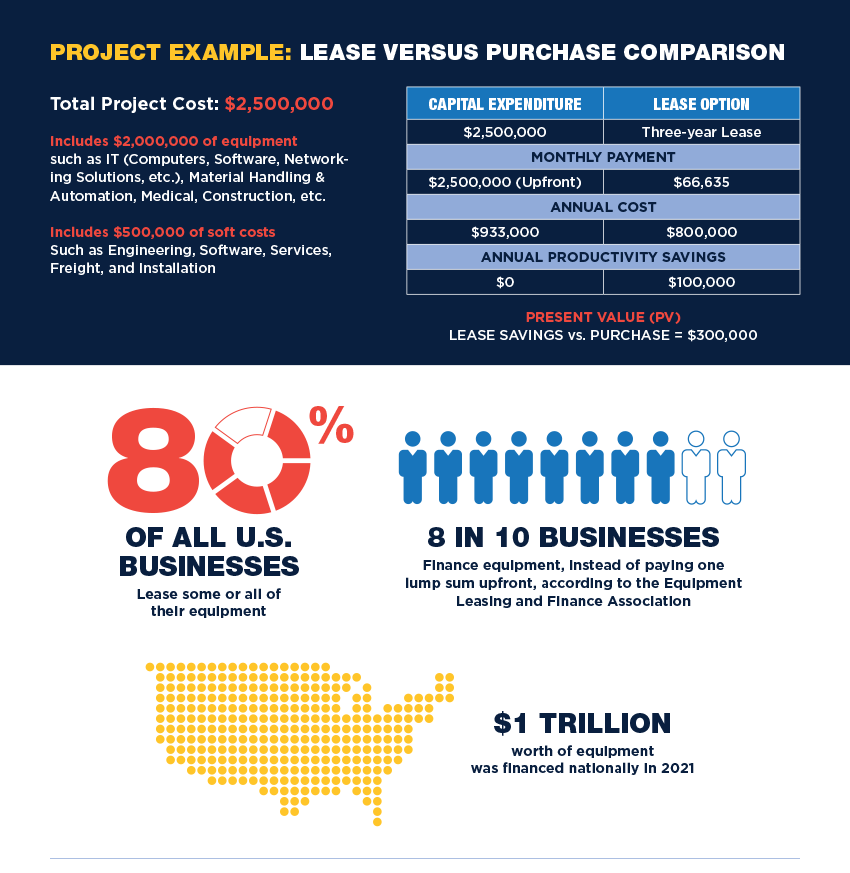
Construction equipment can come with a hefty price tag, making it challenging to find the necessary assets without straining finances or disrupting cash flow. First Financial Equipment Leasing offers acquisition plans that allow businesses to preserve cash while obtaining the equipment required to meet evolving business demands.
Over the last two decades, we have developed long-lasting relationships with manufacturers, dealers, and vendors throughout the US, Canada, and Mexico. Our construction industry pros have a detailed knowledge of your industry and the challenges facing your business. Working side by side through the acquisition process, we create solutions that align with current needs and budgets while preparing for future upgrades and seasonal fluctuations.
A well-executed construction equipment acquisition plan from First Financial Equipment Leasing will increase profitability, accommodate growth and reduce the risks associated with maintaining outdated assets. Having the right equipment at the right price allows businesses to push forward onto more significant projects and build a solid foundation for future expansion.
Jeff Whitcomb, Senior Vice President
Construction Sales Director USA/Canada
346.275.2835
jwhitcomb@ffequipmentleasing.comHello, world


Hello, world
First Financial Equipment Leasing understands the challenges of acquiring critical technology and software solutions at a manageable cost while remaining adaptable as your technology needs grow. When budgets are under unprecedented pressure and facing competing demands for capital, leasing equipment is a sound, fiscally responsible alternative to buying.
During the equipment acquisition process, we will work closely with you to develop tailored leasing structures that match your financial needs with your technical requirements. We will consult with you about equipment lifecycles, market pricing evaluations, and industry best practices and share ideas on maximizing your produc- tivity and financial efficiency. Leveraging all the available options, we can tailor a cost-effective solution that works harder and smarter to promote the profitability and competitiveness of your business.
Dave Sanborne, National Sales Manager
480.363.7554
dsanborne@ffequipmentleasing.comHello, world
Monitor recently caught up with Tom Slevin, founder and CEO, and Brian Dundon, SVP corporate development at First Financial Equipment Leasing ahead of their company’s acquisition of NorFund, an independent leasing company specializing in capital equipment, solar and alternative energy and vendor finance programs.
First Financial Equipment Leasing announced its expansion into Canada in 2022 with the acquisition of NorFund, an independent leasing company specializing in capital equipment, solar and alternative energy and vendor finance programs.
Having been acquired by JA Mitsui Leasing a few years ago, Tom Slevin, founder and CEO of First Financial, and Brian Dundon, SVP corporate development, both knew not only what to expect during the acquisition, but also what to provide to make it a smooth transition.
Reminiscing about First Financial’s acquisition not too long ago, Slevin and Dundon remember the fears they had around acquisitions, which stemmed from stories of other independent companies being purchased by a larger company or bank and facing restrictions and various changes, which lessened the overall experience, value and productivity of some companies. Thankfully, that was not the case for the JA Mitsui Leasing acquisition some years ago, but it offered insight on how to provide insight, resources and opportunities when expanding internationally and into new territory.
“The biggest thing that we have with JA Mitsui and with the folks that we work with is that it’s much more of a partnership than a top-down mentality,” Dundon says. “That’s not something you get in every single big company. And it’s something that I know myself, Tom, and others are really grateful for is having partners that are seeking to actively help.”
The Cultural Fit
The First Financial team plans to take a similar approach in its acquisition of NorFund. Slevin says NorFund is a perfect fit for First Financial. Having been established in Canada for years, NorFund was everything First Financial wanted in a partner, as Slevin puts it, “They have contacts, they have customers, they have vendor relationships, they have relationships within the leasing community there. And it was a really good cultural fit in that they’re creative and entrepreneurial like First Financial.”
NorFund, which has been renamed First Financial Canadian Leasing, will continue to be led by Robert MacFarlane, who has more than 30 years of leasing experience, including roles at Newcourt Credit, National City and PNC that focused on developing fair market value leasing businesses in Canada.
“[What] made NorFund really an attractive target was the people,” Dundon says. “Rob MacFarlane founded NorFund. He led that company, and prior to that, he worked in fair market value, technology leasing, solar leasing, and really the type of businesses that we want to be involved in. There aren’t many people up there in Canada that have done that and understand that market, so being able to acquire NorFund and bring Rob on board, it made a lot of sense.”
What attracted First Financial Equipment Leasing to the Canadian market is how the country does business in a similar fashion to the U.S. From a contractual and legal standpoint, it makes sense, but Selvin also notes that recently, banks have pulled away from that market and have left a potential opportunity open for his company.
“Our goal is to really take what we’ve learned over the last 10 years that we’ve been there and grow that,” Dundon says. “We’re really a relationship focused company. We try to have our customers be our customers for decades, and Canada’s a market that’s pretty similar and people value that kind of approach and relationship mindset.”
Running with NorFund’s previous successes with solar asset classes, Dundon and Slevin plan to expand the company’s offerings to include construction and material handling. In the U.S., First Financial’s asset classes are material handling, information technology, healthcare and construction.
“Since the acquisition, we’ve grown — our equipment leasing volume has tripled and we’ve doubled the back office in three years,” Dundon says. “That pace is continuing to grow and adding Canada in there is only going to further accelerate that in the long run.”
>> Link to monitordaily.com article <<Hello, world