Equipment Finance Insight
Maximizing Benefits with section 179 for Your Forklift Fleet
A timely update in 2026
>> Download PDF <<
Hello, world
Hello, world
TONYA FRY is an owner and Vice President at Harry Fry & Associates. Tonya has 22 years of experience in the heavy equipment finance industry. Tonya brings a strategic and customer-focused approach to equipment financing. She works closely with clients throughout the funding process, helping businesses secure customized financing solutions that support growth, improve cash flow, and maximize profitability. Harry Fry & Associates is a family-owned company specializing in crane and heavy-equipment financing solutions. They have secured approximately $1.7 billion in financing over the past thirty years.
DAN MCDONOUGH is the founder, CEO and president of Commercial Credit Group (CCG). He has 40 years of experience in the construction and transportation equipment financing markets and has been instrumental in growing CCG’s crane portfolio. Commercial Credit Group is an independent equipment finance provider based in Charlotte, NC, specializing in financing for new and used equipment, equipment refinancing and working capital loans. In 22 years, CCG has financed over $500 million in cranes for companies across the U.S. and Canada.
JEFF WHITCOMB is SVP for Construction and Industrial at First Financial Equipment Leasing, a JA Mitsui company. He has 28 years of experience in the construction and transportation equipment financing markets and has been instrumental in adding $230 million in new originations in the past three years. As part of the JA Mitsui Leasing family, First Financial Equipment Leasing offers the stability and resources of a global powerhouse with over $16 billion in assets.
> Download Article PDF <<Hello, world

Many professionals in the construction industry face a common dilemma: securing a significant project only to be halted by financial constraints. Rising equipment costs, extended payment terms stretching between 60-75 days, and the burden of covering two months’ expenses before receiving payment can create a daunting scenario.
Research from recent industry reports shows that:
· A significant 51% of construction professionals view upfront costs as their top challenge.
· 38% express frustration over slow payment processing, which disrupts cash flow and creates uncertainty.
· A concerning 56% have chosen to forgo projects entirely due to concerns over cash flow, demonstrating the significant impact on business opportunities.
· Additionally, it’s worth noting that 76% of projects experience at least a week’s delay due to payment issues, resulting not only in time loss but also in revenue loss, which can affect a company’s bottom line.z
One of the main factors contributing to these cash flow challenges is the reluctance of traditional banks to extend credit to subcontractors unless they are large, established firms. This can put smaller companies at a disadvantage, often forcing them to start projects with a limited workforce due to tight cash controls, which can disrupt timelines and potentially jeopardize job security.
Leasing equipment can be a strategic approach to managing cash flow effectively. Here’s how it can be beneficial:
1. Lower Upfront Costs:
Leasing significantly reduces the immediate financial burden by spreading payments over time. This flexibility allows you to allocate funds more effectively toward labor and materials, enabling projects to kick off smoothly.
2. Improved Cash Flow:
With predictable monthly leasing payments, budgeting becomes easier, reducing the pressure of waiting for payments from clients. Businesses no longer have to cover two months of expenses out of pocket.
3. Reduced Risk:
Leasing helps maintain operational continuity even when clients extend their payment terms. This reduces reliance on credit and emergency funds, allowing you to manage your finances with greater ease.
4. Enhanced Competitiveness:
Accessing the latest equipment without the weight of long-term debt empowers your business to confidently bid on more projects.
A mid-sized contractor in the Midwest faced a frustrating reality: despite winning bids for lucrative commercial projects, they couldn’t move forward. Why? Upfront equipment costs were draining their working capital, leaving them unable to fully staff jobs or purchase necessary materials.
The result was stalled timelines, missed opportunities, and mounting stress. Traditional financing wasn’t an option—banks were hesitant to extend credit without significant collateral.
That’s when they turned to equipment leasing. By spreading costs over manageable monthly payments, they unlocked $250,000 in working capital almost immediately. This financial breathing room allowed them to:
✔ Fully staff projects from day one
✔ Maintain cash flow without relying on emergency credit
✔ Take on three additional projects within the same year
The outcome? An 18% increase in annual revenue, stronger client relationships, and a competitive edge in bidding for future work—all without sacrificing financial stability.
Don’t allow financial challenges to prevent you from pursuing new project opportunities. By adopting a strategic leasing approach, you can turn what once seemed impossible into real achievements, paving the way for significant growth.
If you’re ready to utilize equipment leasing to advance your business, let’s connect. Together, we can explore opportunities that will drive your success.
For more information, contact our construction industry expert, Jeff Whitcomb, at 630-853-1991, jwhitcomb@ffequipmentleasing.com.Hello, world
The passage of the One Big Beautiful Bill has transformed the landscape for equipment financing, offering businesses up to $2.5 million in immediate tax deductions. Whether you’re a contractor, construction firm, or any business relying on heavy equipment or software, this is your moment to invest in growth while preserving capital.
Our Section 179 Playbook breaks down everything you need to know—from how leasing can maximize your tax benefits to real-life case studies showing how companies saved hundreds of thousands of dollars. It’s packed with actionable insights, objection-handling talk tracks, and strategies to help your sales team close more deals before the December 31, 2025 deadline.
Download the playbook now and empower your team to turn tax incentives into business wins.

Hello, world
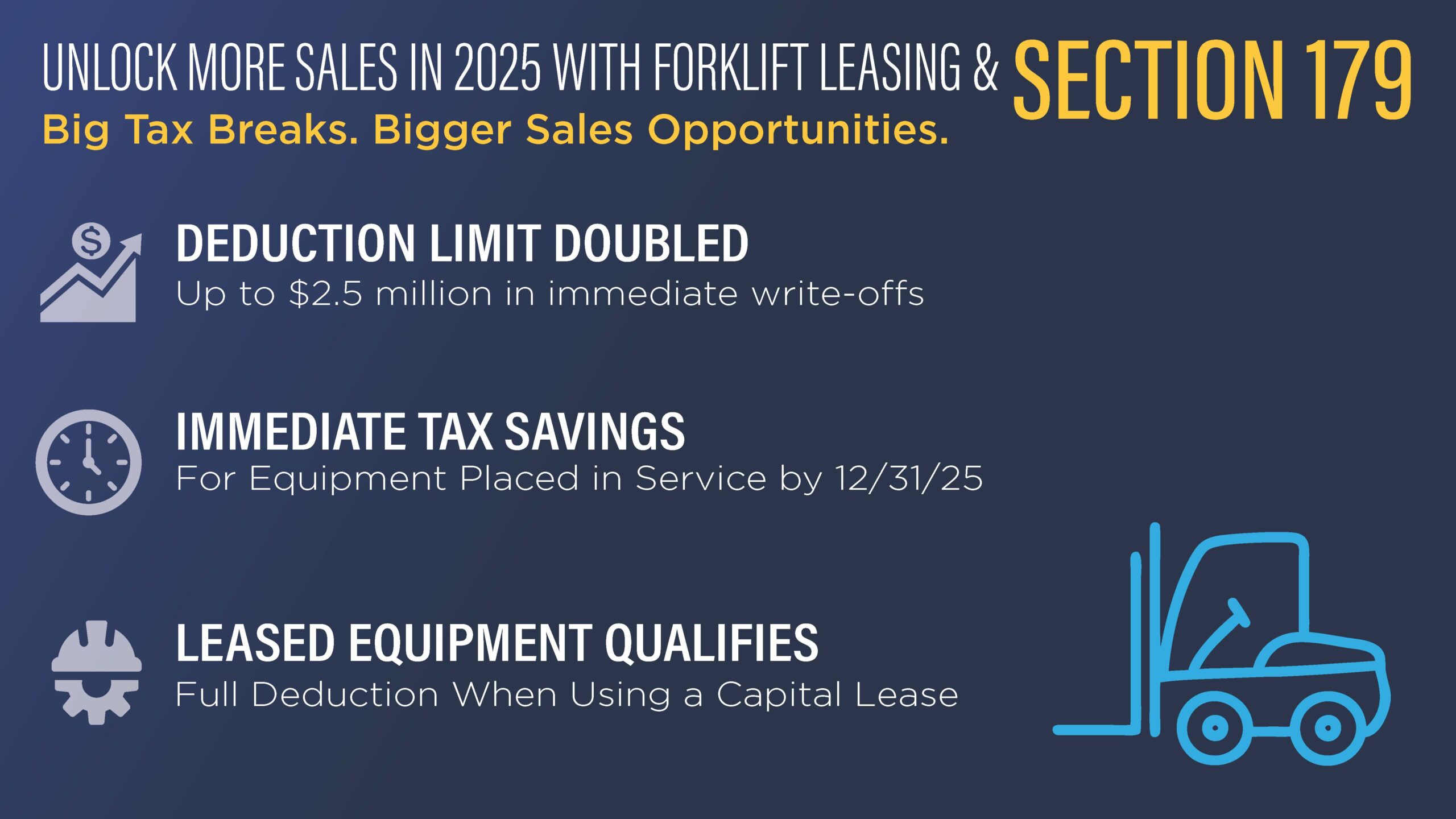
The equipment dealership landscape is poised for a monumental shift in 2025, particularly for forklift sellers, thanks to the One Big Beautiful Bill Act. With substantial updates to Section 179, dealers now have a powerful tool to enhance sales, educate customers, and ultimately increase profitability.
At its core, Section 179 is a crucial part of the U.S. tax code that allows businesses to fully deduct the cost of qualifying equipment, such as forklifts, in the same year it is placed in service. This means buyers can write off the total purchase amount immediately, rather than spreading deductions over 5 to 7 years.
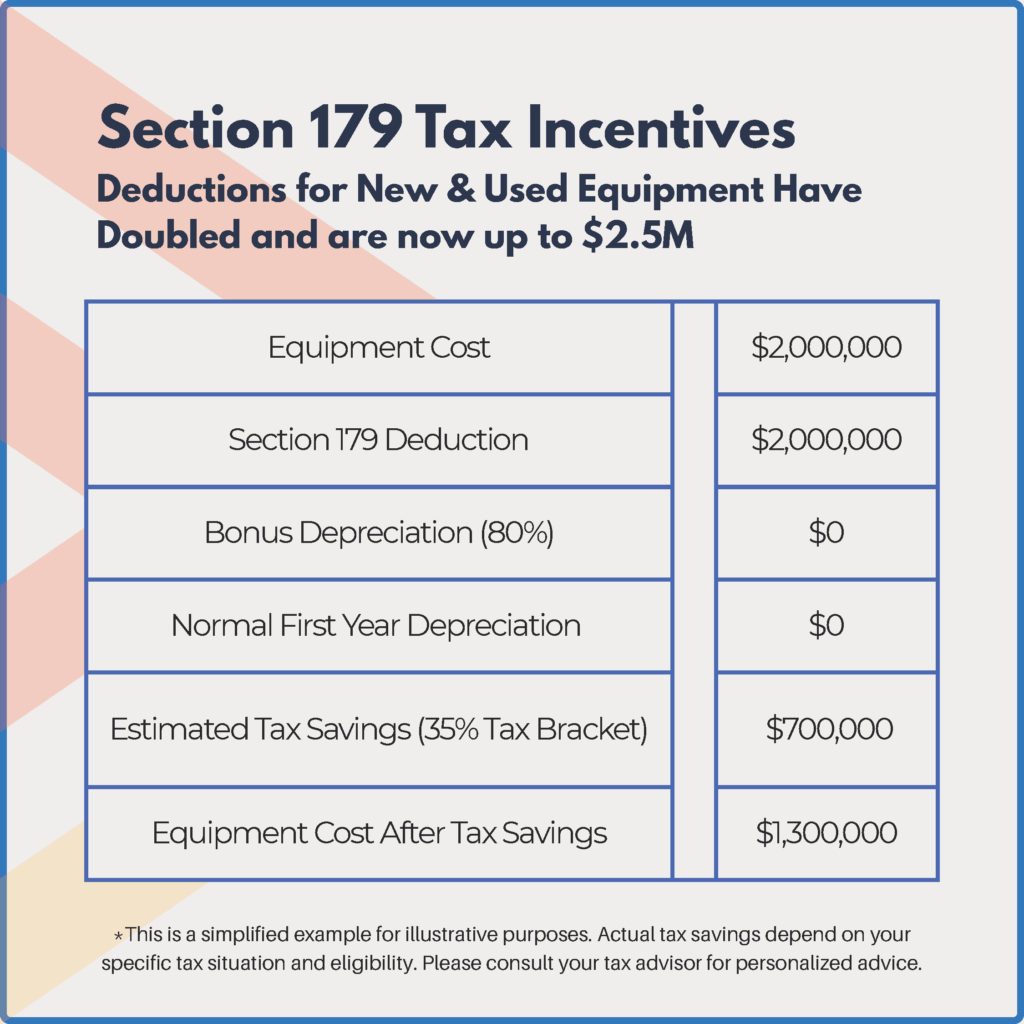
Example 1: Leasing $1.5 Million Worth of Forklifts
Imagine a customer who leases forklifts valued at $1.5 million. Under Section 179, they can deduct the entire amount in the same tax year, even though they are only making monthly lease payments. At a 35% tax rate, this could yield $525,000 in tax savings—funds that can be reinvested in their business.
Example 2: Leasing $2 Million Worth of Forklifts
Consider a larger operation that leases $2 million worth of forklifts. Using Section 179, they can also deduct the full amount in the acquisition year, leading to $700,000 in tax savings at a 35% tax rate. Leasing not only preserves their capital but also maximizes deductions, demonstrating a smart financial strategy.
How This Framework Helps Dealers Sell More Forklifts
The new tax incentives create a sense of urgency among customers to act before December 31, 2025, to claim their deductions. Leasing forklifts makes them more affordable and accessible, allowing dealers to close deals more effectively. By showcasing the immediate return on investment (ROI), dealerships can position themselves as trusted advisors.
Industry Insight: Expected Rise in Forklift Sales
Forecasts indicate that forklift sales are projected to grow by 8 to 12% in Q4 2025, driven by purchasing behavior influenced by the Section 179 tax deduction. Dealers who proactively educate their customers will have a competitive edge.
Equip your team to maximize these opportunities with:
Key Talking Point for Sales Teams:
“Did you know you can lease this forklift and still deduct the full cost this year? It’s a smart way to save cash and reduce your tax bill.”
Section 179 is more than just a tax break; it’s a powerful sales accelerator for dealerships. By taking the initiative to educate your team and customers about these updates, you can transform legislation into a significant competitive advantage. Now is the time to seize the opportunities presented by these changes and strategically position your dealership for success in 2025.
Don’t wait! Start educating your team today and seize the opportunity to enhance your sales strategy. Contact me to learn more about how you can leverage Section 179 to benefit your dealership.
Elise Hardy, ehardy@ffequipmentleasing.com, 410-428-1315
Hello, world

This bill could be one of the most significant sales catalysts for equipment dealers we’ve seen in years. With Section 179 expensing doubled to $2.5 million in 2025 and a $4 million phase-out, this legislation aims to stimulate equipment investment and, more importantly, help you increase your equipment sales.
For equipment dealers, this presents a golden opportunity to drive increased leasing volume and help customers unlock substantial tax savings.
This bill provides your sales team with something priceless: clarity and urgency. It empowers them to have smarter, more confident conversations with customers—and to close deals faster.
Section 179 allows businesses to deduct the full cost of qualifying equipment in the year it’s placed into service — and leasing still qualifies.
This is your moment to shift the conversation from buying to strategic leasing. Here’s how your team can respond to common objections:
The Big Beautiful Bill is more than just a tax incentive — it’s a strategic leasing opportunity. Equip your team, educate your customers, and most importantly, act now.
Don’t wait until Q4 — the earlier you engage, the more leases you’ll close before the December 31 deadline.
This is your moment to move more equipment and help your customers invest in their future in a smart way.Hello, world
https://vimeo.com/1076541437Hello, world
American Cranes & Transport, Finance Industry Focus: April 2025
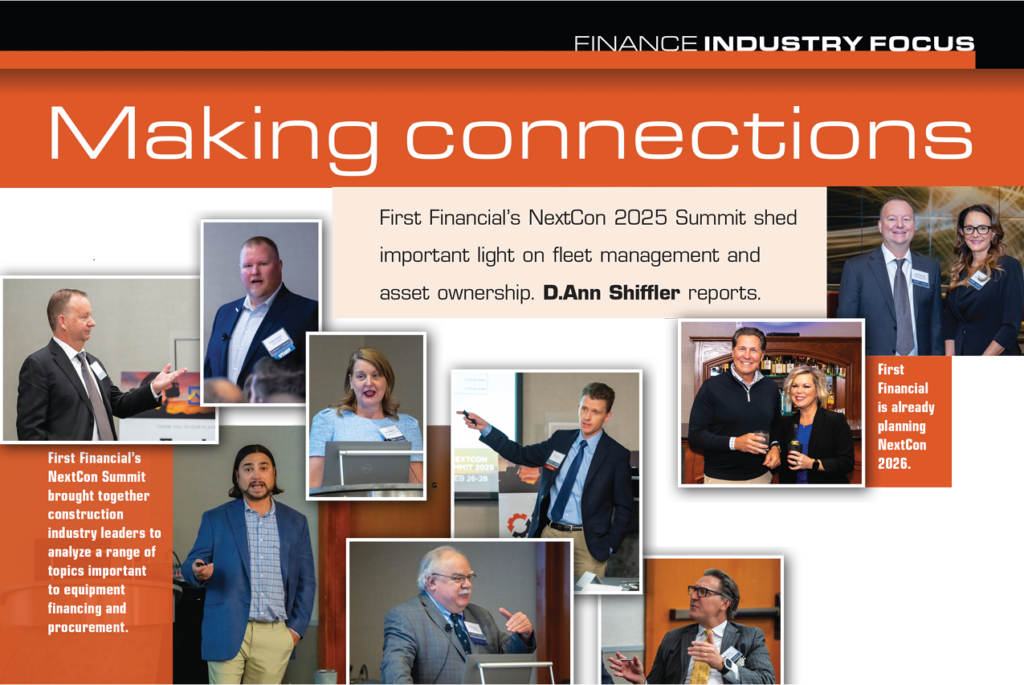
First Financial’s NextCon 2025 Summit shed important light on fleet management and asset ownership. D.Ann Shiffler reports.
The realm of equipment finance is complex, and is further complicated by economic conditions such as interest rates, proposed tariffs, rising insurance costs and even the stock market, to name a few.
To help equipment owners navigate these challenges, First Financial Equipment Leasing hosted its first annual NextCon Summit in Dallas in February. The intimate gathering brought together equipment owners and manufacturers, financial experts and even an economist to discuss topics related to finance and equipment procurement.
“Our goal at the NextCon event was to address the concerns of both longstanding and prospective customers regarding asset ownership,” said Jeffrey Whitcomb, senior vice president and construction sales director for First Financial Equipment Leasing. “Many prospective customers’ experience apprehension about equipment acquisition, especially when deciding between renting, leasing or purchasing. We aimed to ‘demystify’ this decision making process by providing insights into key factors such as economic conditions, advancements in engine technology and shifting dynamics at job sites.”
With the intricacies of today’s economic and political landscape, Whitcomb said NextCon was a forum for industry leaders to share knowledge and perspectives. The goal was to develop a collaborative roadmap for addressing fleet management and procurement strategies and how to navigate the challenges ahead.
NextCon started with an engaging address by Scott Hazelton, consulting director of global intelligence and analysis, S&P Global Market Intelligence. Hazelton, a well-known construction industry analyst and economist, developed and is responsible for S&P Global Market Intelligence’s Global Construction Outlook. He has developed specific forecasting models for construction equipment companies and associations.
He said the key themes for the North American construction outlook are political uncertainty, including implications related to tariffs, immigration and tax cuts; interest rate divergence; and nonresidential construction, including healthy but diminishing infrastructure outlook in the U.S., Canada and Mexico.
“The U.S. construction market is slowing,” Hazelton said. “Uncertainty is off the charts. The outlook for 2025 is difficult to assess because of all the unknowns.”
Speakers at the event included Lampson International’s Kate Lampson; Komatsu’s Joshua Sexton; Cummins’ Mark Jamieson; Equipment Share’s Willy Schlacks; Pulice Construction’s Luis Cisnal; and Equipment Watch’s Grant Nolen, Aaron Strauch and Sam Franzosa. Whitcomb and his First Financial colleague Derrick Bavol conducted panels and Q&A sessions with the speakers. Tom Slevin, CEO and founder of First Financial Equipment Leasing, provided further insight.
The NextCon Summit had many key take-aways, including the reality that the economy may slow and that higher costs are here to stay.
“Increasing costs directly impact leasing rates and client demand,” Whitcomb said. “By understanding these cost structures, we can work with our customers on pricing models that help us maintain competitiveness while ensuring profitability.”
Labor shortages, workforce age, job site technology and a push for sustainability and carbon neutrality were key topics.
“Predicting the economic outlook for the construction equipment industry in the coming year has its challenges, but it also provides a chance to develop effective strategies,” said Whitcomb. “Our recent get-together with global construction company leaders showed how strong our community is. There was a lot of excitement in the room as we talked about the possibilities ahead and how innovation and technology will help us move toward a brighter future.”
NextCon 2026 is already in the works, Whitcomb said.
Click to download PDFHello, world
The construction industry is poised for significant growth in the latter half of 2024, driven by increased construction spending and substantial investments in infrastructure projects. The recent passing of the Bipartisan Infrastructure Law and the Infrastructure Investment and Jobs Act is set to inject billions of dollars into the construction sector, opening up opportunities for contractors specializing in upgrading transportation networks, water and energy systems, and public buildings.
Companies must maintain financial flexibility to capitalize on these opportunities. However, challenges like fluctuating material costs and labor shortages continue to persist. To thrive in this environment, contractors must embrace technological advancements, implement sustainable construction practices, and invest in workforce development initiatives. With economic uncertainties looming, contractors must prioritize robust financial planning and effective risk management. Developing comprehensive project budgets and securing favorable financing terms will be essential in successfully navigating market fluctuations.
When considering acquiring new equipment for upcoming projects, businesses should explore alternative financing options such as leasing, as it conserves capital and offers the benefit of 100 percent financing with no down payment required. Adapting to change and proactively managing risks will be key to achieving success, and staying informed of data and trends will establish a solid foundation for sustainable growth.
Please visit CONEXPO’s website for more information about the challenges and opportunities facing the construction industry in the second half of 2024.Hello, world
Construction equipment can come with a hefty price tag, making it challenging to find the necessary assets without straining finances or disrupting cash flow. First Financial Equipment Leasing offers acquisition plans that allow businesses to preserve cash while obtaining the equipment required to meet evolving business demands.
Over the last two decades, we have developed long-lasting relationships with manufacturers, dealers, and vendors throughout the US, Canada, and Mexico. Our construction industry pros have a detailed knowledge of your industry and the challenges facing your business. Working side by side through the acquisition process, we create solutions that align with current needs and budgets while preparing for future upgrades and seasonal fluctuations.
A well-executed construction equipment acquisition plan from First Financial Equipment Leasing will increase profitability, accommodate growth and reduce the risks associated with maintaining outdated assets. Having the right equipment at the right price allows businesses to push forward onto more significant projects and build a solid foundation for future expansion.
Jeff Whitcomb, Senior Vice President
Construction Sales Director USA/Canada
346.275.2835
jwhitcomb@ffequipmentleasing.comHello, world