This bill could be one of the most significant sales catalysts for equipment dealers we’ve seen in years. With Section 179 expensing doubled to $2.5 million in 2025 and a $4 million phase-out, this legislation aims to stimulate equipment investment and, more importantly, help you increase your equipment sales.

For equipment dealers, this presents a golden opportunity to drive increased leasing volume and help customers unlock substantial tax savings.


Why This Matters for Dealers

This bill provides your sales team with something priceless: clarity and urgency. It empowers them to have smarter, more confident conversations with customers—and to close deals faster.

Section 179 allows businesses to deduct the full cost of qualifying equipment in the year it’s placed into service — and leasing still qualifies.


What Your Customers Need to Know:

  • Immediate tax savings: Businesses can deduct the full purchase price of qualifying equipment (new or used) in the year it’s placed into service.
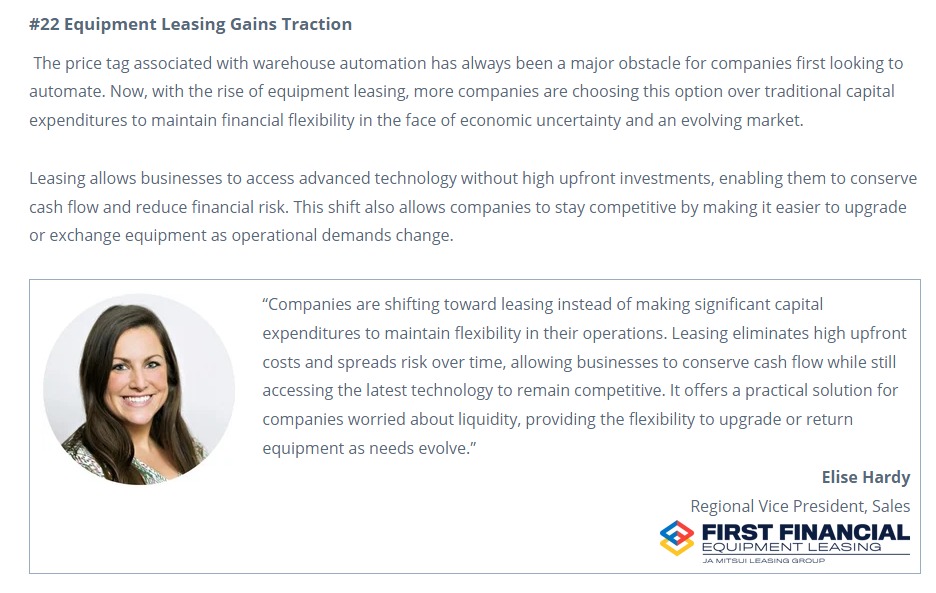
  • Preserve Capital: Leasing minimizes upfront costs and keeps cash available for growth.
  • Wrap It All In: Customers can include software, maintenance, and supplies in the lease.
  • Lower Total Cost of Ownership: Especially for lessees who return or extend their leases.


Equip Your Sales Team to Win

This is your moment to shift the conversation from buying to strategic leasing. Here’s how your team can respond to common objections:

  • We want to pay cash. Leasing allows you to preserve capital for larger opportunities — such as acquisitions or expansion — while still capturing the full tax benefit.
  • We’re not ready to lease yet. If you were planning to lease in 2026, now’s the time to move. These tax benefits won’t wait — and neither will your competitors.
  • I need to talk to my partner. Great — your CPA will love this. Leasing + Section 179 = smart tax strategy + financial flexibility.


Real-World Leasing Scenarios

  • A contractor leases $500K in equipment → Full deduction in 2025
  • A business wraps software and maintenance into a lease → Predictable costs, no surprises
  • A customer shifts a 2026 lease to 2025 → Gains immediate tax advantage and preserves cash


Ready to Capitalize?

The Big Beautiful Bill is more than just a tax incentive — it’s a strategic leasing opportunity. Equip your team, educate your customers, and most importantly, act now.
Don’t wait until Q4 — the earlier you engage, the more leases you’ll close before the December 31 deadline.

This is your moment to move more equipment and help your customers invest in their future in a smart way.Hello, world


Modern Materials Handling magazine: January 27, 2025

25 Warehouse Automation Trends for 2025: From Warehouse Experts

In 2025, warehouses and material handling operations will face new challenges and opportunities driven by rapidly evolving technology, changing consumer expectations, and unpredictable global events. As companies strive to optimize efficiency and resilience, staying ahead warehouse automation trends is more critical than ever. From integrating cutting-edge robotics and dynamic forecasting tools to tackling macro-level issues like climate change and cybersecurity, today’s supply chains are transforming at an unprecedented pace.

Prepare to explore the innovations and strategic shifts that will define material handling and warehousing over the coming year. The path forward is marked by challenges, but for companies ready to embrace these trends, the future promises growth, resilience, and efficiency.

Whether it’s harnessing digital twins for strategic planning, adapting to workforce shifts, or safeguarding assets with resilient cybersecurity, the warehouse automation insights in this blog post will provide a roadmap for success in a world where adaptability is key.

Below we dive into 25 emerging warehouse automation trends that will shape the warehousing landscape in 2025, highlighting how forward-thinking companies are responding to complex demands and securing their operations for the future. Each warehouse automation trend is grouped into one of six major trend categories and accompanied by insights from industry leaders, offering perspectives on how to navigate these changes with agility and purpose.


Click to read blog articleHello, world


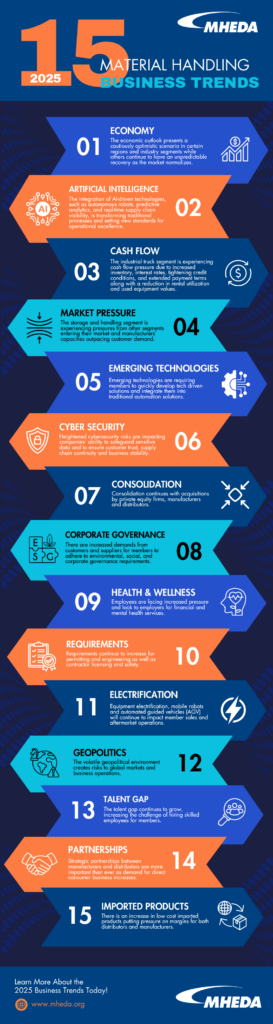
As we move into 2025, MHEDA’s Executive Committee has pinpointed 15 crucial business trends that will significantly impact the material handling industry. Several trends hold particular importance for our organization and our valued customers.

  • Cautiously optimistic economic outlook in specific regions and industry segments, with unpredictable recovery in other areas as the market normalizes.
  • Integrating AI-driven technologies, such as autonomous robots, predictive analytics, and real-time supply chain visibility, will transform traditional processes and set new standards for operational excellence.
  • Pressures from other market segments, with manufacturers’ capacities outpacing customer demand, are placing pressure on the storage and handling segment.
  • There is a need for quick development of tech-driven solutions to integrate emerging technologies into traditional automation solutions.
  • Continued impact on member sales and aftermarket operations from equipment electrification, mobile robots, and automated guided vehicles (AGV).
    Strategic partnerships between manufacturers and distributors are becoming increasingly important as demand for direct consumer business rises.
  • Growing pressure on margins for distributors and manufacturers due to increased low-cost imported products.

Hello, world


We’re thrilled to announce our partnership with America In Motion to offer their customers 100% financing for AGV Mobile Robots. We handle all upfront costs, allowing customers to preserve their working capital. We take care of all upfront deposits and expenses from the initial concept to processing, delivery, and installation.

This can result in significant day-one savings and an immediate return on investment. If you’re seeking to conserve cash and bring predictability to expenses while advancing your automation projects, First Financial Equipment Leasing is ready to assist you.Hello, world


According to a new report released at Modex by MHI and Deloitte, 55% of supply chain leaders are increasing their investments in supply chain technology and innovation. The 2024 MHI Annual Industry Report, “The Collaborative Supply Chain: Tech-forward and Human-Centric,” shows that 88% of those surveyed plan to spend over $1 million, with 42% planning to spend over $10 million. The report provides insights into the latest trends and technologies revolutionizing supply chains and the priorities of those who manage them.

The report also highlighted the significant level of AI adoption and interest in the industry. 84% of survey respondents are planning to adopt AI technologies within the next five years. Furthermore, 51% of the respondents believe AI technologies will create a competitive advantage or disrupt their industry within the next ten years. As a result, company leaders are looking to integrate AI with their business processes to gain a competitive edge.

Generative AI can help optimize key supply chain processes, such as logistics, shipping, transportation, supplier selection/due diligence, and inventory management. These areas have the most significant potential application for AI in supply chain management. However, the report also notes that supply chain management faces a challenging environment due to inflation and rising capital costs.

Inflation concerns tempered growth as workforce and customer demand remain top challenges. 53% of this year’s respondents identified rising prices due to inflation as a significant or extreme challenge to their supply chain operations. Inflation can increase the cost of raw materials, labor, and other operational expenses, squeezing profit margins. To offset these increased expenses, businesses must improve their efficiency and reduce costs elsewhere in their operations.

To solve these challenges, equipment leasing can effectively help companies modernize their supply chain and be in the best position to reap the benefits. Investing in AI technology can be wise for businesses that wish to secure their financial future in the current high inflation environment. Equipment leasing can help companies acquire the required equipment before prices rise again, providing stability to plan with certainty and allocate resources efficiently without worrying about rising costs.

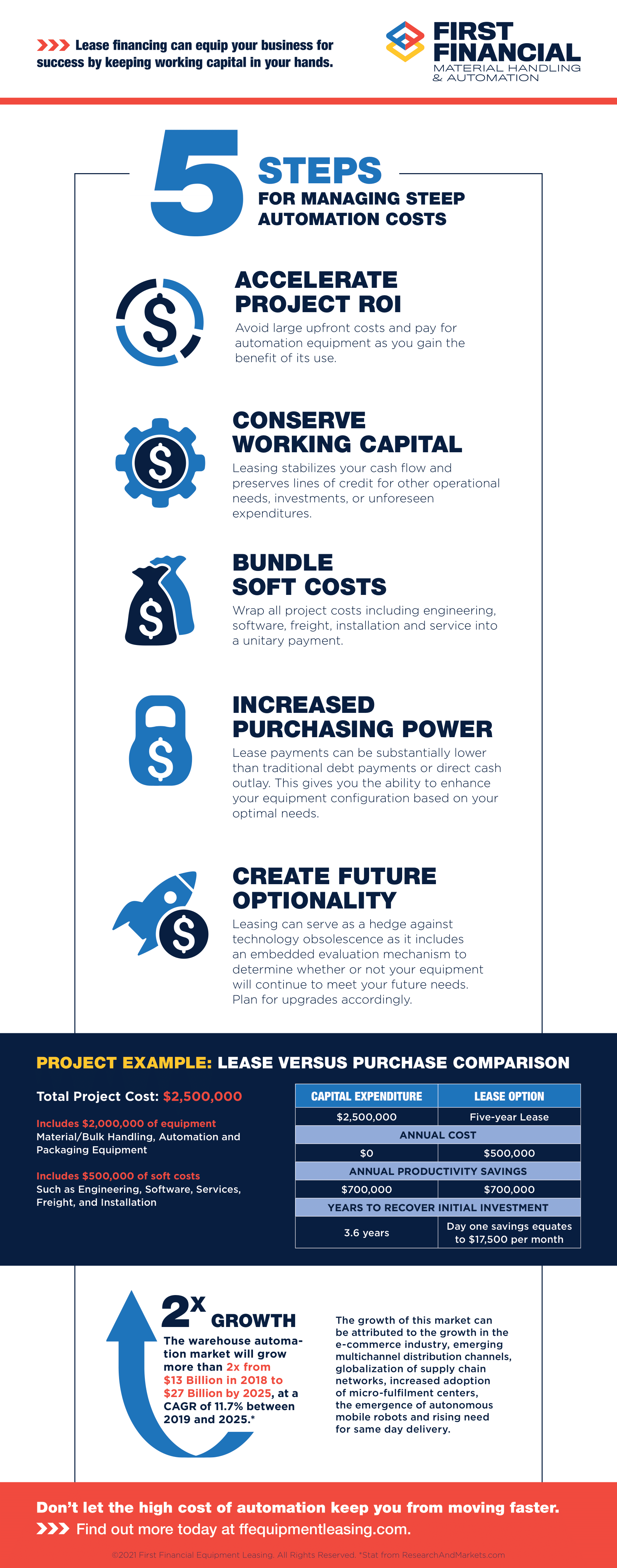
With leasing programs, businesses can enjoy lower upfront costs and improved cash flow, giving them the flexibility to access equipment and technology with no down payment required. This preserves capital, which can be allocated to other expenses or investments, creating more cash reserves during economic downturns. Leasing programs have the potential to significantly increase a business’s purchasing power, offering access to newer technology that might otherwise have been unaffordable. Additionally, payments are generally lower than traditional debt payments, enabling customization of the equipment configuration to match the business’s unique requirements.

At First Financial Equipment Leasing, we specialize in helping businesses make the transition to new technologies attainable and affordable. Our lease financing programs can equip any business for success by keeping working capital where needed most. Investing in AI can help your business stay ahead of the competition and succeed in today’s challenging environment. So, why wait? Contact us today to learn more about how we can help you achieve your goals.

 Hello, world


First Financial Provides Record Levels of New Automation Technology Financing

Today’s e-commerce driven economy is placing a massive burden on distribution centers and warehousing systems, which is being further strained by labor limitations. As online shopping continues to skyrocket, supply chains are suffering severe disruptions. Businesses are working desperately to keep pace with increasing customer demand, while maintaining a safe work environment for their employees.

By leveraging automation solutions, managers at distribution centers and warehouses can increase accuracy and productivity, operate more efficiently, expand faster and ultimately better serve their customers. Although these operational benefits and financial justifications are obvious, many businesses continue to delay essential projects and capital equipment expenditures.

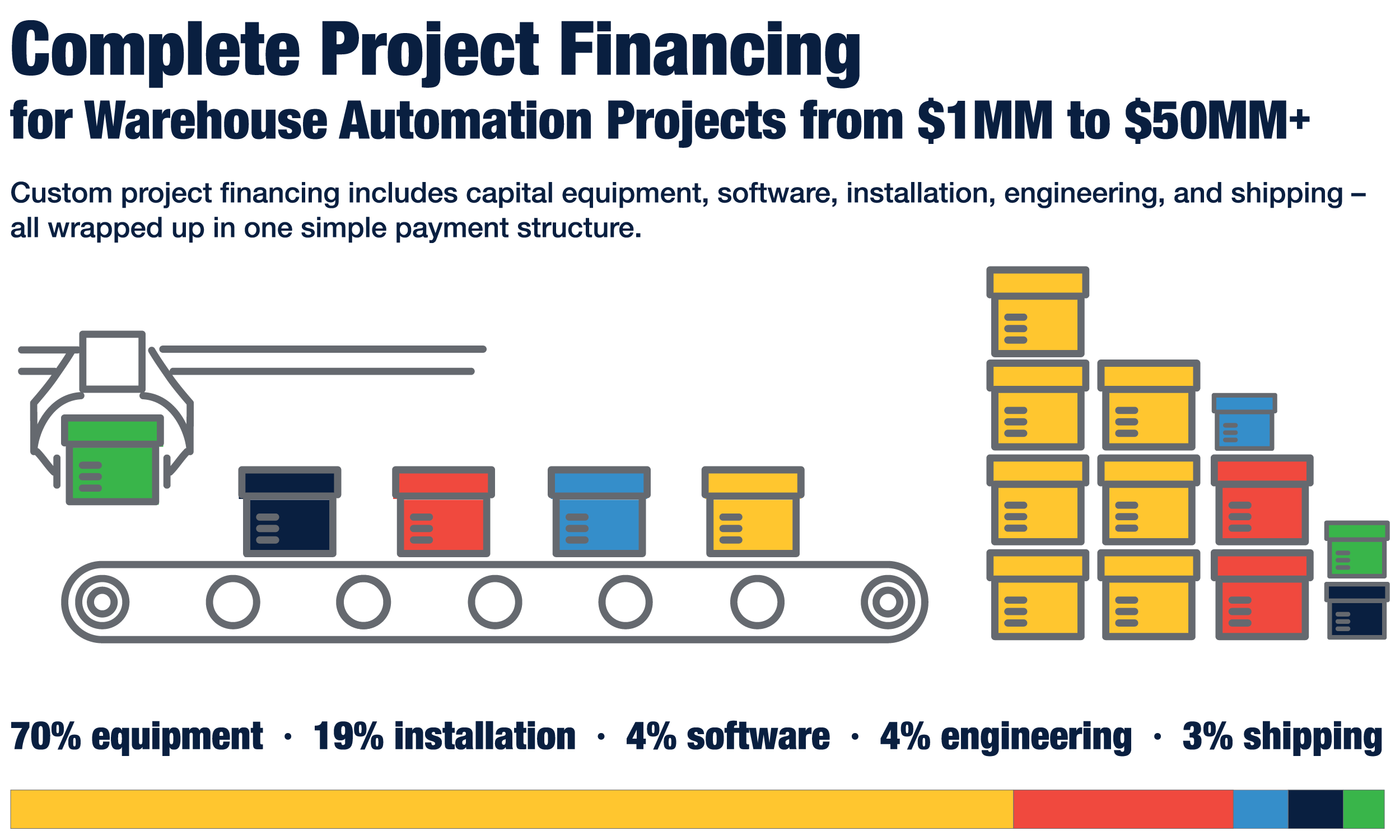
Cost is most often the biggest barrier keeping companies from modernizing warehouses with automation solutions and robotics. Automation integrations can require large upfront payments resulting in many years until positive ROI is achieved due to the hefty price tag – particularly when considering significant costs for installation, engineering, and software. Given today’s economic challenges, traditional lenders and banks have severely tightened their lending parameters, making it tricky to secure funding for extensive projects.

Maintaining Liquidity Through Leasing

Despite the challenges presented by the pandemic, we are seeing companies utilize lease financing to forge ahead with procurement of capital equipment and automation projects – just about everything inside the four walls of their distribution centers and warehouses.

Over the last year alone, First Financial’s investments in automation and material handling equipment have jumped over 30% from the prior year. By working with First Financial to lease their automation projects, many businesses often realize a “day one” savings as the operational benefits exceed the monthly cost of a lease. For unlike a cash purchase or bank loan, First Financial’s leasing solutions provide 100% financing – covering all project costs and eliminating the need for large upfront payments. First Financial makes all initial upfront progress payments, so the customer does not start paying for new automation and material handling solutions until after the project has been implemented and is fully operational.

Capitalizing on the Benefits of Automation Through Leasing

Most recently, First Financial assisted a leading consumer goods company with over $11B in sales avoid an outlay of $27MM for new AGVs and robotics. To keep up with growing consumer demand for their products, the company needed to modernize two distributions centers. Their current facilities operated manually and were highly labor intensive.

The objectives were to implement new equipment and technology tools that would improve operational efficiency, and significantly reduce labor costs. It also required a substantial financial investment, and leasing was a better source of capital than using internal funds.
First Financial stepped in and developed a financing solution that provided 100% financing. This helped the business avoid $27MM in upfront costs for the equipment, and save their working capital for more immediate, short-term needs. First Financial also coordinated with all vendors, manufacturers, and integrators involved in the massive project to make sure all were paid on time.

During the course of the integration – from conception, processing, delivery, to installation – First Financial made all upfront deposits, and covered all costs. This created an enormous day one savings for our customer and offered an immediate return on investment. If the customer had been required to make an up-front capital outlay, it could have taken them several years to realize any ROI.

By moving from labor intensive manual processes to fully automated facilities, the company increased the efficiency of their operations while simultaneously reducing costs. Through the use of AGVs and robotics, the company is expecting to decrease the cost of distribution by as much as 60%. Even more noteworthy, is the anticipated 90% reduction in their workforce the customer hopes to achieve by embracing the right technology solutions to automate their distribution centers.

Automating warehouse and distribution center processes can be transformative for any business, and First Financial’s project financing expertise can make automating attainable and affordable. While there are many factors to consider when making the move to automation, figuring out how to afford the project should not be one of them. Through our lease financing programs, we can equip any business for success by keeping working capital where it is needed most. If you are looking to conserve cash and bring predictability to expenses while moving forward with your automation projects, First Financial is here to help.Hello, world


Throughout most of 2020, the COVID-19 pandemic roiled financial markets, threatening businesses and impeding access to capital.  While many companies needed to invest in their infrastructure, most tended toward managing liquidity rather than buying equipment outright.  To complicate matters, capital markets tightened their lending standards.  Yet despite being a cash-sensitive year, 39% of manufacturing businesses increased their technology investments beyond their pre-COVID budgeted levels.

E-Commerce Accelerates Automation Projects

For many companies, automation was a strategic investment in direct response to the disruption caused by COVID. As online shopping skyrocketed, supply chains suffered severe disruptions and businesses sought desperately to keep pace with the widespread embracement of e-commerce while maintaining a safe work environment for their employees.  Reports indicate the boom in e-commerce sales for 2020 totaled $794.50 billion just in the US alone – up 32.4% year-over-year.

Global e-commerce sales are predicted to surpass $4.5 trillion in 2021, and we are witnessing explosive growth in the automation of fulfillment and distribution networks. Currently, only 14% of retailers are utilizing automation across their fulfillment locations, and 21% expect full automation in the next 12 months – representing a 50% growth over the prior year period.  By leveraging warehouse automation solutions, managers at distribution centers and warehouses can increase accuracy and productivity, operate more efficiently, grow faster and ultimately better serve their customers.

Maintaining Liquidity Through Leasing  

Although the operational benefits and financial justifications of automation are obvious, many businesses continue to delay essential projects and capital equipment expenditures.  Automation integrations can require large upfront payments that result in years of payback, and usually come with a hefty price tag – particularly when you consider soft costs for installation, engineering, and software.  Given today’s economic challenges, banks have severely tightened their lending parameters, and many have labeled the automation and material handling sectors a credit risk.

In contrast, First Financial has been financing new automation technology for mid-sized to Fortune 500 companies at record levels, allowing them to forge ahead with critical equipment acquisitions.  By partnering with First Financial to lease their automation projects, our customers often realize a “day one” savings as operational benefits exceed the monthly cost of a lease.  For unlike a cash purchase or bank loan, leasing provides 100% financing – covering all costs and eliminating the need for a large upfront payment.  We make any and all initial upfront progress payments, so our customers do not start paying for new automation solutions until after it has been fully implemented.

Over the last year alone, our investments in automation and material handling equipment are up over 30% from the prior year.  If you are looking to conserve cash and bring predictability to expenses while moving forward with your automation projects, First Financial is here to help.  For over 20 years we have partnered with companies across a wide range of industries to help them acquire material handling and automation equipment. Let us do the same for you.Hello, world


Hello, world


Hello, world

Hello, world