The Big Beautiful Bill Has Arrived

HERE’S HOW TO HELP YOUR SALES FORCE CAPITALIZE ON IT

––––––––––––––––

JEFF WHITCOMB
Senior Vice President Construction, First Financial Equipment Leasing

––––––––––––––––

Jeff Whitcomb has over 25 years of experience in equipment leasing and sales leadership. Throughout his career, he has demonstrated expertise as an entrepreneur, establishing new companies with strong cultures, as well as taking on challenges at large multinational organizations. His extensive industry knowledge and broad network have consistently yielded positive results. Jeff is particularly adept at mentoring others to help them expand their capabilities, whether they are clients or colleagues.

Before joining First Financial in 2021, Jeff held various sales and sales management positions at eMarket Capital, De Lage Landen Financial Services, People’s Capital and Leasing Corp., ampCNG, Sumitomo Mitsui Finance and Leasing, Mitsubishi UFJ Lease & Finance, and Pathward.

Jeff earned a B.S. degree in business administration from Bucknell University and an M.B.A. from the Thunderbird School of Global Management at the University of Arizona. He resides in Dallas, Texas.


Section 179 changes allow businesses to deduct up to $2.5 million from their tax bill this year; that is a win-win proposition for you and your customers.


The Big Beautiful Bill has been signed into law, and it’s the biggest incentive for equipment sales our industry has ever seen. With the passage of this new bill, equipment distributors now have one of the most essential elements for success: clarity.

Now is the time to arm your sales force with clear, practical information to ensure that they can fully communicate the tremendous opportunity customers have to invest in their future and take full advantage of these tax incentives.


Let’s peel back the layers to understand what’s in the Big Beautiful Bill that benefits your customers:

IT DOUBLES THE SECTION 179 EXPENSING ALLOWANCE TO $2.5 MILLION IN 2025, WITH A $4 MILLION PHASEOUT INDEXED TO INFLATION FOR FUTURE YEARS.

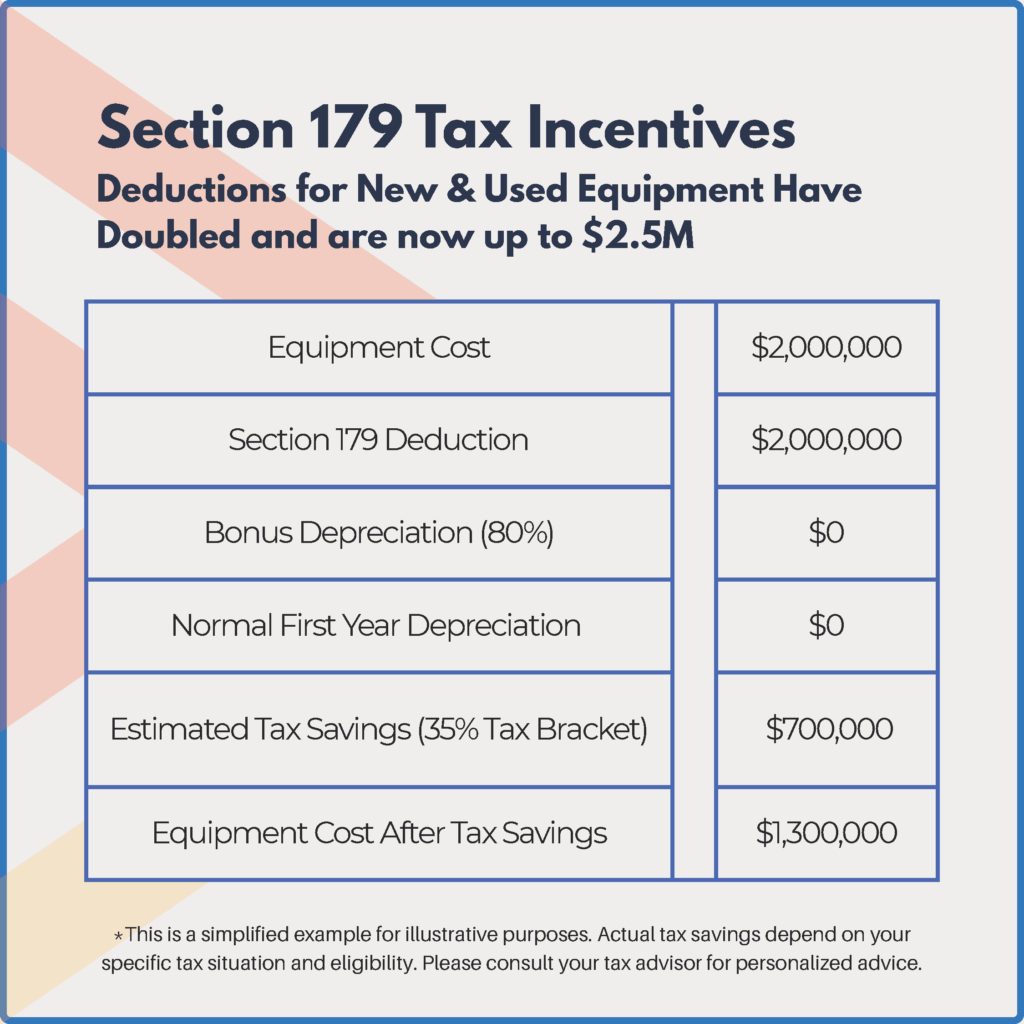
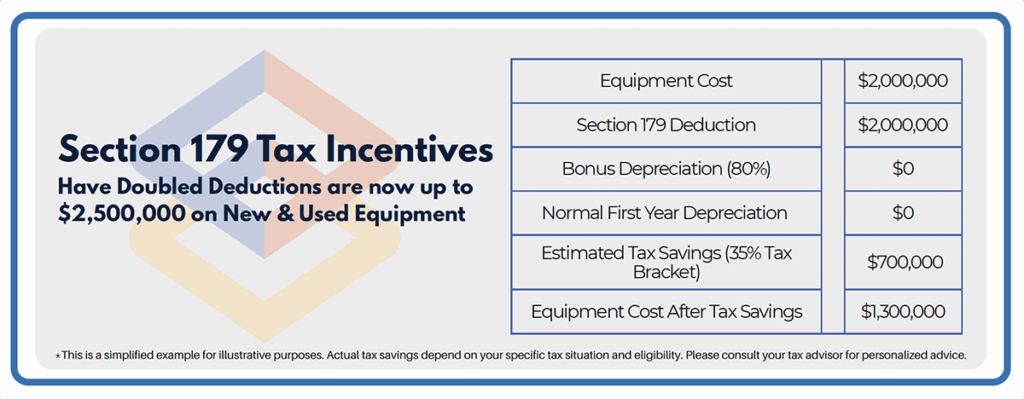
Section 179 of the Internal Revenue Code allows businesses to deduct the full purchase price of qualifying equipment or software in the year it is put into service. Therefore, rather than spreading out deductions over several years, businesses are permitted to claim the entire expense up front, which can significantly reduce their overall tax bill.

The $4 million phaseout threshold means the deduction is reduced dollar- for-dollar above and beyond this limit. It’s intended to benefit small to mid- sized businesses rather than larger companies with deeper pockets.

Both new and used equipment are eligible for the deduction, provided the equipment is new to the business.

It doesn’t matter if businesses borrow, lease or pay cash for the equipment as long as it is placed into service before the end of 2025. This rule applies to different types of equipment, including construction and heavy equipment, tractor-trailers, computers, office equipment and software.


IT PERMANENTLY REINSTATES THE 100% BONUS DEPRECIATION FOR NEW AND USED EQUIPMENT PURCHASES, RETROACTIVE TO JAN. 19, 2025.

Businesses can immediately deduct the entire cost of qualifying new and used equipment placed in service after Jan. 19 of this year. And this is now a lasting part of the tax code and won’t be subject to future reductions or expirations, thus providing businesses with ongoing tax benefits.


BUSINESS INTEREST DEDUCTION LIMIT TO 30% OF EARNINGS BEFORE INTEREST, TAXES, DEPRECIATION AND AMORTIZATION (EBITDA), RATHER THAN EARNINGS BEFORE INTEREST AND TAXES (EBIT).

This reverses a change made in 2022 and is advantageous for businesses that rely heavily on loans and have significant depreciation and amortization expenses. It allows them to deduct more interest, reducing their tax burden and encouraging investment.


HOW DOES THIS IMPACT LEASING?

One of the biggest questions I’m asked is, Can you still take bonus depreciation and/or Section 179 benefits (accelerated depreciation) when you choose a First Amendment Lease? The answer is YES.

And that’s an amazing thing, because leasing can help customers level up the economic value proposition. Leasing allows customers to take advantage of these significant tax incentives with the least amount of up-front capital expenditures (so less cash out of pocket). Leasing is still the lowest overall total cost of ownership for lessees who return or extend their leases.

Businesses can also wrap software, maintenance and supplies into their lease. This can help sidestep surprises, minimize downtime and transfer the burden of maintenance costs away from the company, while helping ensure that equipment stays in tip-top condition throughout the lease term.


DEVISING A WINNING SALES TALK TRACK

What does passage of the Big Beautiful Bill mean for your customers? One word: MORE. More lucrative tax benefits, more preservation of capital, and more opportunities for customers to further their business goals and drive growth.

And it’s ushering in much more opportunity for your sales force, as these new benefits give them more ammunition to counter the most common objections. In fact, it gives you a huge opportunity to wipe out a whole slew of these objections in one fell swoop.

It’s important to have a town hall / family meeting to walk through some practical information that your sales force can use when they get on a call with a contractor. This will help them know what to key in on, so they are equipped with a laser-focused talk track.


What should that talk track look like? We think something like this:

YOUR EQUIPMENT IS TOO EXPENSIVE.

Response: What we now have in place is like the ultimate rebate scheme. You can immediately recoup the full cost of the equipment you buy through tax deductions this year. Everyone’s going to want to get in on this.


WE AREN’T READY TO PURCHASE/LEASE RIGHT NOW.

Response: If you had planned to purchase or lease some equipment in 2026, there’s now a good reason to move your timeline
this new legislation and tax benefits.

Be decisive. Take advantage of this opportunity, because if you don’t, your competitors will, and then you may be at a disadvantage.


WE WANT TO PAY CASH.

Response: I understand you think paying cash makes sense, and maybe you’ve always done it that way, but we’re entering a new environment. There are going to be opportunities for you to buy other companies, maybe a competitor, or start a new line of business, and you’ll want to have the cash to make that investment, because you’ll earn way more from that investment. Keeping your options open – and your cash on hand – is the smarter business strategy.


I NEED TO TALK TO MY BUSINESS PARTNER.

Response: Good, because I guarantee you, your tax accountant is going to love this strategy! Your CPA can confirm that you need to acquire as much equipment as possible by the end of the year to equip your business for success and minimize your taxes.

The Big Beautiful Bill is about to benefit your business – and your customers – in a really big way, and the timing couldn’t be better, as budget cycle planning is about to go into full swing.


–––––––––––––

AED Magazine Article published August 2025Hello, world
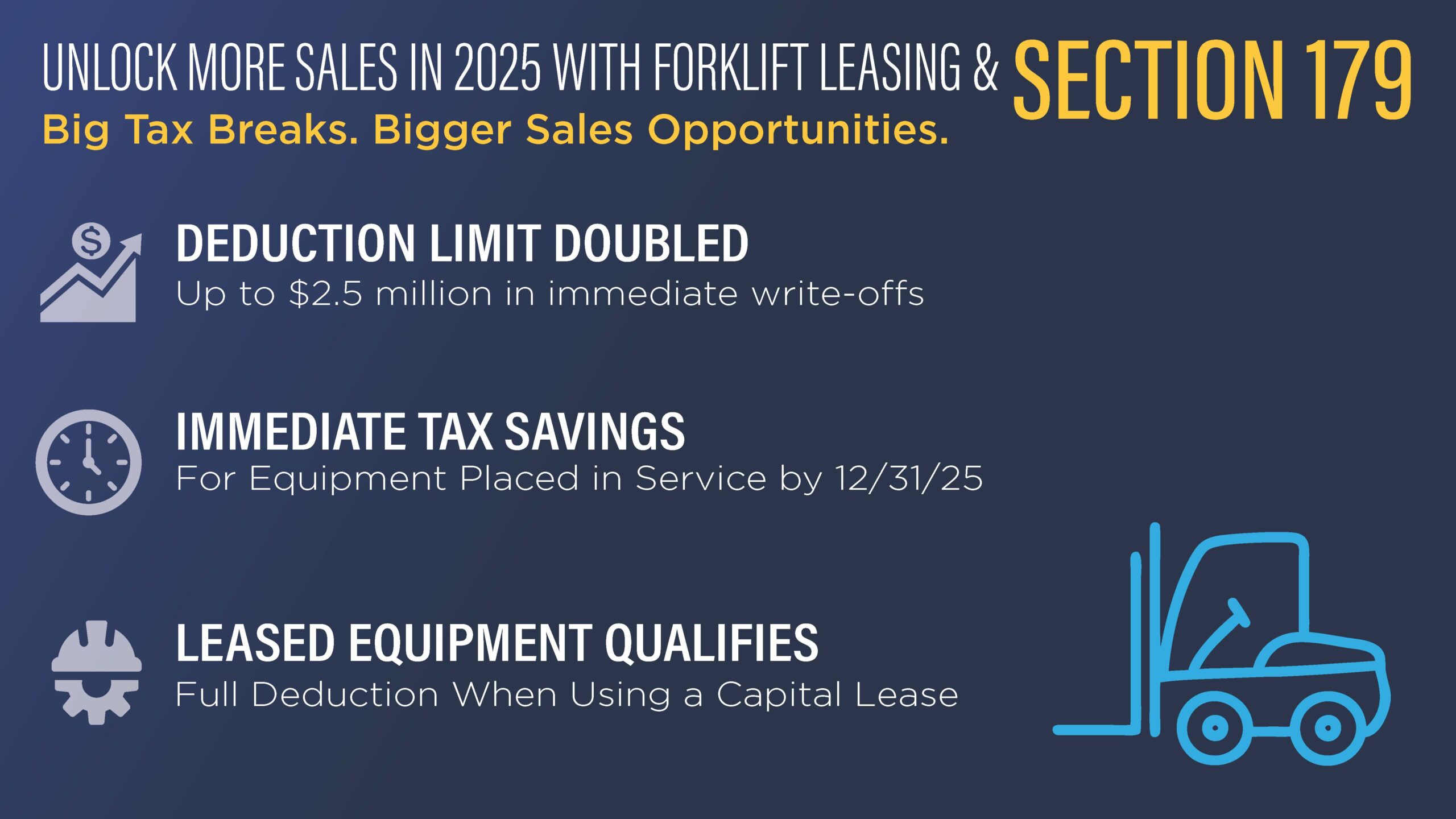

The equipment dealership landscape is poised for a monumental shift in 2025, particularly for forklift sellers, thanks to the One Big Beautiful Bill Act. With substantial updates to Section 179, dealers now have a powerful tool to enhance sales, educate customers, and ultimately increase profitability.


Understanding Section 179

At its core, Section 179 is a crucial part of the U.S. tax code that allows businesses to fully deduct the cost of qualifying equipment, such as forklifts, in the same year it is placed in service. This means buyers can write off the total purchase amount immediately, rather than spreading deductions over 5 to 7 years.


What’s New for 2025? Several key updates to Section 179 have been set to take effect:

  • Deduction Limit: The deduction limit has been doubled to an impressive $2.5 million.
  • Phase-Out Threshold: The phase-out threshold has been raised to $4 million, allowing more businesses to benefit from these tax advantages.
  • 100% Bonus Depreciation: The reinstatement of 100% bonus depreciation is another significant change.
  • Equipment Eligibility: These updates apply to both new and used equipment, including leased equipment.


Why Leasing Forklifts is Beneficial – Leasing forklifts provides maximum flexibility and tax efficiency—advantages that shouldn’t be ignored:

  1. Preserve Cash Flow: Leasing enables businesses to manage their cash flow with lower monthly payments.
  2. Full Section 179 Deduction: Businesses can qualify for the full Section 179 deduction, even if they choose to lease.
  3. Avoid Debt on Balance Sheet: Leases are often categorized as operating expenses, helping businesses avoid adding more debt to their balance sheets.
  4. More Interest Deductions: Leasing offers the potential for additional interest to be written off, improving overall financial efficiency.


High-Value Examples: Demonstrating the Benefits of Leasing

Example 1: Leasing $1.5 Million Worth of Forklifts

Imagine a customer who leases forklifts valued at $1.5 million. Under Section 179, they can deduct the entire amount in the same tax year, even though they are only making monthly lease payments. At a 35% tax rate, this could yield $525,000 in tax savings—funds that can be reinvested in their business.

Example 2: Leasing $2 Million Worth of Forklifts

Consider a larger operation that leases $2 million worth of forklifts. Using Section 179, they can also deduct the full amount in the acquisition year, leading to $700,000 in tax savings at a 35% tax rate. Leasing not only preserves their capital but also maximizes deductions, demonstrating a smart financial strategy.

How This Framework Helps Dealers Sell More Forklifts

The new tax incentives create a sense of urgency among customers to act before December 31, 2025, to claim their deductions. Leasing forklifts makes them more affordable and accessible, allowing dealers to close deals more effectively. By showcasing the immediate return on investment (ROI), dealerships can position themselves as trusted advisors.

Industry Insight: Expected Rise in Forklift Sales

Forecasts indicate that forklift sales are projected to grow by 8 to 12% in Q4 2025, driven by purchasing behavior influenced by the Section 179 tax deduction. Dealers who proactively educate their customers will have a competitive edge.


Educating Your Sales Force is Essential

Equip your team to maximize these opportunities with:

  • Training Sessions: Provide comprehensive training on Section 179 and the benefits of leasing.
  • Sales Scripts: Develop guides for effectively addressing customer objections.
  • Customer-Facing Resources: Create flyers and calculators to simplify decision-making for clients.
  • Role-Playing Scenarios: Build confidence among your team through interactive training.


Key Talking Point for Sales Teams:
“Did you know you can lease this forklift and still deduct the full cost this year? It’s a smart way to save cash and reduce your tax bill.”


Ready to Equip Your Dealership?

Section 179 is more than just a tax break; it’s a powerful sales accelerator for dealerships. By taking the initiative to educate your team and customers about these updates, you can transform legislation into a significant competitive advantage. Now is the time to seize the opportunities presented by these changes and strategically position your dealership for success in 2025.

Don’t wait! Start educating your team today and seize the opportunity to enhance your sales strategy. Contact me to learn more about how you can leverage Section 179 to benefit your dealership.

Elise Hardy, ehardy@ffequipmentleasing.com, 410-428-1315

 Hello, world


What if the key to modernizing hospital infrastructure wasn’t more funding—but smarter financing?

Hospitals across the country are facing mounting financial pressure as cuts to Medicaid and Medicare shrink reimbursement rates. These constraints are forcing difficult decisions: scaling back services, delaying equipment upgrades, and even reducing staff. Yet, amid these challenges, a powerful opportunity is emerging.

By strategically leveraging the expanded Section 179 tax deduction, hospital leaders can unlock new pathways to innovation—without compromising financial stability. This approach, especially when paired with equipment leasing, enables hospitals to upgrade critical technology, enhance patient outcomes, and remain competitive in a rapidly evolving healthcare landscape.


Industry Trends: The Rise of Equipment Leasing

  • The U.S. medical equipment rental market is projected to grow to $5.4 billion by 2028. An increasing demand for advanced technologies and cost-effective procurement options drives this growth.
  • As Medicare and Medicaid reimbursement criteria become more stringent, hospitals are increasingly turning to leasing as a strategy to manage capital constraints and adapt to rapid technological advancements.
  • The transition toward value-based care, alongside the needs of an aging population, is further accelerating the demand for leased diagnostic and therapeutic equipment.
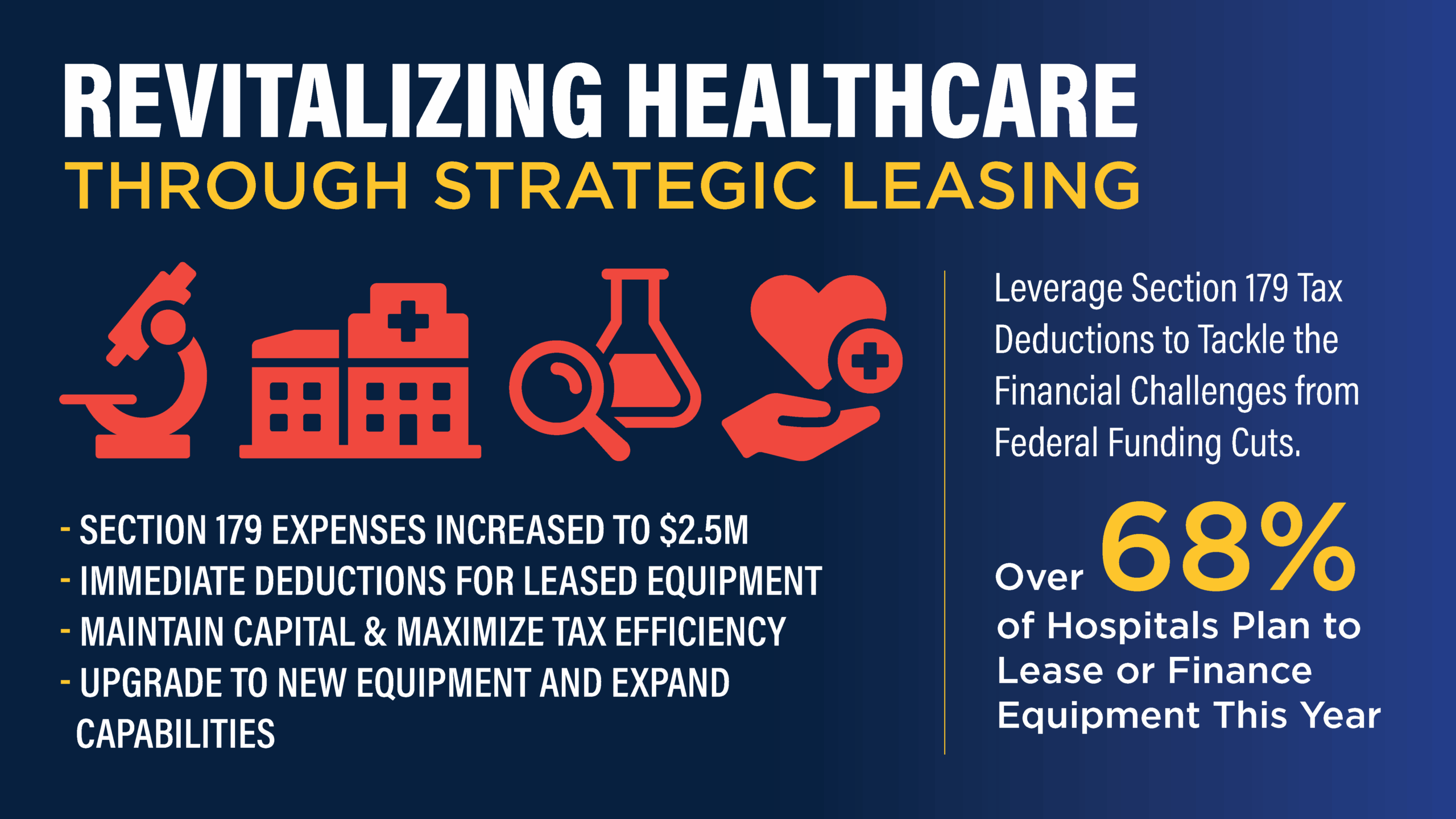
  • Data Markets Insight highlights a significant trend this year: approximately 68% of hospitals in the U.S. are opting to lease or finance medical equipment instead of making outright purchases. This approach enables these institutions to manage their budgets more effectively, stay current with the latest technology, and maintain operational flexibility.


Section 179: A Key Advantage for Equipment Leasing

  1. Immediate Deduction for Leased Equipment: The revised Section 179 guidelines enable hospitals to deduct the costs of qualifying leased equipment, such as advanced imaging systems and diagnostic platforms, within the same tax year that the equipment is placed in service. This provision allows healthcare facilities to access cutting-edge technology while maintaining liquidity and operational flexibility.
  2. Increased Deduction Limits for Larger Projects: The legislation has raised the deduction limit to $2.5 million, with a phased-out threshold starting at $4 million. This significant increase empowers hospitals to undertake expansive projects and lease a broad spectrum of equipment, from state-of-the-art surgical suites to essential IT infrastructure, all while maximizing expense deductions.
  3. Enhanced Interest Deductions: The bill reinstates an EBITDA-based limitation on interest deductions, allowing hospitals to deduct a considerable portion of interest associated with leased equipment. This beneficial change enhances after-tax cash flow, resulting in improved financial flexibility. With improved cash flow, hospitals can allocate more resources toward patient care and operational enhancements, making leasing an increasingly strategic option.


Case Study: Strategic Leasing in Action

A mid-sized regional hospital recently faced a familiar challenge: outdated imaging equipment was compromising diagnostic accuracy, but capital constraints—exacerbated by reduced Medicaid reimbursements—made outright purchases impossible.

Instead of postponing upgrades, the hospital’s leadership chose to lease new MRI and CT systems through a strategic financing arrangement. By utilizing the expanded Section 179 tax deduction, they were able to deduct the full cost of the leased equipment—nearly $1.8 million—in the same year it was placed into service.


Results:

  • Improved Patient Care: Diagnostic wait times dropped by 40%, and scan quality improved, leading to faster and more accurate treatment decisions.
  • Preserved Capital: The hospital maintained its cash reserves, allowing for investments in staff development and facility improvements.
  • Tax Efficiency: The Section 179 deduction significantly reduced taxable income, freeing up resources for future upgrades and operational needs.
  • This example demonstrates how strategic leasing and effective tax planning can enable hospitals to modernize care delivery, even amid financial uncertainty.


Implications for Hospital Leadership

  • Maintain Capital: Leasing offers a way for hospitals to bypass the significant upfront costs of acquiring advanced medical technology, conserving capital for other essential needs such as staffing and facility upgrades.
  • Accelerate Modernization: Leasing enables the swift replacement of outdated technology and allows hospitals to expand their medical capabilities, thereby ensuring improved patient care without the delays linked to capital fundraising or bond issuance.
  • Maximize Tax Efficiency: By leveraging the advantages of Section 179 and bonus depreciation, hospitals can substantially reduce their taxable income, resulting in significant savings that can be reinvested into their operations.
  • Enhance Adaptability: Leasing arrangements support regular updates to equipment in alignment with technological advancements, ensuring hospitals remain competitive and responsive to the evolving demands of healthcare.


By fully embracing the opportunities offered by Section 179, hospital leadership can address the financial challenges of modernization, improve patient care quality, and maintain long-term financial stability.

Is your hospital leveraging Section 179 to its full potential? Connect with one of our Healthcare Specialists and explore how strategic leasing can support your goals.

Channing Lyon (413) 841-2580, clyon@ffequipmentleasing.com
Anthony Marchioni (585) 317-8099, amarchioni@ffequipmentleasing.comHello, world


This bill could be one of the most significant sales catalysts for equipment dealers we’ve seen in years. With Section 179 expensing doubled to $2.5 million in 2025 and a $4 million phase-out, this legislation aims to stimulate equipment investment and, more importantly, help you increase your equipment sales.

For equipment dealers, this presents a golden opportunity to drive increased leasing volume and help customers unlock substantial tax savings.


Why This Matters for Dealers

This bill provides your sales team with something priceless: clarity and urgency. It empowers them to have smarter, more confident conversations with customers—and to close deals faster.

Section 179 allows businesses to deduct the full cost of qualifying equipment in the year it’s placed into service — and leasing still qualifies.


What Your Customers Need to Know:

  • Immediate tax savings: Businesses can deduct the full purchase price of qualifying equipment (new or used) in the year it’s placed into service.
  • Preserve Capital: Leasing minimizes upfront costs and keeps cash available for growth.
  • Wrap It All In: Customers can include software, maintenance, and supplies in the lease.
  • Lower Total Cost of Ownership: Especially for lessees who return or extend their leases.


Equip Your Sales Team to Win

This is your moment to shift the conversation from buying to strategic leasing. Here’s how your team can respond to common objections:

  • We want to pay cash. Leasing allows you to preserve capital for larger opportunities — such as acquisitions or expansion — while still capturing the full tax benefit.
  • We’re not ready to lease yet. If you were planning to lease in 2026, now’s the time to move. These tax benefits won’t wait — and neither will your competitors.
  • I need to talk to my partner. Great — your CPA will love this. Leasing + Section 179 = smart tax strategy + financial flexibility.


Real-World Leasing Scenarios

  • A contractor leases $500K in equipment → Full deduction in 2025
  • A business wraps software and maintenance into a lease → Predictable costs, no surprises
  • A customer shifts a 2026 lease to 2025 → Gains immediate tax advantage and preserves cash


Ready to Capitalize?

The Big Beautiful Bill is more than just a tax incentive — it’s a strategic leasing opportunity. Equip your team, educate your customers, and most importantly, act now.
Don’t wait until Q4 — the earlier you engage, the more leases you’ll close before the December 31 deadline.

This is your moment to move more equipment and help your customers invest in their future in a smart way.Hello, world


*** Click to download Monitor Vendor Finance Rankings & Roundtable 2025 article. ***


“The most rewarding aspect of my career so far has been the opportunity to lead and mentor my team. I strive to foster a culture of collaboration, continuous learning, and excellence.”

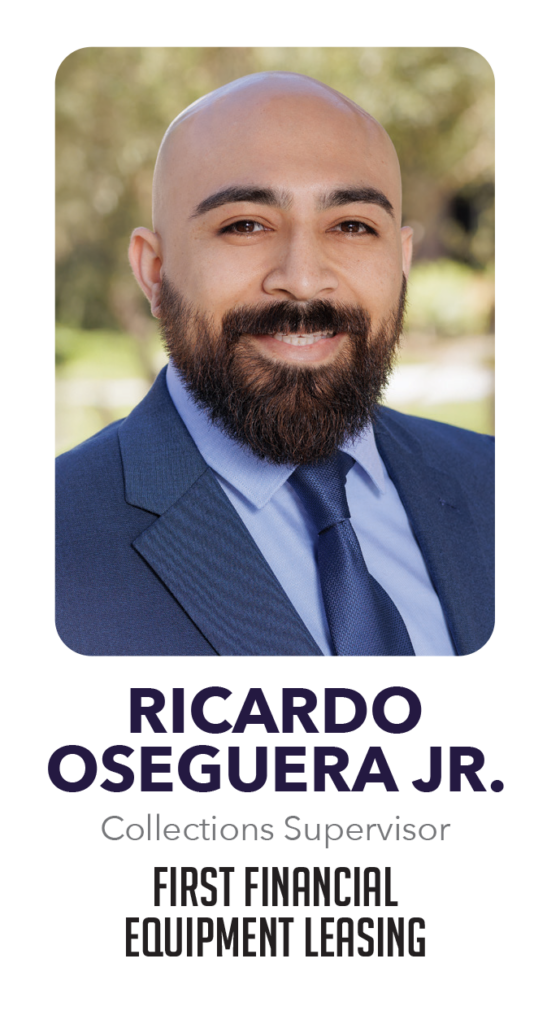
Ricardo Oseguera Jr., Collections Supervisor at First Financial Equipment Leasing, represents a new generation of leaders redefining excellence in the equipment finance sector. With over 14 years of experience, Oseguera has carved out a leadership role that fuses strategic thinking with a collaborative, hands-on management style.

At First Financial, Oseguera has been instrumental in transforming the collections function into a cornerstone of the company’s success. He spearheaded the development of strategic policies and performance benchmarks, leveraging analytical data to align collections efforts with executive objectives. His leadership has led to a 62% reduction in accounts receivable over two and a half years — a testament to his results-driven focus.

But his impact goes beyond numbers. Oseguera works closely with credit, portfolio management and legal teams, fostering a culture of cohesion and shared success. He empowers his team through mentorship, training, and daily engagement, creating an environment where continuous learning and collaboration thrive.

His approach is rooted in adaptability and vision. “I strive to foster a culture of collaboration, continuous learning, and excellence,” Oseguera says, reflecting his commitment to both team development and customer service.

As the industry faces economic uncertainty, Oseguera sees opportunity in education — helping businesses understand the value of leasing as a strategy for maintaining liquidity and agility. He also champions modernization, pointing to automation and AI as key drivers of efficiency and innovation in the coming years.

Oseguera’s ability to lead with both data and empathy, combined with his proactive mindset, positions him as a vital contributor to the future of equipment finance — one where smart strategy and empowered teams shape lasting success.

Hello, world


As we navigate the challenges posed by increasing tariffs and tightening credit conditions, First Financial Equipment Leasing stands firm in our commitment to accelerate growth and expertly guide our customers through these complexities.

The recent shifts in the U.S. economic landscape, marked by changing consumer and business sentiments and rising inflation expectations, indicate that higher rates will impact financing options. However, instead of retreating, businesses have the chance to strategically adapt. Postponing essential equipment purchases can hinder growth and disrupt operations, but we know there’s a better way forward.

While tariffs may elevate costs for parts and equipment, innovative financing solutions like leasing are game-changers, providing considerable advantages for borrowers. In a budget-conscious environment, leasing is not just a practical choice; it’s a strategic imperative. We understand that securing approval in today’s competitive credit climate can be daunting, and that’s where we come in—First Financial Equipment Leasing is dedicated to streamlining this process and making it accessible.

Our financing solutions empower businesses to acquire the equipment they need without the burden of upfront costs, enabling them to channel their resources toward growth and operational excellence. We are not just a lender; First Financial Equipment Leasing is your strategic partner in equipment leasing solutions that drive growth and profitability. With flexible financing options ranging from $100,000 to over $50 million in the U.S. and Canada, we equip our customers to tackle today’s challenges head-on.

In these dynamic times, adaptability is essential. Let’s collaborate to unlock opportunities for success and propel your business forward.Hello, world


https://vimeo.com/1076541437Hello, world


American Cranes & Transport, Finance Industry Focus: April 2025

Making Connections

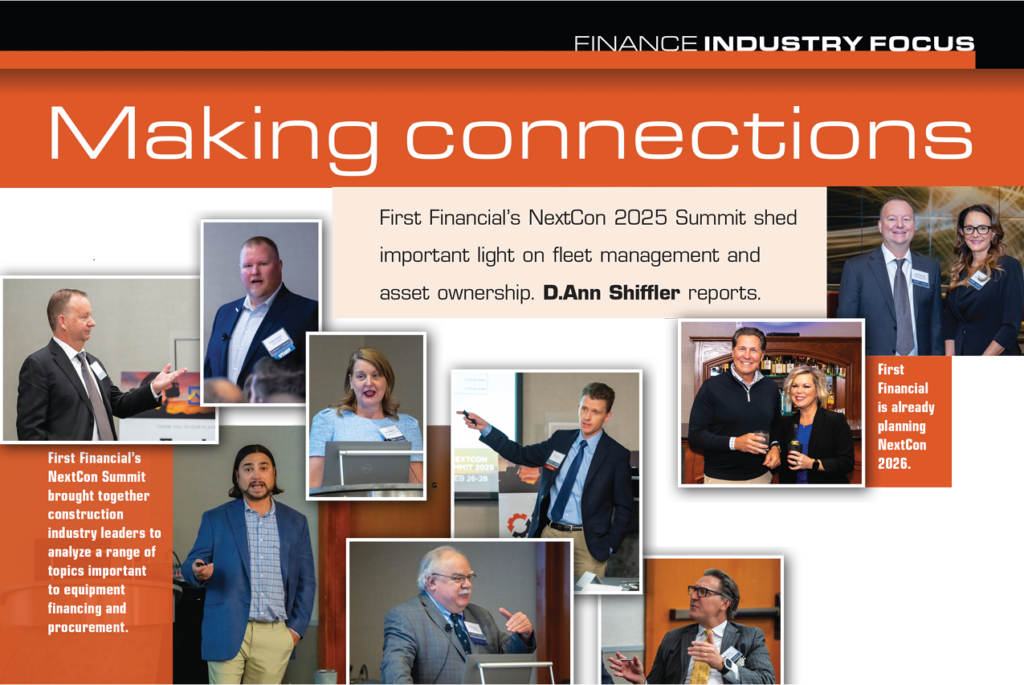
First Financial’s NextCon 2025 Summit shed important light on fleet management and asset ownership. D.Ann Shiffler reports.


The realm of equipment finance is complex, and is further complicated by economic conditions such as interest rates, proposed tariffs, rising insurance costs and even the stock market, to name a few.

To help equipment owners navigate these challenges, First Financial Equipment Leasing hosted its first annual NextCon Summit in Dallas in February. The intimate gathering brought together equipment owners and manufacturers, financial experts and even an economist to discuss topics related to finance and equipment procurement.

“Our goal at the NextCon event was to address the concerns of both longstanding and prospective customers regarding asset ownership,” said Jeffrey Whitcomb, senior vice president and construction sales director for First Financial Equipment Leasing. “Many prospective customers’ experience apprehension about equipment acquisition, especially when deciding between renting, leasing or purchasing. We aimed to ‘demystify’ this decision making process by providing insights into key factors such as economic conditions, advancements in engine technology and shifting dynamics at job sites.”

Industry Forum

With the intricacies of today’s economic and political landscape, Whitcomb said NextCon was a forum for industry leaders to share knowledge and perspectives. The goal was to develop a collaborative roadmap for addressing fleet management and procurement strategies and how to navigate the challenges ahead.

NextCon started with an engaging address by Scott Hazelton, consulting director of global intelligence and analysis, S&P Global Market Intelligence. Hazelton, a well-known construction industry analyst and economist, developed and is responsible for S&P Global Market Intelligence’s Global Construction Outlook. He has developed specific forecasting models for construction equipment companies and associations.

He said the key themes for the North American construction outlook are political uncertainty, including implications related to tariffs, immigration and tax cuts; interest rate divergence; and nonresidential construction, including healthy but diminishing infrastructure outlook in the U.S., Canada and Mexico.

“The U.S. construction market is slowing,” Hazelton said. “Uncertainty is off the charts. The outlook for 2025 is difficult to assess because of all the unknowns.”

Speakers at the event included Lampson International’s Kate Lampson; Komatsu’s Joshua Sexton; Cummins’ Mark Jamieson; Equipment Share’s Willy Schlacks; Pulice Construction’s Luis Cisnal; and Equipment Watch’s Grant Nolen, Aaron Strauch and Sam Franzosa. Whitcomb and his First Financial colleague Derrick Bavol conducted panels and Q&A sessions with the speakers. Tom Slevin, CEO and founder of First Financial Equipment Leasing, provided further insight.

The NextCon Summit had many key take-aways, including the reality that the economy may slow and that higher costs are here to stay.

“Increasing costs directly impact leasing rates and client demand,” Whitcomb said. “By understanding these cost structures, we can work with our customers on pricing models that help us maintain competitiveness while ensuring profitability.”

Labor shortages, workforce age, job site technology and a push for sustainability and carbon neutrality were key topics.

“Predicting the economic outlook for the construction equipment industry in the coming year has its challenges, but it also provides a chance to develop effective strategies,” said Whitcomb. “Our recent get-together with global construction company leaders showed how strong our community is. There was a lot of excitement in the room as we talked about the possibilities ahead and how innovation and technology will help us move toward a brighter future.”

NextCon 2026 is already in the works, Whitcomb said.


Click to download PDFHello, world


UNDERSTANDING EQUIPMENT LEASING: A Comprehensive Guide for Equipment Dealers
By Jeff Whitcomb

Published in AED Magazine:
March 2025


The Role of Equipment Leasing in Economic Resilience

Traditionally, businesses relied on cash, loans or revolving credit to finance equipment and technology purchases. However, with the shifting economic landscape, the demand for cash has significantly increased. Consequently, many organizations are now exploring alternatives to fund their equipment acquisitions, with 82% of U.S. companies indicating they lease some or all of their equipment.

In the fast-paced and capital-intensive contracting sector, equipment leasing has become an essential financial strategy for optimizing operations. For equipment dealers, leasing presents valuable opportunities to broaden their customer base, increase revenue and offer flexible solutions to clients navigating uncertain economic conditions.


Changing Perceptions of Financing Among Customers

Customers’ views on financing have evolved dramatically. It is no longer perceived as a fallback option during financial strains; instead, it is recognized as an effective cash management tool. Clients now evaluate various funding options – such as cash, loans and, increasingly, leases – to determine the best fit for their specific requirements.


Understanding Equipment Leasing

Equipment leasing is a financial arrangement through which a business (the lessee) rents equipment from a dealer or leasing company (the lessor) for a predetermined period. Instead of an outright purchase, the lessee makes regular payments to use the equipment, often with options to buy, upgrade or return it at the lease term’s conclusion. This model is especially prevalent in the equipment industry, where machinery can be costly and technological advancements are frequent. Leasing allows equipment dealers to offer an alternative to direct sales, enabling them to better serve a diverse clientele, including small and medium-sized businesses lacking the capital for outright purchases.


Types of Equipment Leasing

Several types of equipment leasing arrangements cater to different business needs:

1. Capital Lease (Finance Lease): This lease type functions similarly to a loan, with the lessee taking on ownership-like responsibilities, such as maintenance and insurance. At the end of the lease term, the lessee typically has the option to purchase the equipment at a reduced price; this makes capital leases ideal for businesses intending to use the equipment long term.

2. Operating Lease (FMV Lease): Operating leases are short-term rental agreements where the lessor retains ownership of the equipment. They are suitable for businesses requiring equipment for specific projects or those seeking to mitigate obsolescence risks. Operating leases are often more affordable and flexible, featuring lower monthly payments, and are commonly structured around 24- or 36-month terms that align with the equipment’s warranty period.

3. Lease-to-Own: This arrangement allows lessees to make payments with the intention of owning the equipment at the end of the lease. A portion of each payment goes toward the purchase price, making this option appealing for businesses aiming for eventual ownership.

4. Seasonal or Short-Term Leases: Tailored for businesses with fluctuating equipment needs, these leases offer flexibility for short-term projects or seasonal work. Equipment dealers can leverage these leasing options to attract clients requiring machinery for a limited duration.

In summary, equipment leasing serves as a strategic financial tool for construction equipment dealers, allowing them to adapt to changing customer demands and market conditions.


Understanding Equipment Leasing for Equipment Dealers

Equipment leasing is a valuable tool for equipment dealers to navigate the complexities faced by their sales teams. By offering leasing options, dealers can give potential customers the convenience of monthly payments rather than requiring the full up-front cost of equipment. This approach can help avoid excessive discounting, enabling dealers to competitively
position their offerings without sacrificing profit margins.

Leasing facilitates immediate sales and creates opportunities for recurring revenue as customer contracts near their expiration. This approach allows dealers to renew leases or upgrade equipment while incorporating related soft costs – such as training, freight, warranties and installation – into manageable monthly payments. By offering 100% financing, dealers can position themselves as comprehensive solution providers, appealing to a wider range of customers.

In today’s economic environment, access to alternative financing options is particularly important for equipment buyers, who may face budget constraints. Dealers that offer diverse financing solutions enhance their credibility as affordable providers, ultimately fostering long-term customer loyalty.

Here’s a closer look at how the leasing process typically works for equipment dealers:

1. Customer Inquiry: A potential customer approaches the dealer seeking equipment for a project. Instead of a direct purchase, the dealer introduces leasing as an alternative, highlighting its financial and operational advantages while focusing on monthly payments and cash flow benefits.

2. Lease Agreement: The dealer or a partnering leasing company drafts a lease agreement that outlines key terms, including lease duration, payment schedules and end-of-lease options (such as returning, upgrading or purchasing the equipment).

3. Equipment Payments: After the lease agreement is signed, the dealer delivers the equipment to the customer. The dealer may include preventive maintenance and support services as part of the lease package, with these additional costs often capitalized within the lease.

4. Regular Payments: The customer then makes regular payments to the dealer or the leasing company. These payments are frequently tax-deductible as a business expense, and there are options for monthly, quarterly, semiannual or annual payment structures.

5. End-of-Lease Options: At the lease’s conclusion, the customer can choose to return the equipment, extend the lease month-to-month, renew for a specified term (typically at a lower monthly rate), upgrade to newer models, or purchase the equipment at a predetermined price.


Advantages of Equipment Leasing for Equipment Dealers

Equipment leasing presents numerous benefits for construction equipment dealers, beyond establishing a strategic avenue for growth and enhancing customer satisfaction. Here are some key advantages:

1. Expanded Customer Base: By providing leasing options, dealers can attract customers who lack the capital for outright purchases, such as small businesses and budget-constrained contractors.

2. Competitive Advantage: Leasing offers flexibility, allowing dealers to meet varied customer needs. Dealers who include leasing options are often perceived as more customer-oriented and adaptable.

3. Reduced Risk of Obsolescence: Leasing allows for regular inventory updates with the latest equipment, enabling customers to lease modern models and decreasing the risk of outdated stock.

4. Reliable Source if Quality Used Equipment: Leasing creates a steady supply of quality used equipment, typically maintained to high standards. This equipment can be more profitable for resale, often yielding higher margins than new equipment sales without incurring wholesale floor plan costs.

5. Tax Benefits: Lease payments are often classified as operating expenses, thus tax-deductible for lessees. First amendment leases, in particular, allow customers to benefit from tax depreciation on a capital lease and operating lease categorization for GAAP reporting.

6. Customer Loyalty: Leasing fosters long-term client relationships, reinforcing dealer-customer bonds and encouraging repeat business.

Leasing equipment is an impactful strategy for dealers in the industry. This approach caters to the diverse needs of customers – who often seek financial flexibility and access to the latest machinery – and propels business growth by allowing dealers to expand their offerings without the burden of significant up-front costs. By providing clients with affordable, short-term access to high-quality equipment, dealers can build stronger relationships, enhance customer satisfaction and increase market competitiveness. Equipment leasing is a powerful strategy for equipment dealers. It effectively meets customer needs while driving significant business growth through unparalleled financial flexibility.


 Hello, world


https://vimeo.com/1037990083Hello, world