Mastering Innovation Through Surfing: Lessons for Business Transformation

In a podcast for TomorrowZone, Dave Anderson explains why the key to success — both in surfing and in business — is experimentation, patience, and embracing failure as part of the journey.

Take a listen! https://podcasts.apple.com/us/podcast/mastering-innovation-through-surfing-lessons-for-business/id1741229036?i=1000673123417


Hello, world


Life in the construction sector hasn’t been easy lately, given the challenging economy and uncertainties at every turn. Unfortunately, it looks like we’ll all need to continue to keep our seat belts tightly fastened for the foreseeable future. In a recent economic update, Ken Wattret, vice president of global economics at S&P Global Market Intelligence, says: “The path forward will likely remain bumpy, given numerous US-related uncertainties, including the risk of a hard landing, the timing and magnitude of policy rate cuts, and the outcome of elections in November and their policy implications.”

For those in the construction industry, the path to persevere and grow isn’t as clear-cut as in the past. Adaptability is crucial, and this adaptability should also apply to construction equipment financing.

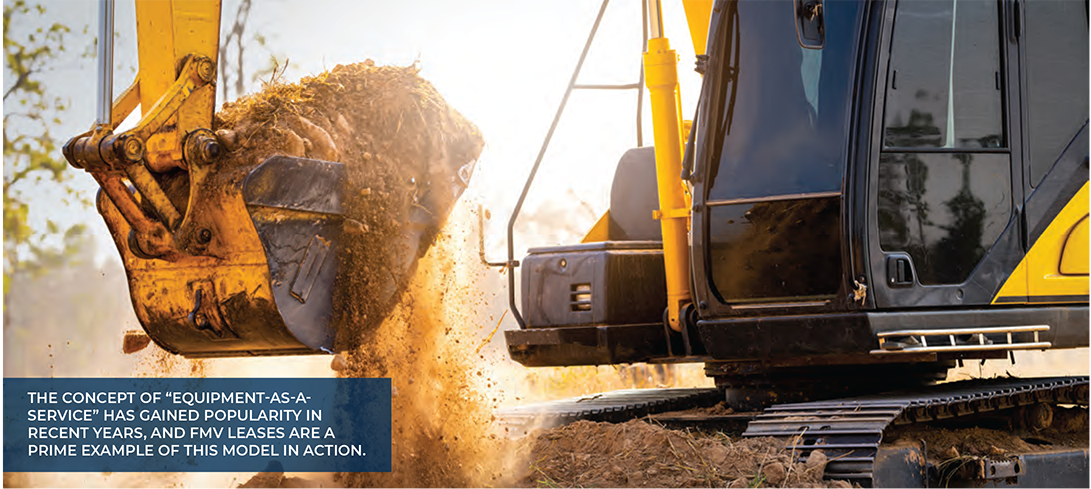
Full Market Value (FMV) leases, which can often be viewed as rigid or conventional, can be customized to meet unique business demands. This ushers in newfound flexibility to help companies adapt and adopt new approaches.

The industry is employing FMV leases in creative ways, empowering companies to navigate significant obstacles and capitalize on new opportunities.

Below are five use cases highlighting the flexibility and potential of FMV leases as creative financing strategies for the construction sector.


1 – CROSSING BORDERS TO SECURE THE RIGHT EQUIPMENT

One area where creative financing approaches can come to the rescue is in the instance of cross-border equipment financing. This may come into play when the equipment needed for your project doesn’t happen to exist in the country you currently operate within. Sometimes, a client may require a piece of equipment built overseas or that exists presently overseas.

Recently, a construction company based in Canada needed to purchase a machine from a dealer in the United Kingdom. The complexities of cross-border transactions can be challenging, especially when it comes to securing the necessary funds. Creative leasing approaches were of benefit here, not only to fund the down payment and ensure the transaction could move forward but also to fully fund the deal before the machine was even shipped to Canada. This approach minimized the financial risk for the company. It streamlined the entire transaction process, making it possible for them to acquire the equipment they needed without delay while enabling them to continuously focus on their day-to-day operations.


2 – MAKING FLEXIBLE PAYMENT STRUCTURES ALIGN WITH CASH FLOW

Cash flow management is critical for construction companies, especially when dealing with large equipment purchases. However, as anyone in the industry knows, cash flow can and often does fluctuate, particularly in the initial months of a contract.

Creative financing approaches can take a debt load off in these scenarios. Look for unique finance structures, such as deferred and skip payments, that align with your revenue streams. By deferring payments or allowing skips in the early months, companies can focus on completing their projects without the added pressure of immediate, substantial payments.

Alternatively, if your business performs seasonal work, such as fewer highway paving projects in the winter months or snow removal in the winter months with less usage in the summer months, payment months can align with months with the highest incoming receivables, making payments much more manageable.


3 – FINANCING SPARE PARTS TO PREVENT DOWNTIME

Unplanned machine downtime can be incredibly costly, so it’s crucial to have spare parts on hand, particularly because replacement parts can be in short supply. Over the past few years, the industry has experienced lengthy lead times for replacement parts.

To help maintain operational efficiency, creative financing approaches can offer needed resources specifically for spare parts purchased along with the machine orders. This proactive approach allows companies to stock essential components to keep their operations running smoothly, by avoiding crucial part shortages and lengthy downtimes.


4 – INTERIM FINANCING FOR FACTORY-ORDERED MACHINES

Long lead times are often required for factory-ordered machines, and manufacturers typically demand a down payment before commencing the build process. For many companies, this presents a significant cash flow challenge, particularly when a machine can take upwards of nine months or longer to build. Creative financing strategies can address this issue by financing the interim payments. This allows organizations to avoid substantial out-of-pocket expenses before the machine is built and operational, providing the financial flexibility needed to begin paying for the equipment once it is put into operation. In this way, companies can achieve a positive return on their equipment investments immediately.


5 – FIRST AMENDMENT LEASES: FLEXIBILITY FOR THE LONG TERM

Creative financing can offer the best of both worlds — a structure that begins with an operating lease, complete with a residual, but with the ability to extend and transition into a full payout term. This innovative approach gives organizations the flexibility to adjust their financing as their needs evolve, giving them more flexibility regarding their assets. Initially, a company can benefit from the lower payments and flexibility of an operating lease. Later, if desired, a company can amend the lease to fully amortize the equipment, retaining it for the long term, giving them more flexibility regarding their assets.


FAIR MARKET VALUE LEASES: THE CREATIVE FINANCING OPTION THAT GIVES YOU OPTIONS

FMV leases can be more than just a standard financing option, they can be incredibly flexible and adaptable; lease terms can be adjusted to address specific needs and an organization’s financial scenario, which is especially crucial when the business outlook and/or cash flow may be unpredictable.

As the use cases above illustrate, they can be a powerful tool to help your business grow, adapt, and thrive. Whether you’re dealing with cross-border transactions, managing cash flow, or planning for future equipment needs, creative financing approaches can help you access needed resources.

As César Pelli, the famous Argentine-American architect who designed some of the world’s tallest buildings and other major urban landmarks, noted, “Construction is a matter of optimism; it’s a matter of facing the future with confidence.” Creative financing gives the construction sector greater capacity and confidence to navigate today’s business and economic challenges.


Hello, world


Hello, world


Construction companies often need to make decisions about how to finance their heavy equipment. There are two main options: operating leases, also known as Fair Market Value (FMV) leases, and capital leases, also known as finance leases.

Although both leasing options have their advantages, there’s a common misconception that capital leases offer greater flexibility. However, a closer look shows that FMV leases may actually be a better choice to provide the quintessential operational versatility that construction companies need.

Let’s take a closer look at each leasing type to debunk the myth of capital lease flexibility and highlight how and why FMV leases can provide optimal flexibility, making this lease type a far superior choice.


UNDERSTANDING CAPITAL LEASES

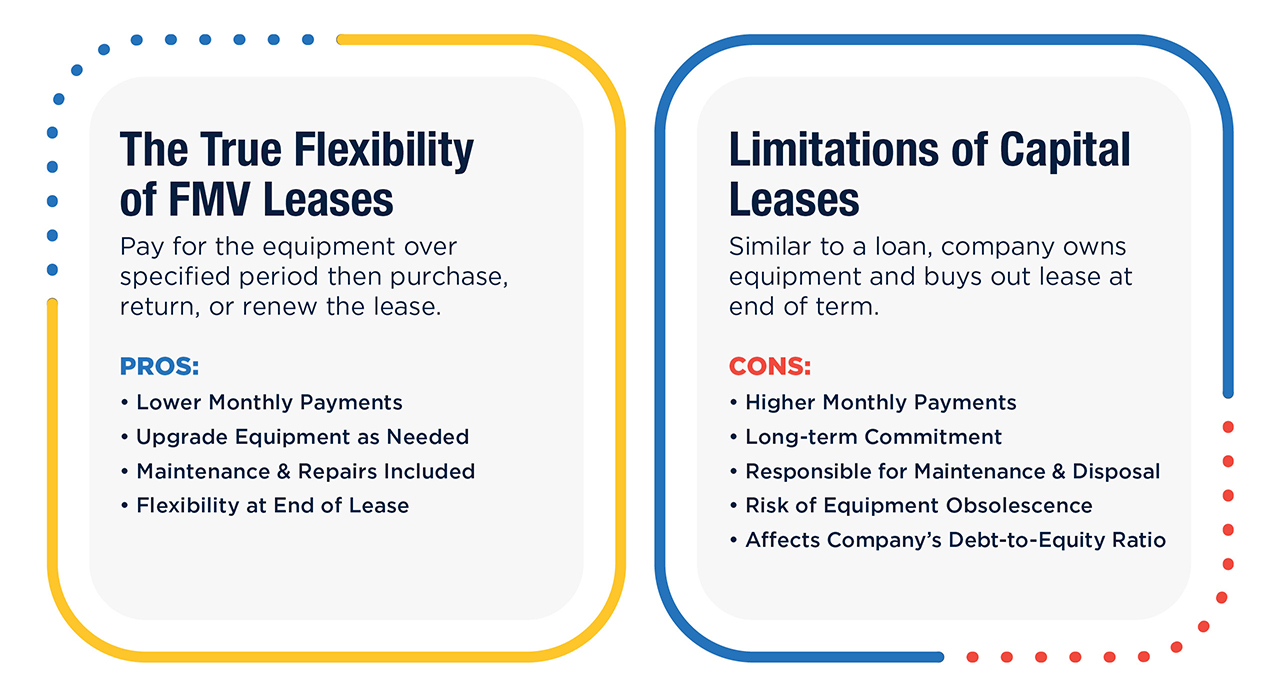
Capital leases essentially give the lessee (borrower) ownership of the equipment. The lease term typically covers most of the equipment’s useful life. At the end of the lease term, the lessee has the option to purchase the equipment for a nominal fee, usually $10 or $1. This type of lease is recorded as an asset and a liability on the company’s balance sheet, reflecting the equipment’s value and the obligation to make future lease payments.

Advantages of Capital Leases

  1. Ownership benefits The lessee eventually owns the equipment, which can be advantageous if the machinery has a long operational life and is essential to the company’s core activities.
  2. Depreciation Although I’m not an accountant, nor do I play one on TV, the company can benefit from tax advantages related to the equipment’s depreciation.
  3. No usage restriction There is no limitation on how many hours a construction company can operate the machinery throughout the lease term. Since the equipment cannot be returned, there are also no concerns about its condition at the end of the lease term. This is beneficial if the equipment is heavily used and may not be in a suitable condition for return. At first blush, capital leases may seem to offer quite a bit in the way of flexibility, but there’s more to this story. Despite these advantages, capital leases may not be as flexible as they appear.


The Illusion of Flexibility in Capital Leases

The perception of flexibility with capital leases often comes from the aspect of ownership. However, this ownership can limit flexibility in several ways:

  1. Long-term commitment Capital leases require a longterm commitment to the equipment. This can be a significant drawback if a company’s needs change or technological advancements render the leased equipment obsolete. In an industry where machinery and technology evolve rapidly, being tied to older equipment can be a disadvantage.
  2. Balance sheet impact Since capital leases are recorded as assets and liabilities, they increase a company’s debt-to-equity ratio — a key financial statement metric. This can affect the company’s financial health, potentially making it more challenging to secure additional financing or impacting borrowing costs, which can restrain growth.
  3. Maintenance and disposal Ownership means the lessee is responsible for all maintenance and disposal costs. These costs can be substantial for heavily used construction equipment. Additionally, the company must manage the logistics of selling or disposing of the equipment at the end of its useful life, adding another layer of complexity. This often means the company must employ its own team of technicians.


THE TRUE FLEXIBILITY OF FMV LEASES

Alternatively, FMV leases offer a different kind of flexibility that can be aligned with the dynamic needs of construction companies. Under an FMV lease, the lessee pays for the use of the equipment for a specified period, with the option to purchase the equipment at its fair market value at the end of the lease term. Alternatively, the lessee can choose to return the equipment or renew the lease, and in some cases, this can be on a month-to month basis.

Advantages of FMV Leases

  1. Lower monthly payments FMV leases typically have lower monthly payments compared to capital leases. This is because the lessee is not paying for the full cost of the equipment, just for its use during the lease term. Lower payments improve cash flow, allowing the company to allocate financial resources to other critical areas.
  2. Upgrade options At the end of the lease term, companies can return the equipment and lease newer models. This is particularly beneficial in the construction industry, where technology and equipment quickly become outdated. The ability to upgrade ensures the company always has access to the latest and most efficient machinery.
  3. Maintenance and repairs Many FMV leases include maintenance and repair services. This reduces downtime and transfers the burden of maintenance costs away from the company while helping ensure the equipment remains in optimal condition throughout the lease term.
  4. Flexibility at lease end FMV leases provide multiple options at the end of the lease term: The lessee can return the equipment, purchase it at fair market value, or extend the lease. This flexibility allows construction companies to adjust their equipment needs based on business conditions and project requirements.


DEBUNKING THE MYTH

Many people mistakenly believe that capital leases offer more flexibility due to the traditional association of ownership with control. However, in the fast-paced construction industry, where adaptability and financial agility are crucial, Fair Market Value (FMV) leases often provide superior flexibility. They enable companies to keep up with technological advancements, manage cash flow more effectively, and avoid the pitfalls associated with long-term ownership commitments.

While capital leases have their own benefits, they do not necessarily provide greater flexibility. For numerous construction companies, FMV leases present a more versatile and financially prudent option. Understanding the true nature of these leasing agreements can help companies make more informed decisions aligned with their operational needs and strategic goals. The real flexibility lies in the ability to adapt to changing circumstances — something that FMV leases facilitate far better than capital leases.

Hello, world


Orange County Business Journal: Women In Finance 2024
July 22, 2024

Uyen Tran, the vice president, GL Accounting Manager at First Financial Equipment Leasing, has made an exceptional impact on the company’s accounting department over the past year through her remarkable leadership skills. Under her strategic guidance, the team has achieved unprecedented success, transforming a department with high turnover into one that is highly efficient, effective, and exceptionally skilled.

When she assumed the role of controller in May 2023, following the departure of the previous controller, she was able to produce financial statements in only 40% of the time it originally took. Tran’s dedication to fostering a cohesive and professional team has resulted in significant enhancements to our financial processes, leading to a remarkable increase in efficiency and accuracy. Her leadership has not only raised the bar for our entire company but also inspired her team to strive for excellence consistently in all our endeavors.

Tran’s significant improvements to our month-end closing process, a 60% increase in efficiency, have profoundly impacted our company’s success. Additionally, she developed a robust Balance Sheet reconciliation process that added 44 more General Ledger accounts for our team to reconcile, an increase of 51% from the number of accounts that were reconciled in the previous fiscal year.  By streamlining the production of financial statements and introducing new reconciliation and documentation processes, she has further enhanced efficiency and internal control. Tran’s exceptional value to our company is immeasurable, and her contributions have been pivotal in driving our success.


Uyen Tran
Vice President, 
GL Accounting Manager
714-646-1608
utran@ffequipmentleasing.comHello, world


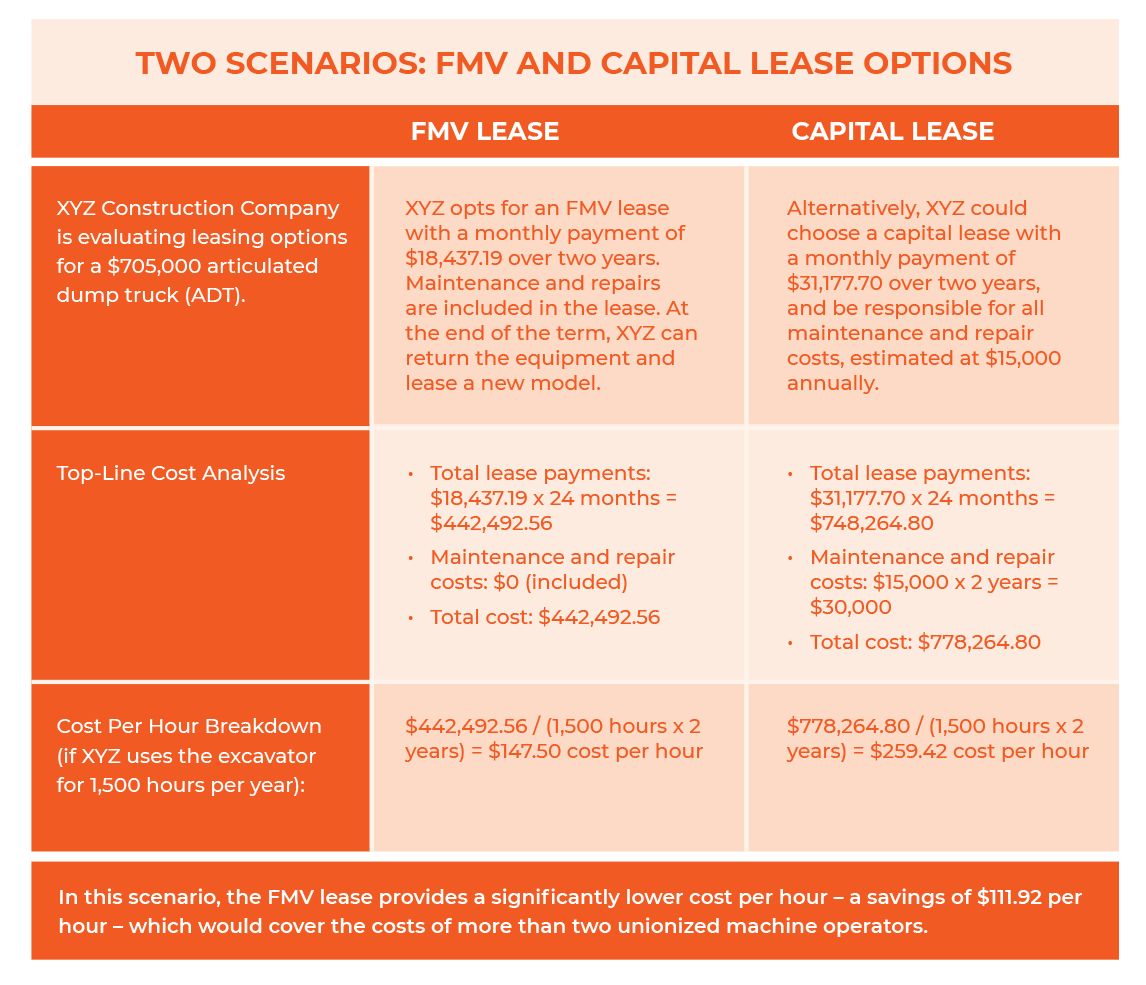
Leasing provides an affordable way to update and upgrade business equipment, preserving cash for other needs. The choice between Fair Market Value (FMV) and capital leases can significantly impact operational efficiency and financial health. To make the best choice, it’s crucial to understand leasing option advantages, particularly in terms of cost per hour.


THE DIFFERENCE BETWEEN FMV LEASES AND CAPITAL LEASES

FMV leases are operating leases and the prevalent choice in the market today. With FMV leases, the lessee can use the equipment for a specific period, paying relatively lower monthly installments. At the end of the lease term, the lessee has the flexibility to return the equipment, purchase it at its fair market value, or extend the lease. This empowers businesses to align equipment usage with evolving needs, making FMV leases a practical and versatile option.

Capital leases, also known as finance leases, are more akin to a loan. The lessee essentially finances the equipment purchase, typically with higher monthly payments, and owns the equipment at the end of the lease term. With this type of lease, there are higher monthly payments when compared to an FMV lease, but at the end of the lease term, the lessee purchases the equipment for $1. This is like an equipment loan and is ideal if you plan to keep the equipment for a long time, or when equipment obsolescence isn’t a concern.


COST PER HOUR ANALYSIS

Cost per hour is a crucial metric that measures the total cost of owning and operating equipment; it’s calculated by dividing the total payments for the initial lease term by the number of hours the equipment is used.

FMV leases can provide several cost per hour advantages:

Lower monthly payments
Since FMV leases do not require the lessee to pay the full equipment cost over the lease term, the monthly financial burden is significantly reduced compared to capital leases. Lower payments mean better cash flow, allowing businesses to allocate funds to other critical areas, such as labour, materials, and project development.

Maintenance and repair costs
FMV leases often include maintenance and repair services as part of the lease agreement. This can equate to substantial savings in equipment operation cost per hour. With maintenance covered, businesses can dodge unexpected repair costs, reduce downtime, and ensure equipment is always in optimal working condition. In contrast, with a capital lease, the lessee is typically responsible for maintenance and repairs, which can be unpredictable and costly.

Technological advancements
Heavy construction equipment technology is constantly evolving. With an FMV lease, companies can upgrade to newer, more efficient models at the end of the lease term without the financial burden of owning outdated equipment. This ensures ongoing access to the latest technology, for greater productivity and reduced operational costs. Capital leases could lock companies into long-term ownership of equipment that may become obsolete, leading to higher costs due to less efficiency.

Flexibility and scalability
FMV leases offer greater flexibility compared to capital leases. Projects vary in scope and duration, and it’s critical to adjust equipment needs accordingly. With FMV leases, companies can scale equipment fleets up or down based on project requirements without long-term ownership commitment. This ensures equipment costs align with actual usage, optimizing cost per hour.

Tax advantages
FMV leases can offer tax benefits not available with capital leases. Lease payments under an FMV lease are often fully deductible as business expenses, reducing taxable income which can provide significant tax savings, lowering overall equipment operation cost per hour. Capital leases typically allow for depreciation deductions, which may not be as advantageous depending on a company’s tax scenario.

FMV leases offer several advantages over capital leases for heavy construction equipment, especially in cost per hour, making FMV leases an appealing option for construction companies seeking to improve their operations and financial well-being.


“The choice between Fair Market Value (FMV) and capital leases can significantly impact operational efficiency and financial health.”

–– NELSON ABELHA, Regional Vice President, First Financial Canadian Leasing

 Hello, world


Secured Research surveyed over 1400 Middle Market CFOs, 5000 Small Business Decision Makers, and 2600 Equipment Sellers on over 800 topic areas for the first six months of 2024. Here are key data points to help drive strategy for a strong year-end close:

  • 58% of Middle Market CFOs and 27% of Small Business decision-makers plan to proceed with previously delayed capital expenditures due to improved economic conditions and lower interest rates.
  • There is a reported “moderate to severe” contraction in credit terms from primary banks, providing opportunities for well-capitalized lenders to gain market share. This means that credit terms have become more restrictive, making it more difficult for businesses to obtain loans or financing.
  • While over 60% of all audiences express concerns about the upcoming election’s impact on growth investment plans, historically, the impact of elections on capital expenditures has been limited.
  • The shift towards subscription-based or as-a-service-based capital expenditure consumption is evident, with a 21% increase in the middle market and a 13% increase in small businesses.
  • Infrastructure spending is gaining momentum, with construction firms reporting higher backlogs and $1.2 trillion in government funding being utilized.
  • Despite revenue pressures, a significant percentage of manufacturers plan to increase automation investment to address labor issues.
  • New electric vehicle and battery factory construction is on the rise, with significant capex spending expected to continue through at least 2026.
  • Equipment sellers are increasingly open to new finance partnerships and seeking alternatives, reflecting a notable shift from previous years.

Our Analysis – In today’s challenging economic climate, businesses may find it difficult to secure financing through traditional banking channels. At times like these, it’s essential to consider alternative solutions, such as leasing arrangements offered by First Financial. As a robust and independent equipment leasing provider, First Financial stands ready to extend credit when other avenues may be closed off.

By opting for leasing solutions, businesses can confidently proceed with capital expenditures that may have been put on hold due to financial constraints. This approach not only ensures the acquisition of necessary equipment but also brings stability to resource allocation and cost planning. Moreover, equipment financing through leasing minimizes upfront costs, bolsters cash flow, and potentially increases purchasing power. This, in turn, enables access to high-quality equipment and supports equipment customization, while also simplifying the process of replacing outdated equipment and averting maintenance costs and production inefficiencies.Hello, world


>> Link to 2024 Monitor 100 – Monitordaily issue <<


>> Link to download PDF <<

Hello, world


The construction industry is poised for significant growth in the latter half of 2024, driven by increased construction spending and substantial investments in infrastructure projects. The recent passing of the Bipartisan Infrastructure Law and the Infrastructure Investment and Jobs Act is set to inject billions of dollars into the construction sector, opening up opportunities for contractors specializing in upgrading transportation networks, water and energy systems, and public buildings.

Companies must maintain financial flexibility to capitalize on these opportunities. However, challenges like fluctuating material costs and labor shortages continue to persist. To thrive in this environment, contractors must embrace technological advancements, implement sustainable construction practices, and invest in workforce development initiatives. With economic uncertainties looming, contractors must prioritize robust financial planning and effective risk management. Developing comprehensive project budgets and securing favorable financing terms will be essential in successfully navigating market fluctuations.

When considering acquiring new equipment for upcoming projects, businesses should explore alternative financing options such as leasing, as it conserves capital and offers the benefit of 100 percent financing with no down payment required. Adapting to change and proactively managing risks will be key to achieving success, and staying informed of data and trends will establish a solid foundation for sustainable growth.

Please visit CONEXPO’s website for more information about the challenges and opportunities facing the construction industry in the second half of 2024.Hello, world


JA Mitsui Leasing, through its subsidiary, JA Mitsui Leasing USA, acquired a 100% interest in Oakmont Capital Services, a specialty finance company that delivers solutions for small-ticket equipment.

“We are excited to supercharge JAML’s strategic North American expansion efforts alongside this highly skilled and experienced team,” Kiyoshi Doi, CEO of JA Mitsui Leasing USA, said. “As a consequence of continued capital markets dislocation, the equipment finance landscape is undergoing profound changes, and the Oakmont Capital team’s deep industry expertise will enable JAML to effectively meet the extensive financing needs of U.S. companies.

“The Oakmont platform is a natural complement to our group companies in the United States, including First Financial Equipment Leasing, Katsumi Global (dba JA Mitsui Capital Americas), and Modern Rail Car. Collectively, JAML can now deliver comprehensive, expert, and timely lending and leasing solutions across the North American market.”

“For over 25 years, OCS has built rapport within the equipment finance industry and with our customers,” Joe Leonard, president, CEO and co-founder of Oakmont Capital Services, said. “We’re honored to join the JA Mitsui Leasing family of companies to take our offerings to the next level and better serve our customers, partners and employees.”

“For over six years, OCS has been on an upward trajectory in volume, technological advancements, headcount and more,” Daryn Lecy, vice president and COO of Oakmont Capital Services, said. “We’re thrilled to combine our strengths and resources with JA Mitsui Leasing to elevate our offerings and continue to approach a growth mindset with a strong strategic vision that will benefit all.”

Established in 1998 as an equipment finance broker, Oakmont Capital Services has matured into a direct lender with offices in West Chester, PA, and Albany, MN, and a staff of more than 60 finance professionals. The company will continue to use the Oakmont Capital Services brand, and there will be no changes to the current management or team.Hello, world