As we navigate the challenges posed by increasing tariffs and tightening credit conditions, First Financial Equipment Leasing stands firm in our commitment to accelerate growth and expertly guide our customers through these complexities.

The recent shifts in the U.S. economic landscape, marked by changing consumer and business sentiments and rising inflation expectations, indicate that higher rates will impact financing options. However, instead of retreating, businesses have the chance to strategically adapt. Postponing essential equipment purchases can hinder growth and disrupt operations, but we know there’s a better way forward.

While tariffs may elevate costs for parts and equipment, innovative financing solutions like leasing are game-changers, providing considerable advantages for borrowers. In a budget-conscious environment, leasing is not just a practical choice; it’s a strategic imperative. We understand that securing approval in today’s competitive credit climate can be daunting, and that’s where we come in—First Financial Equipment Leasing is dedicated to streamlining this process and making it accessible.

Our financing solutions empower businesses to acquire the equipment they need without the burden of upfront costs, enabling them to channel their resources toward growth and operational excellence. We are not just a lender; First Financial Equipment Leasing is your strategic partner in equipment leasing solutions that drive growth and profitability. With flexible financing options ranging from $100,000 to over $50 million in the U.S. and Canada, we equip our customers to tackle today’s challenges head-on.

In these dynamic times, adaptability is essential. Let’s collaborate to unlock opportunities for success and propel your business forward.Hello, world


https://vimeo.com/1076541437Hello, world


https://vimeo.com/1076541437Hello, world


American Cranes & Transport, Finance Industry Focus: April 2025

Making Connections

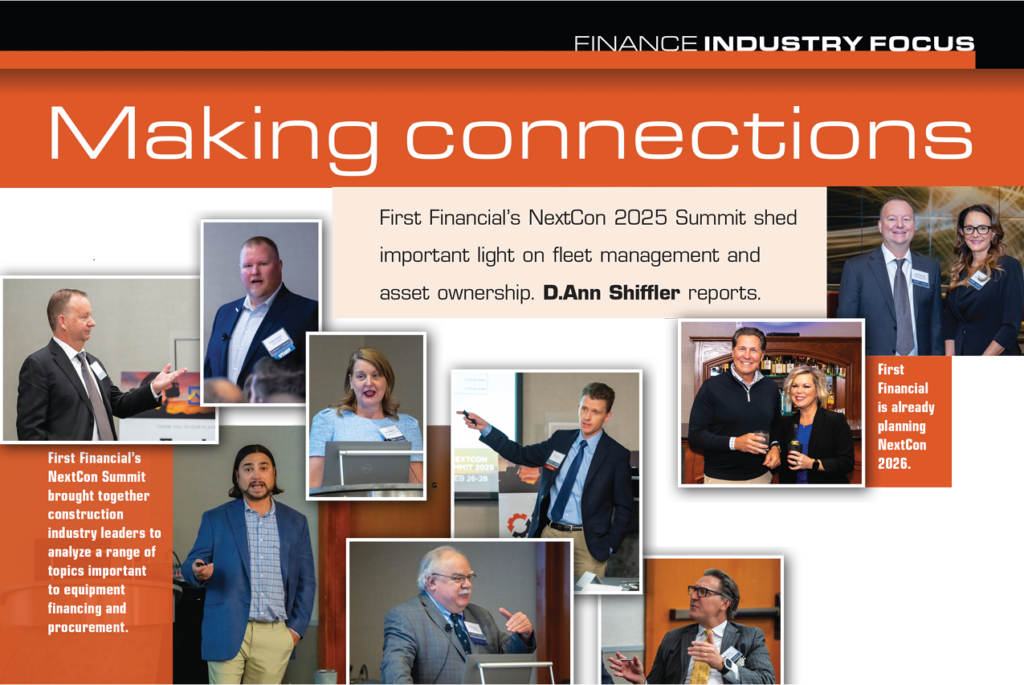
First Financial’s NextCon 2025 Summit shed important light on fleet management and asset ownership. D.Ann Shiffler reports.


The realm of equipment finance is complex, and is further complicated by economic conditions such as interest rates, proposed tariffs, rising insurance costs and even the stock market, to name a few.

To help equipment owners navigate these challenges, First Financial Equipment Leasing hosted its first annual NextCon Summit in Dallas in February. The intimate gathering brought together equipment owners and manufacturers, financial experts and even an economist to discuss topics related to finance and equipment procurement.

“Our goal at the NextCon event was to address the concerns of both longstanding and prospective customers regarding asset ownership,” said Jeffrey Whitcomb, senior vice president and construction sales director for First Financial Equipment Leasing. “Many prospective customers’ experience apprehension about equipment acquisition, especially when deciding between renting, leasing or purchasing. We aimed to ‘demystify’ this decision making process by providing insights into key factors such as economic conditions, advancements in engine technology and shifting dynamics at job sites.”

Industry Forum

With the intricacies of today’s economic and political landscape, Whitcomb said NextCon was a forum for industry leaders to share knowledge and perspectives. The goal was to develop a collaborative roadmap for addressing fleet management and procurement strategies and how to navigate the challenges ahead.

NextCon started with an engaging address by Scott Hazelton, consulting director of global intelligence and analysis, S&P Global Market Intelligence. Hazelton, a well-known construction industry analyst and economist, developed and is responsible for S&P Global Market Intelligence’s Global Construction Outlook. He has developed specific forecasting models for construction equipment companies and associations.

He said the key themes for the North American construction outlook are political uncertainty, including implications related to tariffs, immigration and tax cuts; interest rate divergence; and nonresidential construction, including healthy but diminishing infrastructure outlook in the U.S., Canada and Mexico.

“The U.S. construction market is slowing,” Hazelton said. “Uncertainty is off the charts. The outlook for 2025 is difficult to assess because of all the unknowns.”

Speakers at the event included Lampson International’s Kate Lampson; Komatsu’s Joshua Sexton; Cummins’ Mark Jamieson; Equipment Share’s Willy Schlacks; Pulice Construction’s Luis Cisnal; and Equipment Watch’s Grant Nolen, Aaron Strauch and Sam Franzosa. Whitcomb and his First Financial colleague Derrick Bavol conducted panels and Q&A sessions with the speakers. Tom Slevin, CEO and founder of First Financial Equipment Leasing, provided further insight.

The NextCon Summit had many key take-aways, including the reality that the economy may slow and that higher costs are here to stay.

“Increasing costs directly impact leasing rates and client demand,” Whitcomb said. “By understanding these cost structures, we can work with our customers on pricing models that help us maintain competitiveness while ensuring profitability.”

Labor shortages, workforce age, job site technology and a push for sustainability and carbon neutrality were key topics.

“Predicting the economic outlook for the construction equipment industry in the coming year has its challenges, but it also provides a chance to develop effective strategies,” said Whitcomb. “Our recent get-together with global construction company leaders showed how strong our community is. There was a lot of excitement in the room as we talked about the possibilities ahead and how innovation and technology will help us move toward a brighter future.”

NextCon 2026 is already in the works, Whitcomb said.


Click to download PDFHello, world

https://vimeo.com/1037990083Hello, world


Modern Materials Handling magazine: January 27, 2025

25 Warehouse Automation Trends for 2025: From Warehouse Experts

In 2025, warehouses and material handling operations will face new challenges and opportunities driven by rapidly evolving technology, changing consumer expectations, and unpredictable global events. As companies strive to optimize efficiency and resilience, staying ahead warehouse automation trends is more critical than ever. From integrating cutting-edge robotics and dynamic forecasting tools to tackling macro-level issues like climate change and cybersecurity, today’s supply chains are transforming at an unprecedented pace.

Prepare to explore the innovations and strategic shifts that will define material handling and warehousing over the coming year. The path forward is marked by challenges, but for companies ready to embrace these trends, the future promises growth, resilience, and efficiency.

Whether it’s harnessing digital twins for strategic planning, adapting to workforce shifts, or safeguarding assets with resilient cybersecurity, the warehouse automation insights in this blog post will provide a roadmap for success in a world where adaptability is key.

Below we dive into 25 emerging warehouse automation trends that will shape the warehousing landscape in 2025, highlighting how forward-thinking companies are responding to complex demands and securing their operations for the future. Each warehouse automation trend is grouped into one of six major trend categories and accompanied by insights from industry leaders, offering perspectives on how to navigate these changes with agility and purpose.


Click to read blog articleHello, world


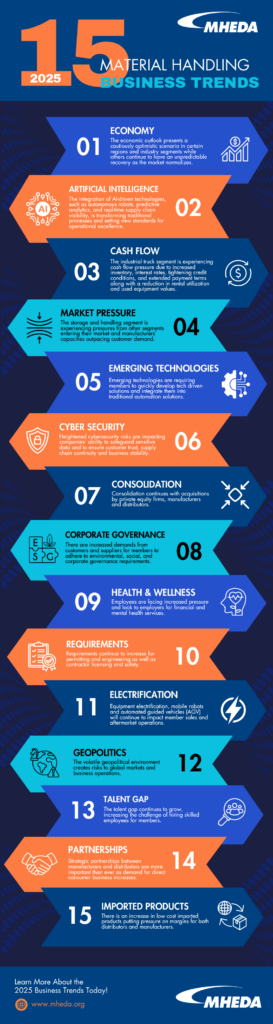
As we move into 2025, MHEDA’s Executive Committee has pinpointed 15 crucial business trends that will significantly impact the material handling industry. Several trends hold particular importance for our organization and our valued customers.

  • Cautiously optimistic economic outlook in specific regions and industry segments, with unpredictable recovery in other areas as the market normalizes.
  • Integrating AI-driven technologies, such as autonomous robots, predictive analytics, and real-time supply chain visibility, will transform traditional processes and set new standards for operational excellence.
  • Pressures from other market segments, with manufacturers’ capacities outpacing customer demand, are placing pressure on the storage and handling segment.
  • There is a need for quick development of tech-driven solutions to integrate emerging technologies into traditional automation solutions.
  • Continued impact on member sales and aftermarket operations from equipment electrification, mobile robots, and automated guided vehicles (AGV).
    Strategic partnerships between manufacturers and distributors are becoming increasingly important as demand for direct consumer business rises.
  • Growing pressure on margins for distributors and manufacturers due to increased low-cost imported products.

Hello, world


Secured Research surveyed over 1400 Middle Market CFOs, 5000 Small Business Decision Makers, and 2600 Equipment Sellers on over 800 topic areas for the first six months of 2024. Here are key data points to help drive strategy for a strong year-end close:

  • 58% of Middle Market CFOs and 27% of Small Business decision-makers plan to proceed with previously delayed capital expenditures due to improved economic conditions and lower interest rates.
  • There is a reported “moderate to severe” contraction in credit terms from primary banks, providing opportunities for well-capitalized lenders to gain market share. This means that credit terms have become more restrictive, making it more difficult for businesses to obtain loans or financing.
  • While over 60% of all audiences express concerns about the upcoming election’s impact on growth investment plans, historically, the impact of elections on capital expenditures has been limited.
  • The shift towards subscription-based or as-a-service-based capital expenditure consumption is evident, with a 21% increase in the middle market and a 13% increase in small businesses.
  • Infrastructure spending is gaining momentum, with construction firms reporting higher backlogs and $1.2 trillion in government funding being utilized.
  • Despite revenue pressures, a significant percentage of manufacturers plan to increase automation investment to address labor issues.
  • New electric vehicle and battery factory construction is on the rise, with significant capex spending expected to continue through at least 2026.
  • Equipment sellers are increasingly open to new finance partnerships and seeking alternatives, reflecting a notable shift from previous years.

Our Analysis – In today’s challenging economic climate, businesses may find it difficult to secure financing through traditional banking channels. At times like these, it’s essential to consider alternative solutions, such as leasing arrangements offered by First Financial. As a robust and independent equipment leasing provider, First Financial stands ready to extend credit when other avenues may be closed off.

By opting for leasing solutions, businesses can confidently proceed with capital expenditures that may have been put on hold due to financial constraints. This approach not only ensures the acquisition of necessary equipment but also brings stability to resource allocation and cost planning. Moreover, equipment financing through leasing minimizes upfront costs, bolsters cash flow, and potentially increases purchasing power. This, in turn, enables access to high-quality equipment and supports equipment customization, while also simplifying the process of replacing outdated equipment and averting maintenance costs and production inefficiencies.Hello, world


The construction industry is poised for significant growth in the latter half of 2024, driven by increased construction spending and substantial investments in infrastructure projects. The recent passing of the Bipartisan Infrastructure Law and the Infrastructure Investment and Jobs Act is set to inject billions of dollars into the construction sector, opening up opportunities for contractors specializing in upgrading transportation networks, water and energy systems, and public buildings.

Companies must maintain financial flexibility to capitalize on these opportunities. However, challenges like fluctuating material costs and labor shortages continue to persist. To thrive in this environment, contractors must embrace technological advancements, implement sustainable construction practices, and invest in workforce development initiatives. With economic uncertainties looming, contractors must prioritize robust financial planning and effective risk management. Developing comprehensive project budgets and securing favorable financing terms will be essential in successfully navigating market fluctuations.

When considering acquiring new equipment for upcoming projects, businesses should explore alternative financing options such as leasing, as it conserves capital and offers the benefit of 100 percent financing with no down payment required. Adapting to change and proactively managing risks will be key to achieving success, and staying informed of data and trends will establish a solid foundation for sustainable growth.

Please visit CONEXPO’s website for more information about the challenges and opportunities facing the construction industry in the second half of 2024.Hello, world


According to a new report released at Modex by MHI and Deloitte, 55% of supply chain leaders are increasing their investments in supply chain technology and innovation. The 2024 MHI Annual Industry Report, “The Collaborative Supply Chain: Tech-forward and Human-Centric,” shows that 88% of those surveyed plan to spend over $1 million, with 42% planning to spend over $10 million. The report provides insights into the latest trends and technologies revolutionizing supply chains and the priorities of those who manage them.

The report also highlighted the significant level of AI adoption and interest in the industry. 84% of survey respondents are planning to adopt AI technologies within the next five years. Furthermore, 51% of the respondents believe AI technologies will create a competitive advantage or disrupt their industry within the next ten years. As a result, company leaders are looking to integrate AI with their business processes to gain a competitive edge.

Generative AI can help optimize key supply chain processes, such as logistics, shipping, transportation, supplier selection/due diligence, and inventory management. These areas have the most significant potential application for AI in supply chain management. However, the report also notes that supply chain management faces a challenging environment due to inflation and rising capital costs.

Inflation concerns tempered growth as workforce and customer demand remain top challenges. 53% of this year’s respondents identified rising prices due to inflation as a significant or extreme challenge to their supply chain operations. Inflation can increase the cost of raw materials, labor, and other operational expenses, squeezing profit margins. To offset these increased expenses, businesses must improve their efficiency and reduce costs elsewhere in their operations.

To solve these challenges, equipment leasing can effectively help companies modernize their supply chain and be in the best position to reap the benefits. Investing in AI technology can be wise for businesses that wish to secure their financial future in the current high inflation environment. Equipment leasing can help companies acquire the required equipment before prices rise again, providing stability to plan with certainty and allocate resources efficiently without worrying about rising costs.

With leasing programs, businesses can enjoy lower upfront costs and improved cash flow, giving them the flexibility to access equipment and technology with no down payment required. This preserves capital, which can be allocated to other expenses or investments, creating more cash reserves during economic downturns. Leasing programs have the potential to significantly increase a business’s purchasing power, offering access to newer technology that might otherwise have been unaffordable. Additionally, payments are generally lower than traditional debt payments, enabling customization of the equipment configuration to match the business’s unique requirements.

At First Financial Equipment Leasing, we specialize in helping businesses make the transition to new technologies attainable and affordable. Our lease financing programs can equip any business for success by keeping working capital where needed most. Investing in AI can help your business stay ahead of the competition and succeed in today’s challenging environment. So, why wait? Contact us today to learn more about how we can help you achieve your goals.

 Hello, world