*** Click to read article on techronicler.com ***


Frank Sommers, Vice President, Technology Leasing, at First Financial Equipment Leasing, brings 30 years of experience in the IT leasing industry, advising global enterprise organizations on how to modernize their infrastructure while preserving capital and accelerating technology adoption. A former collegiate soccer player at Cal Poly San Luis Obispo, Frank brings a strong sense of competitiveness and teamwork to every client relationship.

As AI adoption moves quickly across industries, large enterprises are facing significant financial hurdles, with full-scale AI data center investments ranging from $150 to $500 million. Frank joins us today to explain how organizations can overcome these barriers. He discusses how IT leasing acts as a “budget multiplier,” allowing companies to bypass the massive upfront costs of high-performance compute infrastructure and avoid the trap of rapidly depreciating technology.


Techronicler: AI adoption is moving quickly across industries. What challenges are large enterprises facing as they try to modernize their technology stack?

Frank Sommers:

Large enterprises face several significant challenges when modernizing for AI. First, the core infrastructure is expensive and highly concentrated, particularly GPUs which are essential for processing AI workloads. For a full-scale AI deployment, organizations may need to invest hundreds of thousands to millions per GPU cluster, resulting in total data center investments ranging from $150 to $500 million.

The financial hurdle is especially steep for mid-tier enterprises. Many lack the balance sheet strength to secure traditional credit for these large expenditures. As a result, they often turn to private equity or high-interest lenders, or in some cases are forced to pay cash up front. Even when organizations can afford these purchases, many IT leaders are frustrated in trying to keep pace with AI evolution as the technology can become obsolete before it’s fully deployed.


Techronicler: How does leasing help organizations adopt AI faster than traditional purchasing?

Frank Sommers:

Leasing offers two major advantages that can ease and accelerate AI adoption:

Minimizing upfront costs: Traditional purchasing requires a large cash outlay, which often forces organizations to scale back roll outs even when they need more capacity. Leasing eliminates this barrier by converting a massive one-time upfront expense into manageable monthly payments, freeing up budget for additional needs. For example, instead of spending $50 million upfront, a company could lease the same equipment for a predictable monthly expense, enabling more projects to move forward simultaneously.

Enhancing flexibility and reducing financial risk: When organizations purchase technology, it goes on their balance sheet and depreciates over a set period. If the business needs to change or upgrade the technology before full depreciation, it can result in significant book losses. Alternatively, leasing categorizes the equipment as an operating expense, keeping it off the balance sheet and allowing companies to get in and out of technology quickly without the burden of depreciation or potential financial loss.

Ability to bundle software, security and maintenance: Leasing allows organizations to address AI requirements that go beyond infrastructure – by bundling associated software, maintenance, and security costs into a single package.

Based on these advantages, leasing allows organizations to adopt AI faster by lowering financial barriers, maintaining flexibility, and mitigating risks associated with asset ownership.


Techronicler: What kinds of AI‑related technologies are organizations leasing right now?

Frank Sommers:

The largest category we’re seeing is high-performance compute infrastructure, particularly GPU-based servers designed to handle AI and machine learning workloads. Unlike traditional CPU-based servers, GPUs are optimized for the intense processing demands of AI model training and inference.

Beyond compute, organizations are leasing the full AI technology stack, including: Networking equipment to support high-speed data transfer; enterprise storage systems, often integrated directly into the server environment; data center infrastructure, including fully configured “rack and roll” solutions; security components such as firewalls; and AI-specific and enterprise software that runs on top of the hardware.


Techronicler: Many executives worry about the pace of technology obsolescence. How does leasing address that concern?

Frank Sommers:

Leasing gives organizations flexibility and helps them stay proactive in managing technology lifecycles. Instead of committing to five years of ownership, a three- or four-year lease encourages regular review of what’s in use. At the end of the term, companies can decide to extend the lease, buy out the equipment, or return it and upgrade to newer technology.

This approach prevents the “set it and forget it” mindset that often happens with technology ownership, where equipment ages silently until a critical failure or performance gap forces costly, reactive decisions. In the AI and data center space, this can easily triple costs. Leasing ensures companies remain agile, continuously optimizing their infrastructure and aligning with the latest technology advancements without over-investing or falling behind.


Techronicler: Security and compliance are top-of-mind with any technology deployment. How does a leasing approach support these areas?

Frank Sommers:

Leasing allows organizations to bundle all associated software, maintenance, and security costs into a single package. This includes embedded software, add-on applications, and ongoing maintenance contracts.

Hardware and infrastructure is treated with a residual value, typically 10–15% below its purchase cost, spread over the lease term.

All “soft costs” such as software licenses, maintenance and other services are included in the lease payments and automatically expire at the end of the term, since software licenses can’t be resold.

Clients only assume responsibility for the hardware at lease end, simplifying compliance and ensuring that security-related updates, patches and licenses remain current throughout the lease.

By bundling hardware and software this way, IT leaders can reduce administrative overhead, ensure compliance with licensing requirements, and keeps security measures up to date – side stepping the risk of aging, insecure and unsupported systems.


Techronicler: What advice would you give to enterprise leaders planning large-scale AI adoption in 2026 and beyond?

Frank Sommers:

AI technologies are evolving rapidly, and no one can predict what the landscape will look like in three years. Leasing infrastructure allows organizations to adapt, upgrade, or pivot as business needs change. Owning large amounts of rapidly depreciating technology can leave companies stuck with outdated assets that no longer align with their strategy.

Leaders must also account for the full lifecycle cost of AI infrastructure. Equipment refresh, secure data wiping, asset disposition, and compliance requirements all carry operational and financial burdens. When organizations own the equipment outright, those responsibilities and costs fall entirely on them, and they can be significant.

The most important priority for IT leaders right now is developing a strategy that enables AI adoption with the least possible upfront cost, and which offers maximum flexibility. AI initiatives can be capital intensive, and if organizations commit the bulk of their budget to a single large purchase, they risk not having the funding for other critical projects.

Instead of paying cash and quickly exhausting a $10 or $50 million IT budget, leaders should think of IT leasing as a budget multiplier. For example, rather than spending $10 million upfront, that same capital can be allocated toward predictable monthly lease payments. By doing so, organizations can realize greater total project value while preserving liquidity and maintaining momentum across the broader IT roadmap.


“Instead of paying cash and quickly exhausting a $10 or $50 million IT budget, leaders should think of IT leasing as a budget multiplier.”

That powerful advice from Frank Sommers fundamentally shifts how we should think about enterprise AI strategy. As we discussed, the operational and financial burdens of equipment refresh, secure data wiping, and asset disposition can be significant when organizations own their equipment outright. By treating AI as an operating expense, IT leaders can maintain the flexibility to adapt and upgrade as business needs change.

A huge thank you to Frank for sharing his deep expertise in IT lifecycle management and enterprise procurement. For IT leaders planning large-scale AI adoption in 2026 and beyond, prioritizing maximum flexibility and the lowest possible upfront costs is clearly the winning playbook.


Frank Sommers brings 30 years of experience in the IT leasing industry, working closely with global enterprise organizations to help them modernize infrastructure while preserving capital and accelerating technology adoption. Known for consistently exceeding sales targets, Frank has also developed and led numerous successful vendor financing programs in partnership with major resellers, creating flexible acquisition models that support complex IT environments. His deep expertise in IT lifecycle management, financing strategies, and enterprise procurement has made him a trusted advisor across the industry. A former collegiate soccer player at Cal Poly San Luis Obispo, Frank brings the same competitiveness and teamwork to every client relationship.Hello, world

 

*** Click to read article on datacenterpost.com ***


AI spending is accelerating at a pace most enterprise budgets simply can’t match. While IT leaders are under pressure to deliver transformative AI capabilities, their capital budgets aren’t growing at the same rate as these AI ambitions. This mismatch is forcing difficult trade-offs: delayed projects, stretching aging infrastructure beyond its intended lifecycle, and diverting funding from other critical initiatives.

But there is another option. Increasingly, IT leaders are turning to technology leasing as a savvy strategy to help expedite AI adoption without sacrificing operational agility or financial liquidity.


AI: Thinking Through the Dollars and Sense

From my vantage point, working closely with IT leaders across industries, I hear the lament. AI infrastructure is expensive and highly concentrated, particularly GPU-based compute power. A single GPU cluster designed to support large-scale AI workloads can cost hundreds of thousands to millions. For enterprise-wide deployments, total data center investments can easily reach $150 million and as much as $500 million.

For mid-tier enterprises, challenges are even greater, as many lack the balance-sheet strength to secure traditional credit for such large capital expenditures. Some resort to private equity or high-interest lenders. But even those who can afford to purchase the infrastructure outright are frustrated by the pace of AI innovation; and the risk of technology becoming quickly outdated or obsolete.

For determined IT leaders, the question is not whether to invest in AI infrastructure, but how to fund it without compromising the broader IT roadmap. This is where the financing strategy becomes just as important as the technology strategy.

IT leasing eases these pressures in several critical ways:

  • Minimizing upfront costs. Traditional purchasing requires a massive outlay of capital, sometimes forcing companies to scale back or winnow down the scope of projects despite urgent demand. Leasing converts that one-time expense into predictable monthly payments. Instead of committing $50 million upfront, an organization can structure payments over time, freeing capital for additional initiatives and allowing multiple AI projects to move forward simultaneously.
  • Enhancing flexibility and reducing financial risk. Purchased technology sits on the balance sheet and depreciates over a fixed period. If business needs shift or the organization upgrades early, it can trigger book losses. Leasing – when structured properly – can classify equipment as an operating expense, keeping it off the balance sheet and enabling companies to pivot more easily without the burden of carrying these assets.


Lease the Entire AI Stack, Not Just the Hardware

IT leaders recognize today’s AI deployments extend far beyond servers. Enterprises are leasing high-performance GPU servers optimized for AI model training and inference, along with high-speed networking equipment, enterprise storage systems, integrated “rack and roll” data center solutions, firewalls, and AI-specific software.

Maintenance contracts, security tools, and embedded applications can all be incorporated into a single lease structure.

This bundling delivers administrative and compliance benefits. Hardware typically carries a residual value often 10–15% below purchase cost, amortized across the lease term. Software licenses and other “soft costs” are included in payments and expire at term end, eliminating resale complications. Clients are responsible only for the hardware at lease completion, simplifying compliance and ensuring security updates, patches, and licenses remain current throughout the lifecycle.


Combat Obsolescence Before It Becomes a Liability

One of the most common concerns I hear from executives is technology obsolescence. And given the pace of AI, where innovation cycles are measured in months, not years, that concern is justified.

Leasing naturally enforces a rigor and discipline for countering obsolescence. A three- or four-year term creates a defined decision point: extend, buy out or upgrade the technology. This prevents the “set it and forget it” ownership mindset that often leads to aging, unsupported systems and expensive, reactive refresh cycles. In AI environments, delaying upgrades can multiply total costs through inefficiencies and lost competitive advantage.


Leasing is a Budget Multiplier

Looking ahead to 2026 and beyond, IT leaders must think differently about capital allocation. No one can predict what the AI landscape will look like in three years. Owning large volumes of rapidly depreciating infrastructure can limit strategic agility.

Leaders must also factor in the full lifecycle cost of AI infrastructure, which includes equipment refreshes, secure data wiping, asset disposition, and regulatory compliance. These factors carry operational and financial burdens when assets are owned outright.

The most important priority today is building a strategy that enables AI adoption with minimal upfront cost and maximum flexibility. Leasing can act as a budget multiplier. Instead of exhausting capital on one large acquisition, organizations can deploy that same funding across predictable monthly payments, preserving liquidity while expanding total project capacity. In doing so, IT leaders maintain momentum across their complete technology roadmap, ensuring AI transformation doesn’t come at the expense of operational resilience.


# # #

About the Author

Frank Sommers brings 30 years of experience in the IT leasing industry, working closely with global enterprise organizations to help them modernize infrastructure while preserving capital and accelerating technology adoption. Known for consistently exceeding sales targets, Frank has also developed and led numerous successful vendor financing programs in partnership with major resellers, creating flexible acquisition models that support complex IT environments. His deep expertise in IT lifecycle management, financing strategies, and enterprise procurement has made him a trusted advisor across the industry. A former collegiate soccer player at Cal Poly San Luis Obispo, Frank brings the same competitiveness and teamwork to every client relationship.

 Hello, world


2026 is here. Are you ready to compete? Technology moves fast, and companies that delay upgrades risk falling behind.

Lease Smarter. Innovate Faster: Why IT Leaders Are Choosing Leasing Over Buying in 2026

As we enter a new year, IT leaders face a crucial question: How can we harness the latest technologies while keeping budgets in check? In today’s fast-paced environment, embracing digital transformation isn’t just an option; it’s a necessity for driving growth, boosting efficiency, and staying ahead of the competition. However, the hefty price tag of new technology can often weigh down cash flow and tie up precious working capital.

So, which route is better? Leasing.


Decoding the Market Dynamics

In 2026, global IT spending is projected to skyrocket to $5 trillion, fueled by the rapid adoption of cloud services, AI innovations, and enhanced cybersecurity measures. The speed of tech refresh cycles is also on the rise, with new gear potentially becoming outdated in just 24 to 36 months. Interestingly, over 60% of businesses are opting for leasing and financing solutions for their IT needs, primarily because of the flexibility and optimum cost control they provide.


Why Leasing Beats Buying – Every Time

1. Boost Your Cash Flow & Financial Freedom
Buying equipment often demands a significant upfront investment, which can stifle liquidity and constrain your growth strategies. Leasing, on the other hand, allows you to spread costs through predictable monthly payments, freeing up capital for expansion opportunities.

2. Stay Ahead of the Technology Curve
In a world where technology evolves at lightning speed, leasing provides your business with access to the latest tools without the financial burden of ownership. With built-in upgrade options at the end of the lease term, you can easily refresh your equipment and maintain your competitive edge.

3. Reap Tax & Accounting Perks
Lease payments typically qualify as operating expenses, simplifying accounting and making them fully deductible. While purchasing might offer depreciation benefits, these can be complicated and unpredictable.

4. Reduce Risk & Simplify Lifecycle Management
Many leasing agreements include maintenance and disposal services, substantially reducing your risk and administrative burden. In contrast, owning equipment means you assume full responsibility for maintenance and end-of-life disposal.

5. Align IT Costs with Business Growth
Leasing lets you align your expenses with usage and revenue cycles, allowing for agile responses to market shifts and scalable operations aligned with your growth trajectory.


What Types of IT Equipment Can Be Leased in 2026?

Leasing options today extend well beyond laptops and basic hardware. Modern IT leasing encompasses nearly every component of a digital enterprise, making it a valuable resource for CIOs, CFOs, and IT leaders. Below is a clear breakdown of the most commonly leased categories, based on market insights from 2025 to 2026.

1. Core Infrastructure Hardware
These equipment types form the backbone of corporate IT infrastructure, and all are widely available through leasing programs:

  • Servers  — Enterprise servers for hosting, virtualization, and compute‑intensive workloads. Storage & Backup Systems (SAN, NAS) — Scalable storage arrays and secure backup appliances.
  • Networking Hardware (Routers, Switches, Load Balancers) — Essential for high‑performance networking and connectivity.
  • Firewalls & Security Appliances — Enterprise‑grade security infrastructure, including firewalls and intrusion prevention systems.
  • Data Center Equipment. Racks, UPS systems, and other critical environment components.

2. End‑User Computing Devices
Ideal for fast‑growing teams, remote workforces, and flexible refresh cycles:

  • Laptops & Desktops.  One of the largest and fastest‑growing leasing segments.
  • Monitors, Keyboards, Peripherals.  Often bundled with workstation leases.
  • Printers & Scanners. Still essential in many business environments.
  • Projectors & Conference Room Equipment. Supports hybrid workplace collaboration.

 
3. Specialized or Software‑Integrated Equipment
Leasing extends into more specialized and cloud‑connected tools:

  • Point‑of‑Sale (POS) Systems — Retail and hospitality systems integrating hardware and software.
  • Cybersecurity Systems — Appliances and software‑driven tools are critical for enterprise security posture.
  • Software Licensing / SaaS Bundles — Many leasing programs now include software licensing with hardware (e.g., OS, security suites).

4. Telecommunications & Unified Communications Equipment

  • VoIP Phone Systems
  • Unified Communications Platforms
  • Conference Phones & Video Systems
  • Call Center Hardware & Headsets

5. Cloud‑Connected & Hybrid Infrastructure
As companies adopt hybrid IT:

  • Cloud gateways
  • Edge devices
  • IoT hardware


Why This Matters for IT Leaders in 2026

The ability to lease a wide range of IT equipment offers several advantages for organizations:

  • Stay agile amidst rapid technological changes.
  • Reduce capital expenditure (CAPEX) pressure and preserve cash flow.
  • Simplify refresh cycles and avoid asset obsolescence.
  • Maintain a secure, modern, and scalable technology infrastructure.


All of this can be achieved without the commitment of long-term ownership or the burden of depreciation.

As we move through 2026, the ability to adapt quickly and efficiently in the use of financial resources will be crucial for success. Choosing to lease IT equipment is not just a cost-saving measure; it is a strategic decision that positions your business for future innovation while preserving essential capital. Embracing flexibility can drive growth and help you stay ahead, freeing you from the burdens of ownership.

At First Financial Equipment Leasing, we are dedicated to aligning our technology asset refresh programs with your evolving IT needs. Whether you are looking to expand your infrastructure, upgrade hardware, or implement new software, we are here to provide solutions tailored to your strategy and financial objectives.

Contact us today to explore how flexible IT leasing can empower your enterprise’s growth and success.Hello, world


Mastering Innovation Through Surfing: Lessons for Business Transformation

In a podcast for TomorrowZone, Dave Anderson explains why the key to success — both in surfing and in business — is experimentation, patience, and embracing failure as part of the journey.

Take a listen! https://podcasts.apple.com/us/podcast/mastering-innovation-through-surfing-lessons-for-business/id1741229036?i=1000673123417


Hello, world


Orange County Business Journal: Women In Finance 2024
July 22, 2024

Uyen Tran, the vice president, GL Accounting Manager at First Financial Equipment Leasing, has made an exceptional impact on the company’s accounting department over the past year through her remarkable leadership skills. Under her strategic guidance, the team has achieved unprecedented success, transforming a department with high turnover into one that is highly efficient, effective, and exceptionally skilled.

When she assumed the role of controller in May 2023, following the departure of the previous controller, she was able to produce financial statements in only 40% of the time it originally took. Tran’s dedication to fostering a cohesive and professional team has resulted in significant enhancements to our financial processes, leading to a remarkable increase in efficiency and accuracy. Her leadership has not only raised the bar for our entire company but also inspired her team to strive for excellence consistently in all our endeavors.

Tran’s significant improvements to our month-end closing process, a 60% increase in efficiency, have profoundly impacted our company’s success. Additionally, she developed a robust Balance Sheet reconciliation process that added 44 more General Ledger accounts for our team to reconcile, an increase of 51% from the number of accounts that were reconciled in the previous fiscal year.  By streamlining the production of financial statements and introducing new reconciliation and documentation processes, she has further enhanced efficiency and internal control. Tran’s exceptional value to our company is immeasurable, and her contributions have been pivotal in driving our success.


Uyen Tran
Vice President, 
GL Accounting Manager
714-646-1608
utran@ffequipmentleasing.comHello, world


According to a new report released at Modex by MHI and Deloitte, 55% of supply chain leaders are increasing their investments in supply chain technology and innovation. The 2024 MHI Annual Industry Report, “The Collaborative Supply Chain: Tech-forward and Human-Centric,” shows that 88% of those surveyed plan to spend over $1 million, with 42% planning to spend over $10 million. The report provides insights into the latest trends and technologies revolutionizing supply chains and the priorities of those who manage them.

The report also highlighted the significant level of AI adoption and interest in the industry. 84% of survey respondents are planning to adopt AI technologies within the next five years. Furthermore, 51% of the respondents believe AI technologies will create a competitive advantage or disrupt their industry within the next ten years. As a result, company leaders are looking to integrate AI with their business processes to gain a competitive edge.

Generative AI can help optimize key supply chain processes, such as logistics, shipping, transportation, supplier selection/due diligence, and inventory management. These areas have the most significant potential application for AI in supply chain management. However, the report also notes that supply chain management faces a challenging environment due to inflation and rising capital costs.

Inflation concerns tempered growth as workforce and customer demand remain top challenges. 53% of this year’s respondents identified rising prices due to inflation as a significant or extreme challenge to their supply chain operations. Inflation can increase the cost of raw materials, labor, and other operational expenses, squeezing profit margins. To offset these increased expenses, businesses must improve their efficiency and reduce costs elsewhere in their operations.

To solve these challenges, equipment leasing can effectively help companies modernize their supply chain and be in the best position to reap the benefits. Investing in AI technology can be wise for businesses that wish to secure their financial future in the current high inflation environment. Equipment leasing can help companies acquire the required equipment before prices rise again, providing stability to plan with certainty and allocate resources efficiently without worrying about rising costs.

With leasing programs, businesses can enjoy lower upfront costs and improved cash flow, giving them the flexibility to access equipment and technology with no down payment required. This preserves capital, which can be allocated to other expenses or investments, creating more cash reserves during economic downturns. Leasing programs have the potential to significantly increase a business’s purchasing power, offering access to newer technology that might otherwise have been unaffordable. Additionally, payments are generally lower than traditional debt payments, enabling customization of the equipment configuration to match the business’s unique requirements.

At First Financial Equipment Leasing, we specialize in helping businesses make the transition to new technologies attainable and affordable. Our lease financing programs can equip any business for success by keeping working capital where needed most. Investing in AI can help your business stay ahead of the competition and succeed in today’s challenging environment. So, why wait? Contact us today to learn more about how we can help you achieve your goals.

 Hello, world


American Cranes and Transport (AC&T)

By Hannah Sundermeyer

> LINK TO ARTICLE ON AC&T WEBSITE <

Three experts discuss market indicators – interest rates, inflation and the possibility of a recession.

Heavy equipment and construction markets are in a unique position. The United States is facing the possibility of a looming recession, while on the flip side, the country is seeing a boom in infrastructure projects following the enactment of President Biden’s Bipartisan Infrastructure Law. With money to spend in the new and used equipment realm, the industry is faced with economic risks and rewards, on both sides of the coin.

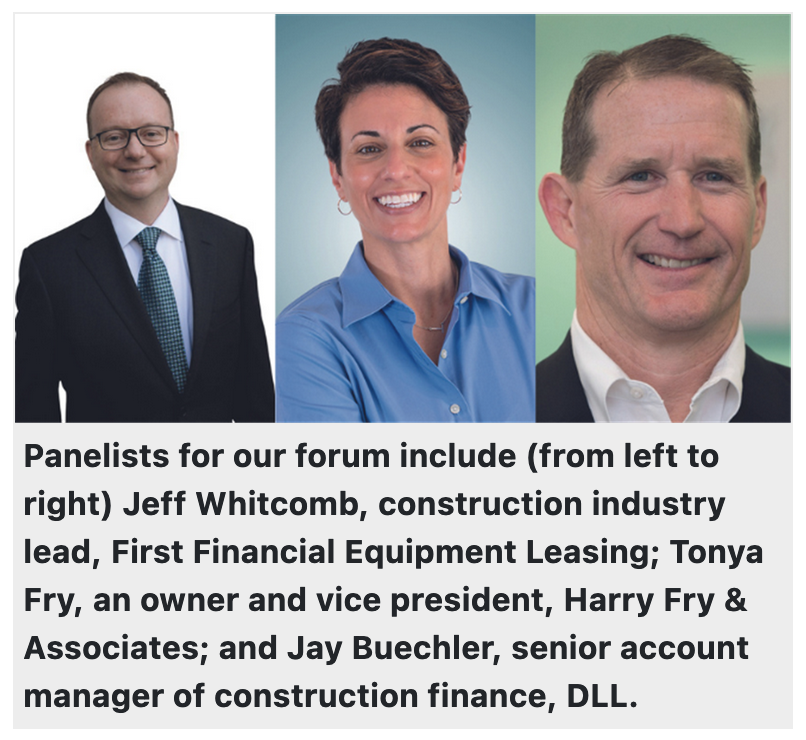
ACT reached out to three finance experts to learn more about their thoughts and perspectives on the current market, interest rates, inflation and much more. Panelists for our forum include Jeff Whitcomb, construction industry lead, First Financial Equipment Leasing; Tonya Fry, an owner and vice president, Harry Fry & Associates; and Jay Buechler, senior account manager of construction finance, DLL.


According to the consultant firm Off-Highway Research, North America was the best performing of the major construction equipment markets last year. How do you characterize the market for new and used cranes?

WHITCOMB: We don’t see it slowing in 2023 or 2024. While it may be that personal consumption drags down GDP, we see both private domestic investment as well as government domestic investment continued strength, and for that reason, we see continued strength in the new and used crane market.

FRY: I would currently characterize the market as cautious. I am continuing to hear from my customers that they have more work than they can service. We are constantly barraged with news of a possible recession, continued record high inflation and interest rate hikes, plus international issues. When this is combined with lack of supply of equipment and delivery delays, of course customers are going to be cautious.

However, I find that many customers are trying not to pay attention to the news, but instead considering what is happening in their geographic market. If they have demand for work or are awarded jobs, they are willing to make the crane purchase as they don’t want to lose the work/jobs. As far as new and used cranes go, if customers are in need of equipment, they will purchase what they can get their hands on. As a result, we have definitely seen prices of equipment significantly increase. I do feel if you are in a market to sell, and have quality, used equipment, you are in a good position.

BUECHLER: Despite the potential for a recession in late 2023, the market remains robust in North America for both new and used cranes, as significant project work continues to require cranes to complete these projects. The supply chain disruptions of the last several years has led to a restricted supply of new cranes, with many new crane models not being available until well into 2024. This has led to a very competitive and aggressive market for used cranes, resulting in increased used crane pricing.


Economists are predicting a recession in 2023. How Do you anticipate this will impact the sales of new and used cranes?

WHITCOMB: We do not think that the recession will have much of an impact on crane sales, both new and used. We think that it will be a consumer recession, and that the commercial activity that has been planned for all this infrastructure work will be in full swing, and that is going to drive strong demand for 2023 to 2025.

FRY: I feel like economists have been predicting a recession since 2021. In addition, the economists have had contradicting opinions on a recession for the past year. As noted above, I think people are trying to pay attention to what is going on in their market area rather than listen to the news. There is still a demand for quality equipment, and I think it is the lack of inventory that is slowing sales.

BUECHLER: Given the short supply of new cranes and equipment and long lead times on some models, we anticipate that new crane sales, as well as used crane sales, will remain brisk and aggressively priced.


To try to control inflation, the Fed has continually raised interest rates over the past year. How have higher interest rates impacted crane financing?

WHITCOMB: Well, 5 percent may be the target Fed funds rate, but we see actual real interest rates much higher. This was somewhat offset by lending at the regional bank level where deposits sometimes hold down interest rates. With the recent banking crisis, we’ve seen a massive pullback by small and regional banks, as depositors have fled those banks. Unfortunately for the retail marketplace, it seems that the big will get bigger and the small will continue to fight to survive.

FRY: When the Fed initially began raising rates, I think it was sticker shock for many. For almost a decade, we had prime rates at historic lows. Customers were used to rates in the threes and sometimes twos.

When I began my career in crane financing in 2004, interest rates were in the 7 to 8 percent range, and this was the normal range. When my parents started the company in the 1990s, rates were 10.5 to 12 percent. We often say that a business that started within the past ten years doesn’t know anything other than extremely low rates. It seems that these businesses were more affected/surprised by the cost of financing than the older, established companies. It has taken a bit for customers to understand, but due to the lack of supply, if they needed the equipment, they accepted what the interest rate would be. By Q4 2022, the sticker shock had worn off and most understood that these rates were here to stay. I think it helped our company had a strong fourth quarter in 2022 because customers didn’t want to risk rates going up, so they would make the purchase. We understand higher rates are a real money cost to a business but not acquiring equipment because the rates are high impacts the business even more by lost revenues. The decision to acquire equipment is always difficult but is typically made for future long-term benefits.

BUECHLER: Increased interest rates are combining with rising new and used crane prices to drive up financing payments for entities seeking to finance their crane acquisitions. This is causing crane customers to look long and hard at the economics between where their financing payments are going and what crane rental rates they are able to extract from the market. If the economics no longer makes sense, we would not be surprised to see some crane rental companies back away from new equipment purchases.


On the flip side, new infrastructure projects are coming online with federal and local monies being pumped into the market. Does this mean new cranes and related equipment will be needed?

WHITCOMB: Absolutely, yes.

FRY: Equipment will definitely be needed, but as is the common theme, the lack of supply is having quite an impact on this. Companies may pay a premium on available equipment as they would not want to risk losing a job.

BUECHLER: New infrastructure projects will definitely continue to require crane utilization. The crane rental companies that will be best positioned for gaining work on these projects will be those that currently have a large installed base of cranes available to work on these projects, such that they are not reliant on the availability of new equipment to service their project work.


What are the biggest challenges/issues in financing equipment in today’s market?

WHITCOMB: 2024 will be the biggest year of federal disbursements on record for capital investment. For this reason, we see continued strength and continued demand for crane and lift equipment.

FRY: I think the biggest challenge in financing right now is that credit is beginning to tighten a bit. Lenders are still lending and buying deals. However, we are finding that they are asking more questions. They want more details on why the equipment is needed and projections for additional work in 2023 and beyond. Lenders are definitely still buying deals. With the constant threat of a recession, they are digging a little deeper into deals, and the credit box is just a bit tighter. I would say that customers just need to be patient when asked for additional info.

BUECHLER: The biggest challenge we see currently in the crane financing market, with increased crane prices and increased interest rates already mentioned, is trying to provide a financial solution that results in a payment that makes economic sense for the customer given the rental rates they are able to charge in the market.


> LINK TO ARTICLE ON AC&T WEBSITE <Hello, world


Monitor recently caught up with Tom Slevin, founder and CEO, and Brian Dundon, SVP corporate development at First Financial Equipment Leasing ahead of their company’s acquisition of NorFund, an independent leasing company specializing in capital equipment, solar and alternative energy and vendor finance programs.
 

First Financial Equipment Leasing announced its expansion into Canada in 2022 with the acquisition of NorFund, an independent leasing company specializing in capital equipment, solar and alternative energy and vendor finance programs.

Having been acquired by JA Mitsui Leasing a few years ago, Tom Slevin, founder and CEO of First Financial, and Brian Dundon, SVP corporate development, both knew not only what to expect during the acquisition, but also what to provide to make it a smooth transition.

Reminiscing about First Financial’s acquisition not too long ago, Slevin and Dundon remember the fears they had around acquisitions, which stemmed from stories of other independent companies being purchased by a larger company or bank and facing restrictions and various changes, which lessened the overall experience, value and productivity of some companies. Thankfully, that was not the case for the JA Mitsui Leasing acquisition some years ago, but it offered insight on how to provide insight, resources and opportunities when expanding internationally and into new territory.

“The biggest thing that we have with JA Mitsui and with the folks that we work with is that it’s much more of a partnership than a top-down mentality,” Dundon says. “That’s not something you get in every single big company. And it’s something that I know myself, Tom, and others are really grateful for is having partners that are seeking to actively help.”


The Cultural Fit

The First Financial team plans to take a similar approach in its acquisition of NorFund. Slevin says NorFund is a perfect fit for First Financial. Having been established in Canada for years, NorFund was everything First Financial wanted in a partner, as Slevin puts it, “They have contacts, they have customers, they have vendor relationships, they have relationships within the leasing community there. And it was a really good cultural fit in that they’re creative and entrepreneurial like First Financial.”

NorFund, which has been renamed First Financial Canadian Leasing, will continue to be led by Robert MacFarlane, who has more than 30 years of leasing experience, including roles at Newcourt Credit, National City and PNC that focused on developing fair market value leasing businesses in Canada.

“[What] made NorFund really an attractive target was the people,” Dundon says. “Rob MacFarlane founded NorFund. He led that company, and prior to that, he worked in fair market value, technology leasing, solar leasing, and really the type of businesses that we want to be involved in. There aren’t many people up there in Canada that have done that and understand that market, so being able to acquire NorFund and bring Rob on board, it made a lot of sense.”

What attracted First Financial Equipment Leasing to the Canadian market is how the country does business in a similar fashion to the U.S. From a contractual and legal standpoint, it makes sense, but Selvin also notes that recently, banks have pulled away from that market and have left a potential opportunity open for his company.

“Our goal is to really take what we’ve learned over the last 10 years that we’ve been there and grow that,” Dundon says. “We’re really a relationship focused company. We try to have our customers be our customers for decades, and Canada’s a market that’s pretty similar and people value that kind of approach and relationship mindset.”

Running with NorFund’s previous successes with solar asset classes, Dundon and Slevin plan to expand the company’s offerings to include construction and material handling. In the U.S., First Financial’s asset classes are material handling, information technology, healthcare and construction.

“Since the acquisition, we’ve grown — our equipment leasing volume has tripled and we’ve doubled the back office in three years,” Dundon says. “That pace is continuing to grow and adding Canada in there is only going to further accelerate that in the long run.”


>> Link to monitordaily.com article <<Hello, world


> Link to Monitor 4th Annual Women in Equipment Finance Issue <<

>> Link to download PDF <<

Hello, world


Hello, world