In the world of heavy equipment, ownership can be costly and burdensome. Aside from the initial purchase price of equipment, there is also the financial responsibility of maintenance, repair, and eventual depreciation.

This is where Fair Market Value (FMV) leases can offer significant cost advantages and flexibility. With an FMV lease, organizations can receive the full benefits of using the equipment while only paying for a portion of the machine’s value over the lease term.


FMV LEASES FREE UP CAPITAL

An FMV lease is a type of operating lease that allows businesses to use equipment for a specified period while making regular payments. This structure is particularly beneficial for companies that need access to heavy equipment but don’t want to invest large amounts of capital up front.

At the end of the lease term, the business has the option to return the equipment, extend the lease, or purchase the equipment at its fair market value. Additionally — and as mentioned previously — one of the biggest advantages of an FMV lease is that it allows businesses to use equipment without having to pay the full cost of ownership. This is especially valuable in the construction sector, where equipment is essential but not always needed long-term. Rather than tying up capital in equipment purchases, companies can allocate those funds toward other critical operational areas.

With an FMV lease, businesses only pay for the use of the equipment during the lease term and are not responsible for the total value of the machine, as they would be with an outright equipment purchase. The result is a more efficient use of financial resources, allowing companies to access the equipment they need while keeping their capital free for other investments.


THE ADVANTAGES OF THE EQUIPMENT-AS-A-SERVICE MODEL

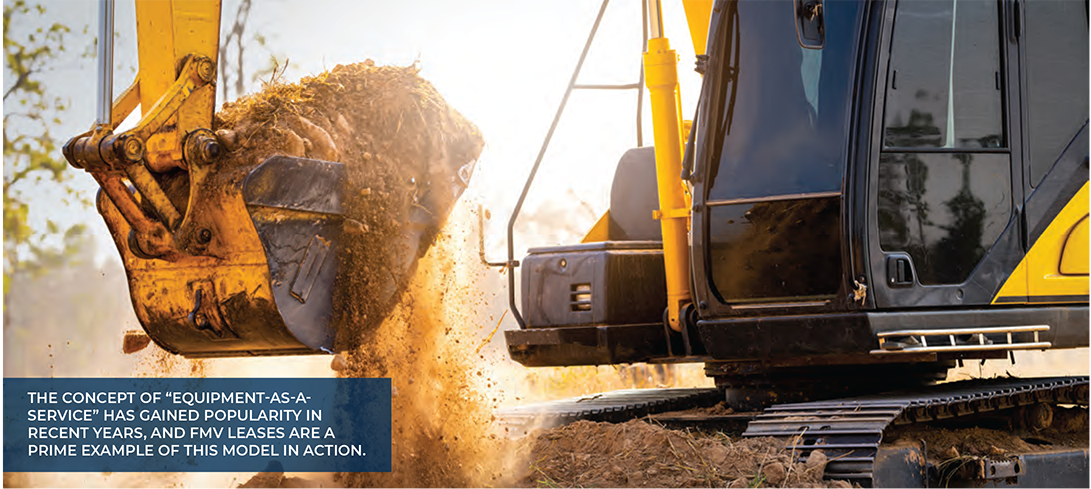
The concept of “equipment-as-a-service” has gained popularity in recent years, and FMV leases are a prime example of this model in action. With equipment-as-a-service, businesses essentially rent the functionality of the machine rather than owning it outright. This approach offers several advantages.

Equipment-as-a-service allows businesses to control costs more effectively by only paying for the use of the machine rather than bearing the total cost of ownership, maintenance, and repairs. Companies can use the equipment for as long as needed and then return it at the end of the lease term, avoiding the long-term commitment and costs associated with ownership.

With an FMV lease, businesses can easily upgrade to newer models at the end of the lease term, ensuring they always have access to cutting-edge technology and the best tools for the job. This regular access to newer equipment can lead to improved efficiency, reduced downtime, and, ultimately, a stronger bottom line.

The ability to turn variable costs into fixed costs has a direct impact on a company’s cash flow and financial forecasting. When costs are predictable, it’s easier for businesses to allocate funds toward other essential areas such as labour, materials, and project development. This is especially important in an industry such as construction, where cash flow can be inconsistent due to the seasonal nature of the work and dependencies on supply chains and project timelines.

By returning equipment at the end of the lease and opting for newer models, businesses can also avoid the pitfalls of owning outdated equipment, which can become costly to maintain and less efficient over time.


A LOOK AT THE EQUIPMENT-AS-A SERVICE MODEL IN ACTION

ABC Construction needed a fleet of excavators for a two-year project. Instead of purchasing the machines outright, ABC opted for an FMV lease.

By choosing to lease rather than purchase, ABC Construction effectively shielded itself from potential financial losses tied to the resale of depreciated equipment at the project’s end. This savvy decision relieved the company from the obligation of paying the total value of the machines up front and eliminated burdensome maintenance costs.

Opting for a Fair Market Value (FMV) lease allowed ABC Construction to streamline its expenses into a single manageable monthly payment. This not only ensured consistent monthly costs covering the equipment but also included essential maintenance, repairs, and soft costs like installation. Such an approach not only simplifies budgeting but also enhances operational efficiency, making it a wise choice for any construction firm.

This strategic shift stabilized ABC Construction’s cash flow, providing the funds needed for critical areas like hiring skilled labor and procuring materials. As a result, the company boosted profitability and increased its capacity to take on more projects without the fear of unexpected financial burdens.

At the conclusion of the 24-month project, ABC simply returned the equipment, having only paid for its use throughout the lease. This method allowed them to expand its equipment fleet for the larger short-term project and return the machinery once it was no longer needed. Ultimately, this strategy put them in a prime position to upgrade to the latest models, ensuring the company always has access to cutting-edge technology for future projects.

By leasing rather than purchasing, ABC Construction avoided the costs associated with making payments on the full value of the machine, in maintaining that equipment and taking a loss on the eventual sale of this depreciated equipment at the end of its useful life. By opting for an FMV lease, ABC Construction was able to bundle all these variable costs into its monthly lease payment. Over the course of the lease term, the company enjoyed fixed monthly costs that covered not just the equipment, but also all associated maintenance, repairs, and soft costs such as installation.

This shift allowed ABC Construction to stabilize its cash flow, ensuring it had sufficient funds available for other important areas such as hiring skilled labor and purchasing materials. As a result, the company saw increased profitability and was able to take on more projects without having to worry about unexpected expenses.

At the end of the 24-month project, ABC simply returned the equipment, having only paid for the use of the machines during the lease term. ABC Construction was able to expand its equipment fleet to accommodate this larger short-term project, then return the equipment at the end of the lease, when it was no longer needed. Ultimately, they were able to upgrade to the latest models when their next project required more advanced technology.


A SMART, FLEXIBLE SOLUTION FOR EQUIPMENT NEEDS

FMV leases provide businesses with the flexibility and financial efficiency needed to stay competitive in the construction sector. By allowing companies to receive the full benefit of equipment without paying for its total value, and by offering the option of regular equipment upgrades, FMV leases are effectively turning equipment into a service that businesses can rely on.

An FMV lease provides more than just access to equipment — it offers financial predictability. By converting variable costs such as repairs, maintenance, and soft costs into fixed payments, construction companies can better manage cash flow, reduce financial risks, and make more informed business decisions. For greater financial stability in an unpredictable industry, an FMV lease is a valuable tool that is worthy of consideration.
 

Hello, world


Life in the construction sector hasn’t been easy lately, given the challenging economy and uncertainties at every turn. Unfortunately, it looks like we’ll all need to continue to keep our seat belts tightly fastened for the foreseeable future. In a recent economic update, Ken Wattret, vice president of global economics at S&P Global Market Intelligence, says: “The path forward will likely remain bumpy, given numerous US-related uncertainties, including the risk of a hard landing, the timing and magnitude of policy rate cuts, and the outcome of elections in November and their policy implications.”

For those in the construction industry, the path to persevere and grow isn’t as clear-cut as in the past. Adaptability is crucial, and this adaptability should also apply to construction equipment financing.

Full Market Value (FMV) leases, which can often be viewed as rigid or conventional, can be customized to meet unique business demands. This ushers in newfound flexibility to help companies adapt and adopt new approaches.

The industry is employing FMV leases in creative ways, empowering companies to navigate significant obstacles and capitalize on new opportunities.

Below are five use cases highlighting the flexibility and potential of FMV leases as creative financing strategies for the construction sector.


1 – CROSSING BORDERS TO SECURE THE RIGHT EQUIPMENT

One area where creative financing approaches can come to the rescue is in the instance of cross-border equipment financing. This may come into play when the equipment needed for your project doesn’t happen to exist in the country you currently operate within. Sometimes, a client may require a piece of equipment built overseas or that exists presently overseas.

Recently, a construction company based in Canada needed to purchase a machine from a dealer in the United Kingdom. The complexities of cross-border transactions can be challenging, especially when it comes to securing the necessary funds. Creative leasing approaches were of benefit here, not only to fund the down payment and ensure the transaction could move forward but also to fully fund the deal before the machine was even shipped to Canada. This approach minimized the financial risk for the company. It streamlined the entire transaction process, making it possible for them to acquire the equipment they needed without delay while enabling them to continuously focus on their day-to-day operations.


2 – MAKING FLEXIBLE PAYMENT STRUCTURES ALIGN WITH CASH FLOW

Cash flow management is critical for construction companies, especially when dealing with large equipment purchases. However, as anyone in the industry knows, cash flow can and often does fluctuate, particularly in the initial months of a contract.

Creative financing approaches can take a debt load off in these scenarios. Look for unique finance structures, such as deferred and skip payments, that align with your revenue streams. By deferring payments or allowing skips in the early months, companies can focus on completing their projects without the added pressure of immediate, substantial payments.

Alternatively, if your business performs seasonal work, such as fewer highway paving projects in the winter months or snow removal in the winter months with less usage in the summer months, payment months can align with months with the highest incoming receivables, making payments much more manageable.


3 – FINANCING SPARE PARTS TO PREVENT DOWNTIME

Unplanned machine downtime can be incredibly costly, so it’s crucial to have spare parts on hand, particularly because replacement parts can be in short supply. Over the past few years, the industry has experienced lengthy lead times for replacement parts.

To help maintain operational efficiency, creative financing approaches can offer needed resources specifically for spare parts purchased along with the machine orders. This proactive approach allows companies to stock essential components to keep their operations running smoothly, by avoiding crucial part shortages and lengthy downtimes.


4 – INTERIM FINANCING FOR FACTORY-ORDERED MACHINES

Long lead times are often required for factory-ordered machines, and manufacturers typically demand a down payment before commencing the build process. For many companies, this presents a significant cash flow challenge, particularly when a machine can take upwards of nine months or longer to build. Creative financing strategies can address this issue by financing the interim payments. This allows organizations to avoid substantial out-of-pocket expenses before the machine is built and operational, providing the financial flexibility needed to begin paying for the equipment once it is put into operation. In this way, companies can achieve a positive return on their equipment investments immediately.


5 – FIRST AMENDMENT LEASES: FLEXIBILITY FOR THE LONG TERM

Creative financing can offer the best of both worlds — a structure that begins with an operating lease, complete with a residual, but with the ability to extend and transition into a full payout term. This innovative approach gives organizations the flexibility to adjust their financing as their needs evolve, giving them more flexibility regarding their assets. Initially, a company can benefit from the lower payments and flexibility of an operating lease. Later, if desired, a company can amend the lease to fully amortize the equipment, retaining it for the long term, giving them more flexibility regarding their assets.


FAIR MARKET VALUE LEASES: THE CREATIVE FINANCING OPTION THAT GIVES YOU OPTIONS

FMV leases can be more than just a standard financing option, they can be incredibly flexible and adaptable; lease terms can be adjusted to address specific needs and an organization’s financial scenario, which is especially crucial when the business outlook and/or cash flow may be unpredictable.

As the use cases above illustrate, they can be a powerful tool to help your business grow, adapt, and thrive. Whether you’re dealing with cross-border transactions, managing cash flow, or planning for future equipment needs, creative financing approaches can help you access needed resources.

As César Pelli, the famous Argentine-American architect who designed some of the world’s tallest buildings and other major urban landmarks, noted, “Construction is a matter of optimism; it’s a matter of facing the future with confidence.” Creative financing gives the construction sector greater capacity and confidence to navigate today’s business and economic challenges.


Hello, world


Construction companies often need to make decisions about how to finance their heavy equipment. There are two main options: operating leases, also known as Fair Market Value (FMV) leases, and capital leases, also known as finance leases.

Although both leasing options have their advantages, there’s a common misconception that capital leases offer greater flexibility. However, a closer look shows that FMV leases may actually be a better choice to provide the quintessential operational versatility that construction companies need.

Let’s take a closer look at each leasing type to debunk the myth of capital lease flexibility and highlight how and why FMV leases can provide optimal flexibility, making this lease type a far superior choice.


UNDERSTANDING CAPITAL LEASES

Capital leases essentially give the lessee (borrower) ownership of the equipment. The lease term typically covers most of the equipment’s useful life. At the end of the lease term, the lessee has the option to purchase the equipment for a nominal fee, usually $10 or $1. This type of lease is recorded as an asset and a liability on the company’s balance sheet, reflecting the equipment’s value and the obligation to make future lease payments.

Advantages of Capital Leases

  1. Ownership benefits The lessee eventually owns the equipment, which can be advantageous if the machinery has a long operational life and is essential to the company’s core activities.
  2. Depreciation Although I’m not an accountant, nor do I play one on TV, the company can benefit from tax advantages related to the equipment’s depreciation.
  3. No usage restriction There is no limitation on how many hours a construction company can operate the machinery throughout the lease term. Since the equipment cannot be returned, there are also no concerns about its condition at the end of the lease term. This is beneficial if the equipment is heavily used and may not be in a suitable condition for return. At first blush, capital leases may seem to offer quite a bit in the way of flexibility, but there’s more to this story. Despite these advantages, capital leases may not be as flexible as they appear.


The Illusion of Flexibility in Capital Leases

The perception of flexibility with capital leases often comes from the aspect of ownership. However, this ownership can limit flexibility in several ways:

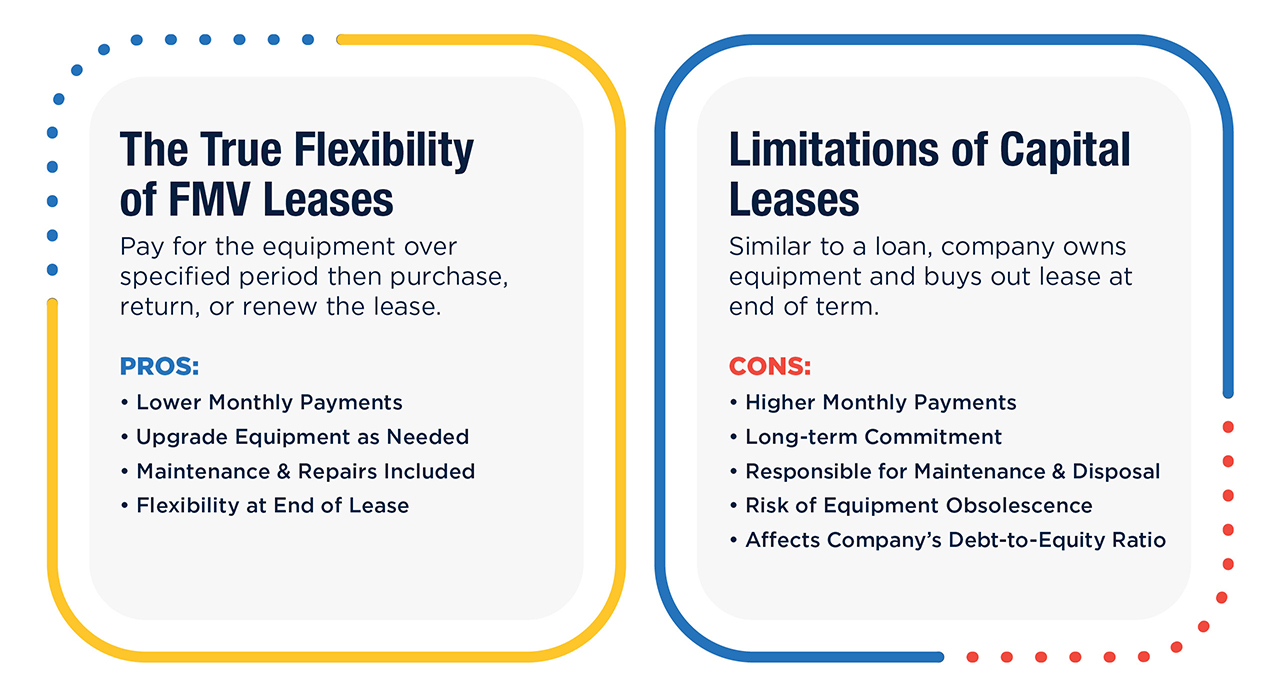
  1. Long-term commitment Capital leases require a longterm commitment to the equipment. This can be a significant drawback if a company’s needs change or technological advancements render the leased equipment obsolete. In an industry where machinery and technology evolve rapidly, being tied to older equipment can be a disadvantage.
  2. Balance sheet impact Since capital leases are recorded as assets and liabilities, they increase a company’s debt-to-equity ratio — a key financial statement metric. This can affect the company’s financial health, potentially making it more challenging to secure additional financing or impacting borrowing costs, which can restrain growth.
  3. Maintenance and disposal Ownership means the lessee is responsible for all maintenance and disposal costs. These costs can be substantial for heavily used construction equipment. Additionally, the company must manage the logistics of selling or disposing of the equipment at the end of its useful life, adding another layer of complexity. This often means the company must employ its own team of technicians.


THE TRUE FLEXIBILITY OF FMV LEASES

Alternatively, FMV leases offer a different kind of flexibility that can be aligned with the dynamic needs of construction companies. Under an FMV lease, the lessee pays for the use of the equipment for a specified period, with the option to purchase the equipment at its fair market value at the end of the lease term. Alternatively, the lessee can choose to return the equipment or renew the lease, and in some cases, this can be on a month-to month basis.

Advantages of FMV Leases

  1. Lower monthly payments FMV leases typically have lower monthly payments compared to capital leases. This is because the lessee is not paying for the full cost of the equipment, just for its use during the lease term. Lower payments improve cash flow, allowing the company to allocate financial resources to other critical areas.
  2. Upgrade options At the end of the lease term, companies can return the equipment and lease newer models. This is particularly beneficial in the construction industry, where technology and equipment quickly become outdated. The ability to upgrade ensures the company always has access to the latest and most efficient machinery.
  3. Maintenance and repairs Many FMV leases include maintenance and repair services. This reduces downtime and transfers the burden of maintenance costs away from the company while helping ensure the equipment remains in optimal condition throughout the lease term.
  4. Flexibility at lease end FMV leases provide multiple options at the end of the lease term: The lessee can return the equipment, purchase it at fair market value, or extend the lease. This flexibility allows construction companies to adjust their equipment needs based on business conditions and project requirements.


DEBUNKING THE MYTH

Many people mistakenly believe that capital leases offer more flexibility due to the traditional association of ownership with control. However, in the fast-paced construction industry, where adaptability and financial agility are crucial, Fair Market Value (FMV) leases often provide superior flexibility. They enable companies to keep up with technological advancements, manage cash flow more effectively, and avoid the pitfalls associated with long-term ownership commitments.

While capital leases have their own benefits, they do not necessarily provide greater flexibility. For numerous construction companies, FMV leases present a more versatile and financially prudent option. Understanding the true nature of these leasing agreements can help companies make more informed decisions aligned with their operational needs and strategic goals. The real flexibility lies in the ability to adapt to changing circumstances — something that FMV leases facilitate far better than capital leases.

Hello, world


Leasing provides an affordable way to update and upgrade business equipment, preserving cash for other needs. The choice between Fair Market Value (FMV) and capital leases can significantly impact operational efficiency and financial health. To make the best choice, it’s crucial to understand leasing option advantages, particularly in terms of cost per hour.


THE DIFFERENCE BETWEEN FMV LEASES AND CAPITAL LEASES

FMV leases are operating leases and the prevalent choice in the market today. With FMV leases, the lessee can use the equipment for a specific period, paying relatively lower monthly installments. At the end of the lease term, the lessee has the flexibility to return the equipment, purchase it at its fair market value, or extend the lease. This empowers businesses to align equipment usage with evolving needs, making FMV leases a practical and versatile option.

Capital leases, also known as finance leases, are more akin to a loan. The lessee essentially finances the equipment purchase, typically with higher monthly payments, and owns the equipment at the end of the lease term. With this type of lease, there are higher monthly payments when compared to an FMV lease, but at the end of the lease term, the lessee purchases the equipment for $1. This is like an equipment loan and is ideal if you plan to keep the equipment for a long time, or when equipment obsolescence isn’t a concern.


COST PER HOUR ANALYSIS

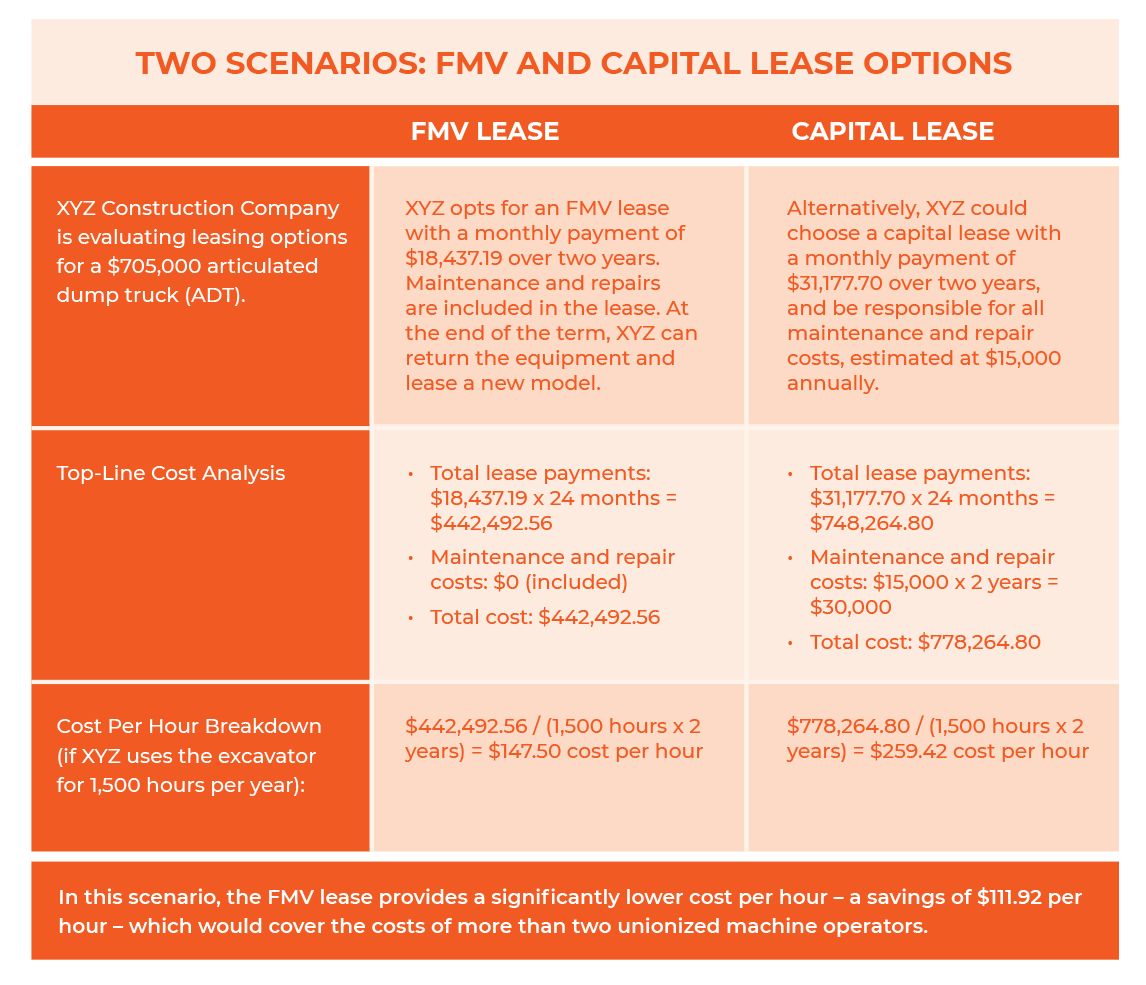
Cost per hour is a crucial metric that measures the total cost of owning and operating equipment; it’s calculated by dividing the total payments for the initial lease term by the number of hours the equipment is used.

FMV leases can provide several cost per hour advantages:

Lower monthly payments
Since FMV leases do not require the lessee to pay the full equipment cost over the lease term, the monthly financial burden is significantly reduced compared to capital leases. Lower payments mean better cash flow, allowing businesses to allocate funds to other critical areas, such as labour, materials, and project development.

Maintenance and repair costs
FMV leases often include maintenance and repair services as part of the lease agreement. This can equate to substantial savings in equipment operation cost per hour. With maintenance covered, businesses can dodge unexpected repair costs, reduce downtime, and ensure equipment is always in optimal working condition. In contrast, with a capital lease, the lessee is typically responsible for maintenance and repairs, which can be unpredictable and costly.

Technological advancements
Heavy construction equipment technology is constantly evolving. With an FMV lease, companies can upgrade to newer, more efficient models at the end of the lease term without the financial burden of owning outdated equipment. This ensures ongoing access to the latest technology, for greater productivity and reduced operational costs. Capital leases could lock companies into long-term ownership of equipment that may become obsolete, leading to higher costs due to less efficiency.

Flexibility and scalability
FMV leases offer greater flexibility compared to capital leases. Projects vary in scope and duration, and it’s critical to adjust equipment needs accordingly. With FMV leases, companies can scale equipment fleets up or down based on project requirements without long-term ownership commitment. This ensures equipment costs align with actual usage, optimizing cost per hour.

Tax advantages
FMV leases can offer tax benefits not available with capital leases. Lease payments under an FMV lease are often fully deductible as business expenses, reducing taxable income which can provide significant tax savings, lowering overall equipment operation cost per hour. Capital leases typically allow for depreciation deductions, which may not be as advantageous depending on a company’s tax scenario.

FMV leases offer several advantages over capital leases for heavy construction equipment, especially in cost per hour, making FMV leases an appealing option for construction companies seeking to improve their operations and financial well-being.


“The choice between Fair Market Value (FMV) and capital leases can significantly impact operational efficiency and financial health.”

–– NELSON ABELHA, Regional Vice President, First Financial Canadian Leasing

 Hello, world


Our ambitious foray into clean technology and its pursuit of net-zero targets have taken center stage, echoing through Canadian government and corporate corridors alike. In a defining move, the Canadian government, in March 2023, unveiled a suite of investment tax credits (ITCs) aimed at accelerating the nation’s decarbonization drive, with the goal of achieving a net-zero emissions status by 2050.

Budgets & Boons

With the 2023 Federal Budget, eligible Canadian clean technology projects are set to receive a 30 percent refundable tax credit, a financial boon that stands poised to reshape the landscape of sustainable innovation. This credit can be leveraged by taxable entities for investments in a gamut of clean technologies and materials. The ITC covers a wide range of zero-emission technologies. While legislative details are still being fine-tuned, all investments in eligible technologies, initiated from the Budget’s proclamation on March 28, 2023, stand eligible for the ITC. The credit, however, is slated for a gradual phasing-out process, with rates reducing to 15 percent in 2034 and eventually tapering off to zero.

The Clean Technology Tax Credit holds tremendous promise, transforming up to now cost-prohibitive sustainable projects into financially viable ventures, and paving the way for clean tech projects to become cash-flow positive right from their inception. In essence, the financial outlay for these projects becomes offset by the expected energy savings or revenue generated.

For these ventures to succeed, creative financing proves crucial. It demands financial institutions that have a deep understanding of the industry’s nuances, capable of crafting flexible structures that minimize finance payments and maximize the potential for projects to become cash-flow positive.

US and Canada

Interestingly, Canada’s ITC framework bears a striking similarity to its American counterpart, which gives a sense of comfort to would-be American lenders that are already acquainted with the structure and intricacies of the system. The biggest difference is that in Canada, the ITC is refundable, meaning recipients receive the full amount regardless of how much income tax they pay. This allows more recipients to take advantage of the credit and also removes many administrative and operational hurdles for the lender. An example is the need to find a third-party tax equity partner that has a big enough tax liability to leverage the ITC.

One example of how lenders can use structure to align with current demand is to structure a lump-sum payment, equal to the ITC in year one. Timing would depend on when the ITC is expected to be received, with the borrower using their ITC to make the lump-sum payment. Credit can get more comfortable with a rapid reduction in overall exposure, and the lump-sum payment will reduce all other payments, allowing the project a better chance of being cash-flow positive.

For many smaller clean tech projects, if a customer has borderline credit quality, or more importantly, if the finance amount is right up against their exposure limits, that rapid reduction in exposure can often be a make-or-break change in terms of credit approval.

Tempered Enthusiasm

Yet, in the excitement that surrounds environmental, social, and governance (ESG) goals, these projects and investments need to make sense financially – for all stakeholders. While some lenders are enthusiastically expanding their cleantech lending portfolio to bolster their ESG credentials, others have reservations as they consider the underlying asset collateral to be weak, (i.e., on solar projects where the resale value of the panels is not strong). These lenders often still view renewable energy and clean technology as an emerging industry in Canada and are approaching this economic upswing with caution.

It’s imperative that the finance industry embrace the clean energy economic boom, utilize flexible structuring to incorporate the ITC’s and align their lending products to allow more projects to move forward. Canada needs companies to embrace the Clean Technology Tax Credit, but to do this, we need lending partners that can be resourceful, flexible, and move quickly to meet this marketplace need to bring these projects to fruition.

About the Author

Grant MacFarlane is Regional Vice President at First Financial Canadian Leasing, a JA Mitsui Leasing, Ltd. company that is very active in lending and structured finance for the renewable energy sector.


>> Link to Canadian Finance News article <<Hello, world


Creative financing can be a game-changer to accelerate return on investments from sustainable projects

by Grant MacFarlane


Investments in clean technology and net zero targets are being mandated across the board, at every level of government in Canada as well as within corporations. In March 2023, the Canadian government announced several major investment tax credits (ITCs) with the goal of accelerating decarbonization in Canada to meet its net-zero emissions goal by 2050.

Under the 2023 Federal Budget, eligible Canadian clean technology projects will receive a 30 percent refundable tax credit that taxable entities can be leveraged for eligible investments in clean technologies and materials. The ITC covers a wide range of zero-emission technologies. While legislation is still being finalized, in the interim, all investments in applicable technologies from the date of the Budget – March 28, 2023 onward – are eligible for the ITC. The credit will be phased out after 2034, with the credit rate reduced to 15 percent for 2034 and zero percent thereafter.

The Clean Technology Tax Credit holds tremendous promise to help accelerate the rollout of sustainable projects that previously may have been viewed as cost prohibitive. The ITC significantly improves project economics and allows more clean tech projects to become cash flow positive from day one, meaning the finance payments are less than the expected energy savings or revenue associated with the project.

Many clean technology vendors are focusing on this “cash-flow positive” model to go to market and increase their sales. Creative financing can provide a very strategic onramp, as these projects absolutely require flexible financing solutions to move forward. It also requires a lender that is knowledgeable about the industry and can offer flexible structures to achieve the lowest possible finance payments to allow more of these projects to become cash-flow positive.

Since Canada’s ITCs are very similar to those used in the US, many American lenders are more comfortable with the structure and how to navigate the unique challenges. The biggest difference is that in Canada, the ITC is refundable, meaning recipients receive the full amount regardless of how much income tax they pay. This allows more recipients to take advantage of the credit and also removes many administrative and operational hurdles from a lending perspective, such as the need to find a third-party tax equity partner that has a big enough tax liability to leverage the ITC.

One example of how lenders can use structure to align with current demand is to structure a lump-sum payment, equal to the ITC in year one. Timing would depend on when the ITC is expected to be received, with the borrower using their ITC to make the lump-sum payment. Credit can get more comfortable with a rapid reduction in overall exposure, and the lump-sum payment will reduce all other payments, allowing the project a better chance of being cash-flow positive.

For many smaller clean tech projects, if a customer has borderline credit quality, or more importantly, if the finance amount is right up against their exposure limits, that rapid reduction in exposure can often be a make-or-break change in terms of credit approval.

While it seems every corporation touts the importance of ESG goals, at the end of the day, these projects and investments need to make sense financially – for all stakeholders. We are noticing that while some lenders are starting to really lean into increasing their ESG goals by growing their clean tech lending portfolio, some still aren’t entirely comfortable with lending for many projects as they consider the underlying asset collateral to be weak, i.e., on solar projects where the re-sale value of the panels is not strong. These lenders often still view renewable energy and clean technology as an emerging industry in Canada and are approaching this economic upswing with caution.

It’s imperative that the finance industry embrace the clean energy economic boom, utilize flexible structuring to incorporate the ITC’s and align their lending products to allow more projects to move forward. Canada needs companies to embrace the Clean Technology Tax Credit, but to do this, we need lending partners that can be resourceful, flexible, and move quickly to meet this marketplace need to bring these projects to fruition.


Grant MacFarlane is Regional Vice President at First Financial Canadian Leasing, a JA Mitsui Leasing, Ltd. company that is very active in lending and structured finance for the renewable energy sector.


>>Link to Total Finance article <<Hello, world


Monitor recently caught up with Tom Slevin, founder and CEO, and Brian Dundon, SVP corporate development at First Financial Equipment Leasing ahead of their company’s acquisition of NorFund, an independent leasing company specializing in capital equipment, solar and alternative energy and vendor finance programs.


First Financial Equipment Leasing announced its expansion into Canada in 2022 with the acquisition of NorFund, an independent leasing company specializing in capital equipment, solar and alternative energy and vendor finance programs.

Having been acquired by JA Mitsui Leasing a few years ago, Tom Slevin, founder and CEO of First Financial, and Brian Dundon, SVP corporate development, both knew not only what to expect during the acquisition, but also what to provide to make it a smooth transition.

Reminiscing about First Financial’s acquisition not too long ago, Slevin and Dundon remember the fears they had around acquisitions, which stemmed from stories of other independent companies being purchased by a larger company or bank and facing restrictions and various changes, which lessened the overall experience, value and productivity of some companies. Thankfully, that was not the case for the JA Mitsui Leasing acquisition some years ago, but it offered insight on how to provide insight, resources and opportunities when expanding internationally and into new territory.

“The biggest thing that we have with JA Mitsui and with the folks that we work with is that it’s much more of a partnership than a top-down mentality,” Dundon says. “That’s not something you get in every single big company. And it’s something that I know myself, Tom, and others are really grateful for is having partners that are seeking to actively help.”


The Cultural Fit

The First Financial team plans to take a similar approach in its acquisition of NorFund. Slevin says NorFund is a perfect fit for First Financial. Having been established in Canada for years, NorFund was everything First Financial wanted in a partner, as Slevin puts it, “They have contacts, they have customers, they have vendor relationships, they have relationships within the leasing community there. And it was a really good cultural fit in that they’re creative and entrepreneurial like First Financial.”

NorFund, which has been renamed First Financial Canadian Leasing, will continue to be led by Robert MacFarlane, who has more than 30 years of leasing experience, including roles at Newcourt Credit, National City and PNC that focused on developing fair market value leasing businesses in Canada.

“[What] made NorFund really an attractive target was the people,” Dundon says. “Rob MacFarlane founded NorFund. He led that company, and prior to that, he worked in fair market value, technology leasing, solar leasing, and really the type of businesses that we want to be involved in. There aren’t many people up there in Canada that have done that and understand that market, so being able to acquire NorFund and bring Rob on board, it made a lot of sense.”

What attracted First Financial Equipment Leasing to the Canadian market is how the country does business in a similar fashion to the U.S. From a contractual and legal standpoint, it makes sense, but Selvin also notes that recently, banks have pulled away from that market and have left a potential opportunity open for his company.

“Our goal is to really take what we’ve learned over the last 10 years that we’ve been there and grow that,” Dundon says. “We’re really a relationship focused company. We try to have our customers be our customers for decades, and Canada’s a market that’s pretty similar and people value that kind of approach and relationship mindset.”

Running with NorFund’s previous successes with solar asset classes, Dundon and Slevin plan to expand the company’s offerings to include construction and material handling. In the U.S., First Financial’s asset classes are material handling, information technology, healthcare and construction.

“Since the acquisition, we’ve grown — our equipment leasing volume has tripled and we’ve doubled the back office in three years,” Dundon says. “That pace is continuing to grow and adding Canada in there is only going to further accelerate that in the long run.”


>> Link to monitordaily.com article <<Hello, world


NorFund Capital to be rebranded as First Financial Canadian Leasing.

ORANGE, CA and TORONTO, Canada – Thursday, December 8th, 2022 – First Financial
Equipment Leasing (FFEL), a leading provider of equipment financing solutions and a member company of JA Mitsui Leasing Ltd (JAML), announces a strategic expansion into Canada with the acquisition of NorFund Capital. Based in Toronto, Canada, NorFund Capital is an independent leasing company specializing in capital equipment, solar and alternative energy, and vendor finance programs.

The acquisition continues First Financial Equipment Leasing’s tremendous growth trajectory, driven by its vision to elevate and broaden solutions offered to its global customers. “NorFund
Capital’s expertise and creativity within the Canadian market made it the ideal fit to lead our growth in new markets and industries,” said Tom Slevin, FFEL Co-Founder and CEO. “With Canada becoming a significant part of our North American platform, this acquisition provides key opportunities for us to extend our financing solutions and enhance the customer experience throughout our global client base.”

“We are excited to join First Financial Equipment Leasing and the JA Mitsui Leasing Ltd. family of companies,&quot; said Robert MacFarlane, President and Founder NorFund Capital.”

“Our organizations have a shared passion for building innovative financing solutions with a customer-focus approach. Given the complementary nature of our combined businesses, we look forward
to a strengthened global platform with expanded investment opportunities.”

MacFarlane will lead the newly named First Financial Canadian Leasing as Senior Vice President, overseeing the Canadian sales strategies and business development. He will focus on growing the company’s fair market value (FMV) leases and establishing First Financial Canadian Leasing as a market leader in renewable energy financing in Canada. MacFarlane has over 30 years of experience in the leasing industry and has built and managed several highly successful equipment finance companies.

First Financial Equipment Leasing was represented by Cassels Brock & Blackwell LLP on the transaction.

About First Financial Canadian Leasing

FF Canadian Leasing, Inc. dba First Financial Canadian Leasing (FFCL) is a privately held equipment finance leader working with Canadian businesses and subsidiaries of US corporations. FFCL provides businesses with equipment financing for all categories of commercial assets and various industries, including construction and heavy equipment, IT solutions and services, material handling and automation, and solar and renewable energy. FFCL is a division of First Financial Equipment Leasing, and a member of JA Mitsui Leasing Ltd. (JAML), a Japanese equipment leasing company providing leasing and financial solutions in Japan and Globally (offices in Asia and North America). For additional information, please visit the company’s website at www.ffcanadianleasing.com.Hello, world